Review
. 2016 Aug;39(8):552-566.
doi: 10.1016/j.tins.2016.05.002. Epub 2016 Jun 17.

Sleep: A Novel Mechanistic Pathway, Biomarker, and Treatment Target in the Pathology of Alzheimer's Disease?

Affiliations
Review

Sleep: A Novel Mechanistic Pathway, Biomarker, and Treatment Target in the Pathology of Alzheimer's Disease?

Bryce A Mander et al. Trends Neurosci. 2016 Aug.

Abstract

Sleep disruption appears to be a core component of Alzheimer's disease (AD) and its pathophysiology. Signature abnormalities of sleep emerge before clinical onset of AD. Moreover, insufficient sleep facilitates accumulation of amyloid-β (Aβ), potentially triggering earlier cognitive decline and conversion to AD. Building on such findings, this review has four goals: evaluating (i) associations and plausible mechanisms linking non-rapid-eye-movement (NREM) sleep disruption, Aβ, and AD; (ii) a role for NREM sleep disruption as a novel factor linking cortical Aβ to impaired hippocampus-dependent memory consolidation; (iii) the potential diagnostic utility of NREM sleep disruption as a new biomarker of AD; and (iv) the possibility of sleep as a new treatment target in aging, affording preventative and therapeutic benefits.

Keywords: Alzheimer's disease; aging; amyloid-β; cognitive decline; sleep.


Figures

Figure 1
Figure 1
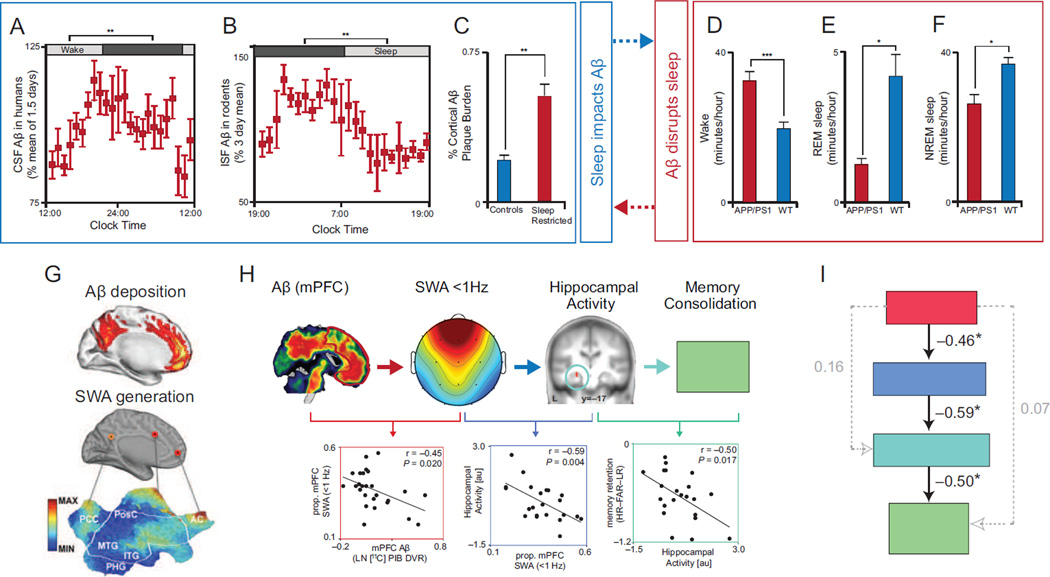
Reciprocal relationship between Aβ and Sleep, and their influence on hippocampus-dependent memory consolidation. CSF Aβ in humans (a) and ISF Aβ in rodents (b) rise during wake and fall during sleep, and sleep restricting APP/PS1 mutant rodents results in higher cortical Aβ plaque burden (c; adapted from). Further, APP/PS1 mutant rodents (red bars) exhibit increased wake time (d) and reduced REM (e) and NREM (f) sleep time relative to wild type rodents (blue bars; adapted from). These findings represent a reciprocal relationship between sleep and Aβ: sleep and sleep disturbance can influence Aβ accumulation (a–c, blue box), while Aβ aggregation can disrupt sleep and increases wake time (d–f, red box). A potential mechanism underlying disrupted NREM SWS by Aβ pathology is the aggregation of Aβ (g, top sagittal brain slice adapted from) within the same medial prefrontal cortical nodes critical for the electrical source generation of NREM slow waves (g, bottom sagittal brain slice adapted from). Indeed, medial prefrontal Aβ burden predicts the degree of disrupted <1Hz NREM SWA (h, red scatter plot, adapted from). The disruption of <1Hz NREM SWA by Aβ, in turn, is associated with impaired sleep-dependent consolidation of hippocampus-dependent memory. Disrupted <1Hz NREM SWA is associated with reduced overnight development of hippocampus-independent retrieval (h, blue scatter plot), that normally fosters superior memory stabilization and thus remembering (h, turquoise scatter plot). These interactions are further supported by structural equation modeling, which revealed that the only significant path linking Aβ pathology to impaired hippocampus-dependent memory was through its intermediary disruption of <1Hz NREM SWA (i, adapted from). While the relationship between Aβ and NREM SWA is likely to be bidirectional, the strongest link between Aβ and memory was through its association with NREM SWA. Abbreviations: Aβ, amyloid-β protein; CSF, cerebrospinal fluid; ISF, interstitial fluid; APP/PS1, amyloid precursor protein and presenilin 1 mutant rodents; SWA, slow wave activity; MAX, maximum; MIN, minimum; PCC, posterior cingulate cortex; PosC, post-central gyrus; MTG, medial temporal gyrus; ITG, inferior temporal gyrus; PHG, parahippocampal gyrus; AC, anterior cingulate gyrus; mPFC, medial prefrontal cortex; prop., proportion; LN, natural logarithm; DVR, distribution volume ratio; L, left hemisphere; HR, hit rate; FAR, false alarm rate; LR, lure rate; au, arbitrary units; and HC, hippocampus.
Figure 2
Figure 2
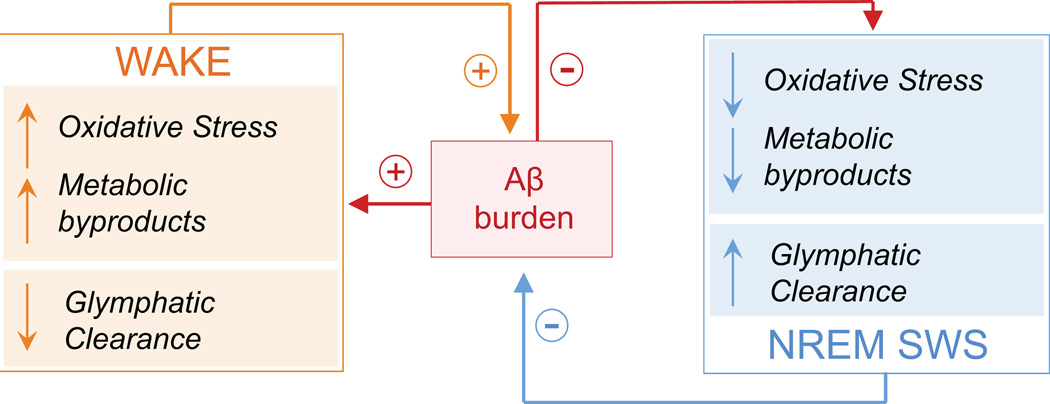
Proposed theoretical schematic of active mechanistic processes regulating the reciprocal nature between NREM sleep and wake with respect to Aβ burden. During wake (orange box), glymphatic Aβ clearance is low, neurometabolic and neuronal spiking activity is high, , and oxidative stress is high, fostering higher Aβ burden (red box), , , . Aβ, in turn, promotes greater oxidative stress, neuronal hyperexcitability, and reduces glymphatic clearance through processes including cerebral amyloid angiopathy and, presumably, NREM sleep disturbance, . Thus, a facilitatory process is created where Aβ may promote its own accumulation. During NREM sleep (blue box), glymphatic Aβ clearance is high, neurometabolic rate is low,, and active cellular processes promote cellular restitution that reduces oxidative damage. This balances both Aβ accumulation and the negative consequences of Aβ accumulation under conditions of healthy sleep. However, under pathological conditions, Aβ burden may actively disrupt NREM sleep, . This disruption, alongside reduced Aβ clearance due to cerebral amyloid angiopathy, theoretically creates an environment whereby NREM sleep can no longer successfully suppress Aβ accumulation. This once again exacerbates the vicious cycle, triggering greater Aβ aggregation and accelerating AD pathophysiological progression. Abbreviations: Aβ, amyloid-β protein; and NREM SWS, non-rapid-eye-movement slow wave sleep.
Figure 3
Figure 3
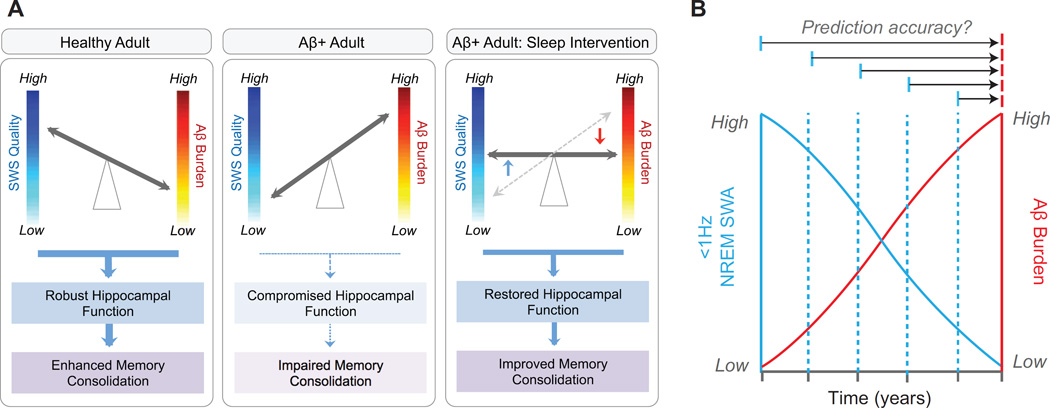
Proposed consequences of the reciprocal relationship between Aβ, <1Hz NREM SWA and memory functioning under different circumstances, and the potential utility of sleep as a novel biomarker. In healthy older adults with low Aβ burden (a, left panel), NREM SWS quality is high, thereby facilitating hippocampus-dependent memory consolidation. In Aβ+ older adults (a, middle panel), NREM SWS quality is low, resulting in compromised memory consolidation. However, should NREM SWS quality be rescued through therapeutic sleep intervention in Aβ+ older adults (a, right panel), memory consolidation should be improved through two non-mutually exclusive pathways: i) by minimizing the negative impact of Aβ burden on sleep-dependent memory processing, and/or ii) through facilitating greater glymphatic Aβ clearance. (b) Since <1Hz NREM SWA is associated with Aβ burden in healthy older adults before MCI or AD onset, it is possible that this measure may offer diagnostic utility as a noninvasive biomarker of Aβ burden and AD risk. Longitudinal studies have the ability to examine the diagnostic potential of <1Hz NREM SWA, not only as a static, surrogate marker of current Aβ burden, but as a predictive biomarker that forecasts Aβ accumulation or risk of conversion to AD years in advance (multiple horizontal arrow tests). Abbreviations: Aβ, amyloid-β protein; Aβ + adult, an older adult with Aβ pathology; SWS, slow wave sleep; and NREM SWA, non-rapid-eye-movement slow wave activity.

References

    1. Sperling RA, et al. Testing the right target and right drug at the right stage. Sci Transl Med. 2011;3:111cm133. - PMC - PubMed
    1. Ohayon MM, et al. Meta-analysis of quantitative sleep parameters from childhood to old age in healthy individuals: developing normative sleep values across the human lifespan. Sleep. 2004;27:1255–1273. - PubMed
    1. Carrier J, et al. Sleep slow wave changes during the middle years of life. Eur J Neurosci. 2011;33:758–766. - PubMed
    1. Mander BA, et al. Prefrontal atrophy, disrupted NREM slow waves and impaired hippocampal-dependent memory in aging. Nat Neurosci. 2013;16:357–364. - PMC - PubMed
    1. Vitiello MV. Recent Advances in Understanding Sleep and Sleep Disturbances in Older Adults: Growing Older Does Not Mean Sleeping Poorly. Current Directions in Psychological Science. 2009;18:316–320.

Publication types