


Newborn Screening for Vitamin B6 Non-responsive Classical Homocystinuria: Systematical Evaluation of a Two-Tier Strategy
- PMID: 27325427
- PMCID: PMC5362558
- DOI: 10.1007/8904_2016_556
Newborn Screening for Vitamin B6 Non-responsive Classical Homocystinuria: Systematical Evaluation of a Two-Tier Strategy
Abstract
Background: In classical homocystinuria (HCU, MIM# 236200) due to the deficiency of cystathionine β-synthase (EC 4.2.1.22) there is a clear evidence for the success of early treatment. The aim of this study was to develop and evaluate a two-tier strategy for HCU newborn screening.
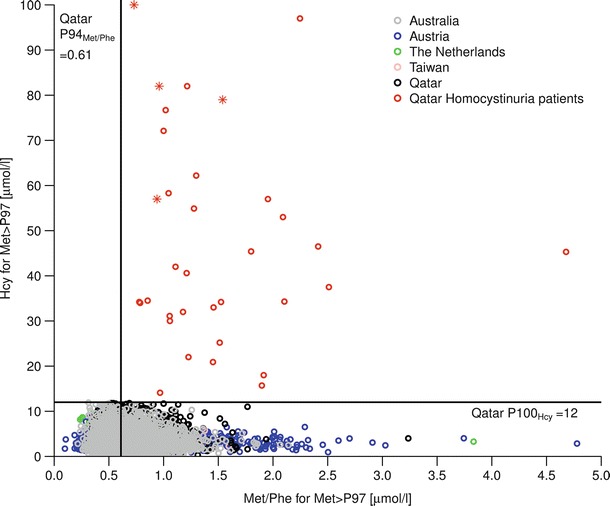
Methods: We reevaluated data from our newborn screening programme for Qatar in a total number of 125,047 neonates including 30 confirmed HCU patients. Our hitherto existing screening strategy includes homocysteine (Hcy) measurements in every child, resulting in a unique dataset for evaluation of two-tier strategies. Reevaluation included methionine (Met) levels, Met to phenylalanine (Phe) ratio, and Hcy. Four HCU cases identified after database closure were also included in the evaluation. In addition, dried blood spot samples selected by Met values >P97 in the newborn screening programs in Austria, Australia, the Netherlands, and Taiwan were analyzed for Hcy.
Results: Met to Phe ratio was found to be more effective for first sieve than Met, sorting out nearly 90% of normal samples. Only 10% of the samples would have to be processed by second-tier measurement of Hcy in dried blood spots. As no patient with HCU was found neither in the samples investigated for HCU, nor by clinical diagnosis in the other countries, the generalization of our two-tier strategy could only be tested indirectly.
Conclusion: The finally derived two-tier algorithm using Met to Phe ratio as first- and Hcy as second-tier requires 10% first-tier positives to be transferred to Hcy measurement, resulting in 100% sensitivity and specificity in HCU newborn screening.
Keywords: Classical homocystinuria; Cystathionine β-synthase; Dried blood spots; Homocysteine; Newborn screening; Two-tier strategy.
Figures
References
-
- Aymé S, Hivert V (2011) Report on rare disease research, its determinants in Europe and the way forward. Homocystinuria due to cystathionine beta-synthase deficiency: Estimated Prevalence: 0.4/100,000
LinkOut - more resources
Full Text Sources
Other Literature Sources
Research Materials
Miscellaneous
