


Regorafenib for the Treatment of Advanced Gastric Cancer (INTEGRATE): A Multinational Placebo-Controlled Phase II Trial
- PMID: 27325864
- PMCID: PMC5019744
- DOI: 10.1200/JCO.2015.65.1901
Regorafenib for the Treatment of Advanced Gastric Cancer (INTEGRATE): A Multinational Placebo-Controlled Phase II Trial
Abstract
Purpose: We evaluated the activity of regorafenib, an oral multikinase inhibitor, in advanced gastric adenocarcinoma.
Patients and methods: We conducted an international (Australia and New Zealand, South Korea, and Canada) randomized phase II trial in which patients were randomly assigned at a two-to-one ratio and stratified by lines of prior chemotherapy for advanced disease (one v two) and region. Eligible patients received best supportive care plus regorafenib 160 mg or matching placebo orally on days 1 to 21 of each 28-day cycle until disease progression or prohibitive adverse events occurred. The primary end point was progression-free survival (PFS). Final analysis included data to December 31, 2014.
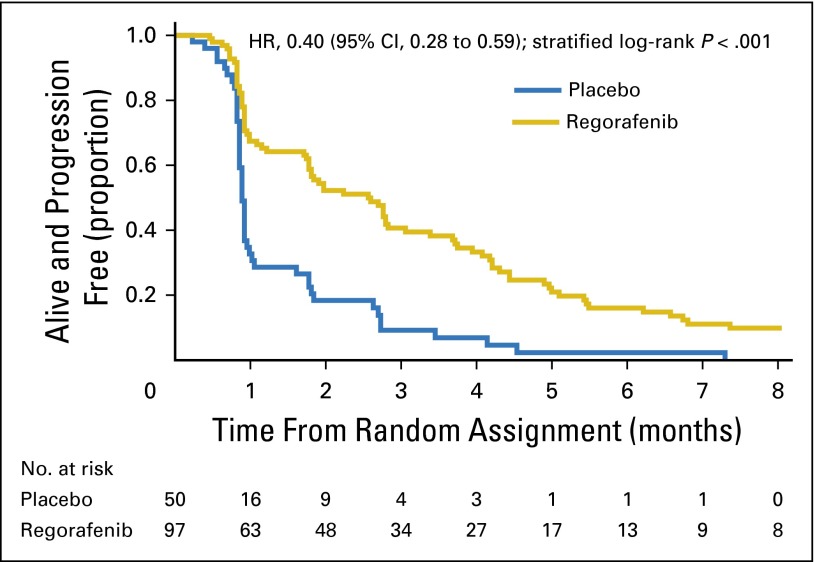
Results: A total of 152 patients were randomly assigned from November 7, 2012, to February 25, 2014, yielding 147 evaluable patients (regorafenib, n = 97; placebo, n = 50). Baseline characteristics were balanced. Median PFS significantly differed between groups (regorafenib, 2.6 months; 95% CI, 1.8 to 3.1 and placebo, 0.9 months; 95% CI, 0.9 to 0.9; hazard ratio [HR], 0.40; 95% CI, 0.28 to 0.59; P < .001). The effect was greater in South Korea than in Australia, New Zealand, and Canada combined (HR, 0.12 v 0.61; interaction P < .001) but consistent across age, neutrophil-to-lymphocyte ratio, primary site, lines of chemotherapy, peritoneal metastasis presence, number of metastatic sites, and plasma vascular endothelial growth factor A. A survival trend in favor of regorafenib was seen (median, 5.8 months; 95% CI, 4.4 to 6.8 v 4.5 months; 95% CI, 3.4 to 5.2; HR, 0.74; P = .147). Twenty-nine patients assigned to placebo received open-label regorafenib after disease progression. Regorafenib toxicity was similar to that previously reported.
Conclusion: In this phase II trial, regorafenib was effective in prolonging PFS in refractory advanced gastric adenocarcinoma. Regional differences were found, but regorafenib was effective in both regional groups. A phase III trial is planned.
© 2016 by American Society of Clinical Oncology.
Conflict of interest statement
Authors’ disclosures of potential conflicts of interest are found in the article online at www.jco.org. Author contributions are found at the end of this article.
Figures



Comment in
-
Regorafenib: lights and shadows of antiangiogenic therapies in gastric cancer.Transl Gastroenterol Hepatol. 2017 Feb 23;2:11. doi: 10.21037/tgh.2017.02.01. eCollection 2017. Transl Gastroenterol Hepatol. 2017. PMID: 28275743 Free PMC article. No abstract available.
-
Regorafenib in gastric cancer.Transl Gastroenterol Hepatol. 2017 Mar 15;2:16. doi: 10.21037/tgh.2017.01.07. eCollection 2017. Transl Gastroenterol Hepatol. 2017. PMID: 28447051 Free PMC article. No abstract available.
-
The evolving landscape of treatment for advanced gastric cancer and the role of anti-angiogenic therapy: implications from results of the INTEGRATE study.Transl Gastroenterol Hepatol. 2017 Apr 7;2:29. doi: 10.21037/tgh.2017.02.02. eCollection 2017. Transl Gastroenterol Hepatol. 2017. PMID: 28447064 Free PMC article. No abstract available.
References
-
- Brenner H, Rothenbacher D, Arndt V. Epidemiology of stomach cancer. Methods Mol Biol. 2009;472:467–477. - PubMed
-
- Wagner AD, Unverzagt S, Grothe W, et al. Chemotherapy for advanced gastric cancer. Cochrane Database Syst Rev. 2010;(3):CD004064. - PubMed
-
- Kang JH, Lee SI, Lim H, et al. Salvage chemotherapy for pretreated gastric cancer: A randomized phase III trial comparing chemotherapy plus best supportive care with best supportive care alone. J Clin Oncol. 2012;30:1513–1518. - PubMed
-
- Ford HER, Marshall A, Bridgewater JA, et al. Docetaxel versus active symptom control for refractory oesophagogastric adenocarcinoma (COUGAR-02): An open-label, phase 3 randomised controlled trial. Lancet Oncol. 2014;15:78–86. - PubMed
-
- Thuss-Patience PC, Kretzschmar A, Bichev D, et al. Survival advantage for irinotecan versus best supportive care as second-line chemotherapy in gastric cancer: A randomised phase III study of the Arbeitsgemeinschaft Internistische Onkologie (AIO) Eur J Cancer. 2011;47:2306–2314. - PubMed
Publication types
MeSH terms
Substances
LinkOut - more resources
Full Text Sources
Other Literature Sources
Medical
