Review
. 2016 Jul 1;8(7):a021881.
doi: 10.1101/cshperspect.a021881.

Activins and Inhibins: Roles in Development, Physiology, and Disease

Affiliations
Review

Activins and Inhibins: Roles in Development, Physiology, and Disease

Maria Namwanje et al. Cold Spring Harb Perspect Biol. .

Abstract

Since their original discovery as regulators of follicle-stimulating hormone (FSH) secretion and erythropoiesis, the TGF-β family members activin and inhibin have been shown to participate in a variety of biological processes, from the earliest stages of embryonic development to highly specialized functions in terminally differentiated cells and tissues. Herein, we present the history, structures, signaling mechanisms, regulation, and biological processes in which activins and inhibins participate, including several recently discovered biological activities and functional antagonists. The potential therapeutic relevance of these advances is also discussed.


Figures

Figure 1.
Figure 1.
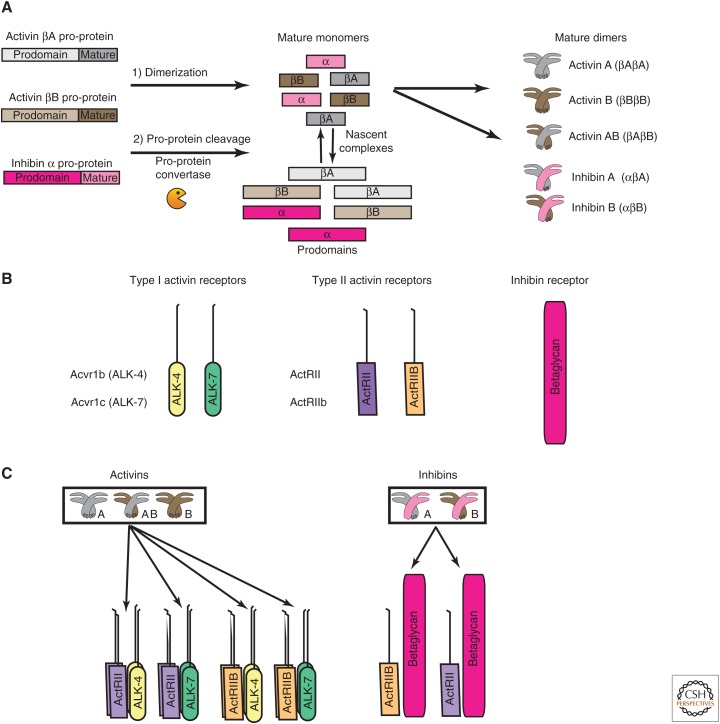
Activin and inhibin ligands and receptors. (A) Activin βA, activin βB, and inhibin α are synthesized as pro-proteins that comprise a prodomain and mature domain. The pro-proteins associate to form homo- or heterodimers, which are ultimately processed into activins A, B, AB, and inhibins A and B. The junctions of the pro- and mature domains are cleaved by pro-protein convertases, resulting in dimer complexes that retain the noncovalently linked prodomains. (B) The two type I receptors for activins are ActRIB (ALK-4) and ActRIC (ALK-7). The two type II receptors are ActRII and ActRIIB. The inhibins antagonize activin signaling by using one type II receptor and one type III TGF-β receptor, betaglycan. (C) The mature activin dimers bind type I and type II receptors to form active signaling complexes. Each activin dimer can bind more than one combination of type I and type II receptors with different affinities, and each type I/type II receptor combination can bind different dimers, including other members of the TGF-β family. The active signaling complex is comprised of one activin dimer, two type I, and two type II receptors. Inhibins competitively antagonize activin signaling by binding one type II receptor and betaglycan, thereby sequestering type II receptors in an inactive complex.
Figure 2.
Figure 2.
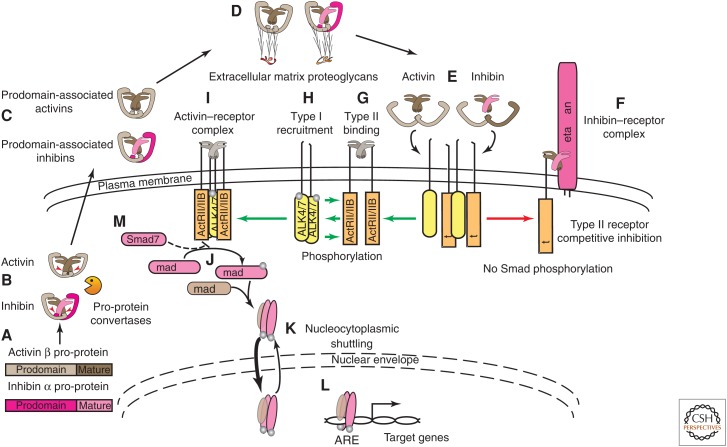
Activin and inhibin processing and signaling. (A) Activin and inhibin monomers are synthesized as pro-proteins. (B) The pro-proteins associate as homodimers or heterodimers with their intact prodomains. Within the cell, the junctions of the pro- and mature domains (red arrowheads) are cleaved by pro-protein convertases, leaving the noncovalent interactions among the domains intact. (C) Prodomain-associated activins and inhibins are released from the cell. (D) The intact prodomains enable interactions with glycosaminoglycans on proteins within the extracellular matrix. (E) Activins and inhibins compete for type I and II activin receptor binding, and, on receptor binding, release their associated prodomains. (F) Inhibin antagonizes activin signaling through association of its single inhibin β subunit with a single type II activin receptor and the association of its single inhibin α subunit with the membrane proteoglycan, betaglycan, thereby forming an inactive inhibin–receptor complex. This complex is incapable of signal transduction and thus inhibits activin signaling by sequestering type II activin receptors (red arrow). (G) The activation of activin receptors requires several steps (green arrows). The activin dimer binds two type II activin receptors, and activates type II receptor serine–threonine kinase activity. (H) Type II receptor binding results in recruitment and association with two type I activin receptors, ActRIB (ALK-4) or ActRIC (ALK-7), that are subsequently phosphorylated. (I,J) The fully assembled, hexameric ligand–receptor complex then initiates Smad-mediated signaling by phosphorylating regulatory Smad2 and/or Smad3 (Smad2 and Smad3) near their carboxyl termini, followed by association of two phosphorylated Smads with a common Smad4. (K) Smad complexes are in equilibrium between the cytoplasm and nucleus. Receptor signaling results in a shift in equilibrium toward the nucleus. (L) Binding of the Smad complex and transcription coactivators to activin-responsive elements (AREs) results in the transcription of hundreds of genes, a process that is tightly regulated by a variety of proteins that impact nucleocytoplasmic shuttling, Smad phosphorylation status, Smad degradation, and transcriptional activity. (M) Inhibitory Smad7 competes with Smad2 and Smad3 for activated type I receptor binding, thereby preventing Smad2 and Smad3 phosphorylation and facilitating proteasomal degradation or dephosphorylation of activin–receptor complexes.
Figure 3.
Figure 3.
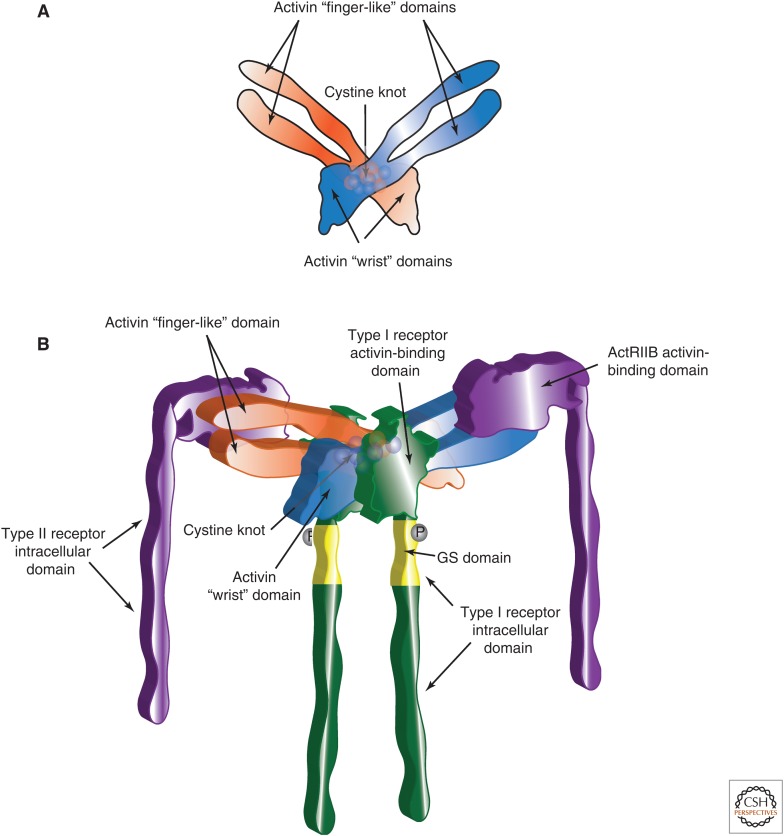
Structures of the activin dimer and activin–receptor complex. (A) Two-dimensional representation of an activin dimer. Two activin monomers associate through interactions between the convex surface of the α-helical “wrist” domain of one monomer and the concave surface of the “finger-like” domain, comprised of antiparallel β-sheets, of the second monomer, giving the appearance of an “open hand” or “butterfly.” Covalent dimerization occurs through one of the seven conserved cysteines that define TGF-β family ligands. The cysteines are organized into a “cystine knot” (spheres) within the core of the activin dimer. (B) Three-dimensional rendition of the activin–receptor complex. The activin dimer and cystine knot are represented as shades of orange and blue. The assembly of the activin dimer with two activin type II receptors occurs through interactions among the convex surfaces of the ligand finger regions with concave surfaces of each of the type II receptors (shown in purple). The binding of the type II receptors by activin stabilizes the receptors within the cell membrane, yet the flexibility of the bound ligand, shown here as a “spreading” of the activin monomers, allows it to further interact with two type I receptors (shown in green). The type I receptors are subsequently phosphorylated (dark gray spheres) at their glycine–serine rich (GS) domains, shown in yellow, thereby activating the type I receptor kinase.
Figure 4.
Figure 4.
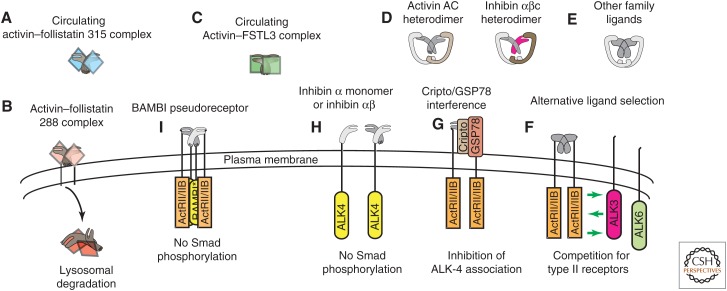
Regulation of activin signaling. (A,B) Follistatin occurs in circulating (follistatin 315) and membrane-bound (follistatin 288) forms. Activins bind irreversibly to follistatin and the activin–follistatin complex is internalized and degraded in lysosomes (B). (C) FSTL3 is a structurally similar, follistatin-like protein that also binds circulating activins with high affinity and functions as an activin inhibitor. (D) Activin βC can heterodimerize with activins βA and βB as well as inhibin α. Some data suggest that “atypical” activins C and E might antagonize activin A or B signaling by forming nonfunctional heterodimers. (E,F) Other TGF-β family ligands can bind type II activin receptors, so the potential exists for competition in tissues where ligands and receptors coexpress. (G) Although the EGF-CFC coligand/coreceptor Cripto enhances signaling for some TGF-β family ligands, it inhibits functional activin–receptor complexes by binding type II receptor-associated activins, thus preventing the recruitment and phosphorylation of type I receptors. Glucose-regulated protein 78 (GRP78) is also an essential component of this inhibitory complex. (H) In addition to associations with betaglycan, inhibin α monomers and αβ dimers also bind directly to ALK-4 and inhibit activin signaling in vitro. (I) BMP and activin membrane-bound inhibitor (BAMBI) is a type I pseudoreceptor that cannot phosphorylate Smads. However, it competes with functional type I receptors for inclusion in activin–receptor complexes, thereby inhibiting activin signaling.
Figure 5.
Figure 5.
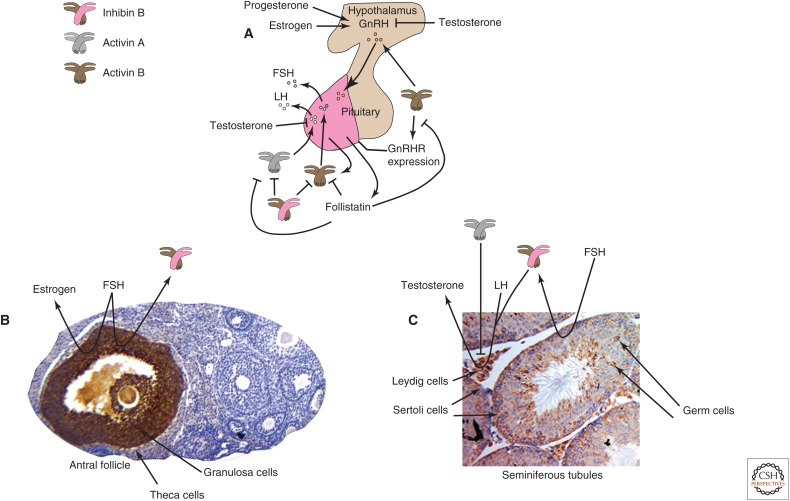
Activins and inhibins in the hypothalamic–pituitary–gonadal (HPG) axis. (A) The pituitary gland is divided into anterior (magenta) and posterior (tan) lobes. The anterior pituitary gonadotropes produce follicle-stimulating hormone (FSH) and luteinizing hormone (LH). The production and release of LH and FSH are primarily regulated by gonadotropin-releasing hormone (GnRH), produced by the hypothalamus, which receives input from gonad-derived signals, inhibins, estrogen, progesterone, and testosterone. The production of GnRH in the hypothalamus and expression of GnRH receptors (GnRHRs) on pituitary gonadotropes are enhanced by activins, and pituitary activin B expression is also controlled by GnRH. The LH and FSH β subunits are primary targets for regulation by activins and inhibins. Activin B (brown-colored icon) from the anterior pituitary exerts paracrine effects on gonadotropes, enhancing GnRH-induced FSH production and release. Similarly, activin A (gray-colored icon) augments GnRH-induced LH production, antagonized by testosterone. Activin also enhances the expression of GnRH receptors on gonadotropes, an effect that is blocked by follistatin. Inhibin B (brown-pink icon) produced by the gonads plays an important role in feedback mechanisms that regulate the HPG axis, as inhibin B and follistatin antagonize many functions of activins. (B) The antral follicle contains steroidogenic cells that collaborate to produce and release estrogen. The granulosa cells produce estrogen and inhibins, driven by pituitary FSH, with inhibin B the major circulating form. FSH expression is ultimately repressed by circulating inhibin B from ovarian follicles in a negative feedback loop. Activin βA immunostaining (brown) shows abundant expression restricted to the granulosa cells of a single, large antral follicle, but not in follicles at earlier stages (CW Brown, unpubl.). (C) The seminiferous tubules are comprised of germ cells, Sertoli cells, Leydig cells, and other cells. All activin and inhibin subunits, activin receptors, betaglycan and follistatin are expressed in the testis, and their expression is controlled by the stage of the seminiferous cycle, age and pubertal stage, and cell type. Activin βA immunostaining (brown) in this adult testis section is apparent in Leydig cells, Sertoli cells and germ cells at more than one stage of development (CW Brown, unpubl.). Inhibin B (brown-pink icon) is the only inhibin produced by the testis and the major circulating form. In Sertoli cells, FSH stimulates inhibin B production, providing negative feedback for pituitary FSH production, whereas LH induces the production of androgens from rodent Leydig cells, a process that is augmented by inhibin and attenuated by activin (gray icon).
Figure 6.
Figure 6.
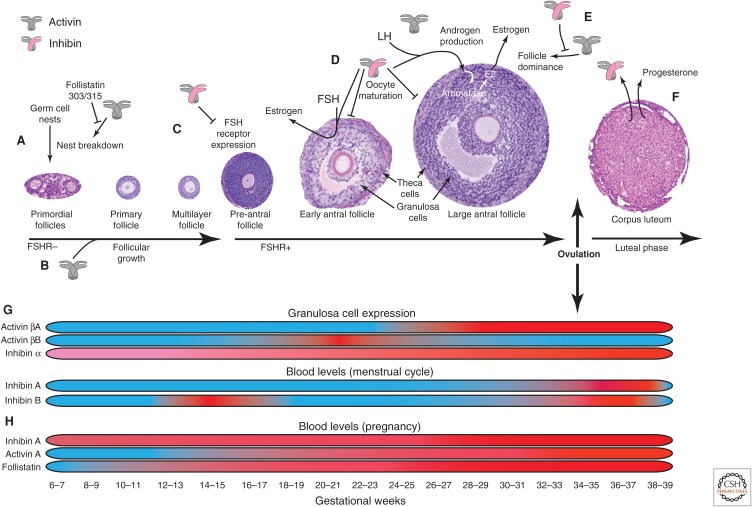
Activins and inhibins in ovarian folliculogenesis and pregnancy. Activins and inhibins play important autocrine/paracrine roles at several steps of ovarian folliculogenesis. (A) Activin A (gray icon) contributes to the breakdown of germ cell nests, which increases the primordial follicle pool and fertility potential, antagonized by follistatin. (B) Activin contributes to early stages of follicular growth. (C) Expression of the follicle-stimulating hormone (FSH) receptor in granulosa cells of multilayer follicles is required for folliculogenesis. Inhibin (gray-pink icon) antagonizes FSH receptor expression in granulosa cells. (D) Inhibin enhances FSH-induced estrogen production in granulosa cells, and luteinizing hormone (LH)-induced androgen production in theca cells, whereas androgen production is antagonized by activin (gray icon). Androgens are converted to estrogen (E2) by aromatase in granulosa cells. Inhibin also slows the maturation of oocytes at the antral follicle stage. (E) Although variable numbers of primordial follicles are recruited for folliculogenesis during each ovarian cycle, only a few will proceed to ovulation. The process of “follicular dominance” is supported by activin and antagonized by inhibin. (F) After ovulation, the remaining follicular cells coalesce to form the corpus luteum, whose major function is LH-induced progesterone production to support the early stages of pregnancy. Inhibin is also produced by the corpus luteum at high levels throughout the luteal phase of the ovarian cycle. (G) Granulosa cell expression and blood levels of activin and inhibin in the context of the ovarian cycle are shown, with low levels in blue and high levels in red. Activin β subunits are expressed at very low levels in early-stage follicles. Activin βA is most abundantly expressed in late antral follicles and in corpora lutea, whereas activin βB is restricted to small antral follicles. The inhibin α subunit is expressed throughout the ovarian cycle, increasing in mature follicles and corpora lutea. However, circulating levels of inhibins do not correlate with the levels of expression in granulosa cells. Inhibin A levels increase rapidly during ovulation and peak in the midluteal phase. In contrast, inhibin B has a biphasic pattern with peak levels at the early follicular and early luteal phases. (H) During pregnancy, inhibin, activin, and follistatin levels progressively increase, and markedly increase during the third trimester. Follistatin levels are greater than activin levels throughout pregnancy, whereas basal inhibin levels are higher and decrease slightly before the rapid increase between 25 and 30 weeks gestation.
Figure 7.
Figure 7.
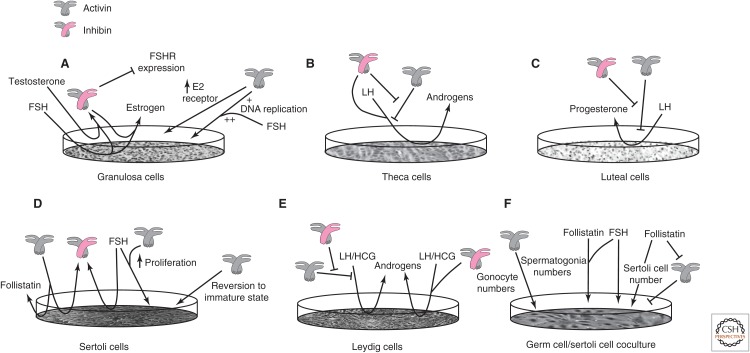
Activin and inhibin effects in cultured gonadal cells. (A) In cultured granulosa cells from early-stage follicles, follicle-stimulating hormone (FSH) stimulates the release of inhibin (gray-pink icon) and estrogen (Hillier et al. 1991a). Inhibin augments FSH-induced estrogen production, while inhibiting the expression of FSH receptor (Campbell and Baird 2001; Lu et al. 2009). In contrast, activin A (gray icon) enhances the expression of estrogen receptors and increases DNA replication, an effect that is augmented by FSH (Rabinovici et al. 1990; Miro and Hillier 1996; Kipp et al. 2007). (B) In cultured theca cells, activin suppresses luteinizing horm (LH)-induced androgen production, while inhibin augments androgen production and antagonizes activin’s suppressive effect (Hillier et al. 1991b). (C) In cultured luteal cells, activin suppresses LH-induced progesterone synthesis, whereas inhibin antagonizes activin’s effects (Rabinovici et al. 1990; Di Simone et al. 1994). (D) Cultured Sertoli cells from young, postnatal rats proliferate in response to FSH and activin A, and FSH increases expression of inhibin. Activin stimulates follistatin and inhibin production and causes adult-derived Sertoli cells to revert to a less differentiated state. (E) LH or human chorionic gonadotropin (HCG) induces androgen production in rodent Leydig cells. Inhibin increases and activin antagonizes LH-induced androgen production and inhibin blocks activin’s suppressive effect. The activin and inhibin effects on androgen production require LH and HCG. (F) When treated with activins, cocultures of germ cells and Sertoli cells from early postnatal rat testis show increased numbers of spermatogonia and gonocyte precursors. The combination of FSH and follistatin also increases the number of spermatogonia. Activin treated co-cultures have fewer Sertoli cells than controls, an effect that is suppressed by follistatin. Follistatin also independently increases the number of Sertoli cells.

References

    1. Acharyya S, Guttridge DC. 2007. Cancer cachexia signaling pathways continue to emerge yet much still points to the proteasome. Clin Cancer Res 13: 1356–1361. - PubMed
    1. Ageta H, Murayama A, Migishima R, Kida S, Tsuchida K, Yokoyama M, Inokuchi K. 2008. Activin in the brain modulates anxiety-related behavior and adult neurogenesis. PLoS ONE 3: e1869. - PMC - PubMed
    1. Ageta H, Ikegami S, Miura M, Masuda M, Migishima R, Hino T, Takashima N, Murayama A, Sugino H, Setou M, et al. 2010. Activin plays a key role in the maintenance of long-term memory and late-LTP. Learn Mem 17: 176–185. - PubMed
    1. Akhurst RJ, Hata A. 2012. Targeting the TGFβ signalling pathway in disease. Nat Rev Drug Discov 11: 790–811. - PMC - PubMed
    1. Akpan I, Goncalves MD, Dhir R, Yin X, Pistilli EE, Bogdanovich S, Khurana TS, Ucran J, Lachey J, Ahima RS. 2009. The effects of a soluble activin type IIB receptor on obesity and insulin sensitivity. Int J Obes (Lond) 33: 1265–1273. - PMC - PubMed

LinkOut - more resources