Review
. 2016 Aug 1;6(8):a026211.
doi: 10.1101/cshperspect.a026211.

Attenuating the p53 Pathway in Human Cancers: Many Means to the Same End

Affiliations
Review

Attenuating the p53 Pathway in Human Cancers: Many Means to the Same End

Amanda R Wasylishen et al. Cold Spring Harb Perspect Med. .

Abstract

The p53 pathway is perturbed in the majority of human cancers. Although this most frequently occurs through the direct mutation or deletion of p53 itself, there are a number of other alterations that can attenuate the pathway and contribute to tumorigenesis. For example, amplification of important negative regulators, MDM2 and MDM4, occurs in a number of cancers. In this work, we will review both the normal regulation of the p53 pathway and the different mechanisms of pathway inhibition in cancer, discuss these alterations in the context of the global genomic analyses that have been conducted across tumor types, and highlight the translational implications for cancer diagnosis and treatment.


Figures

Figure 1.
Figure 1.
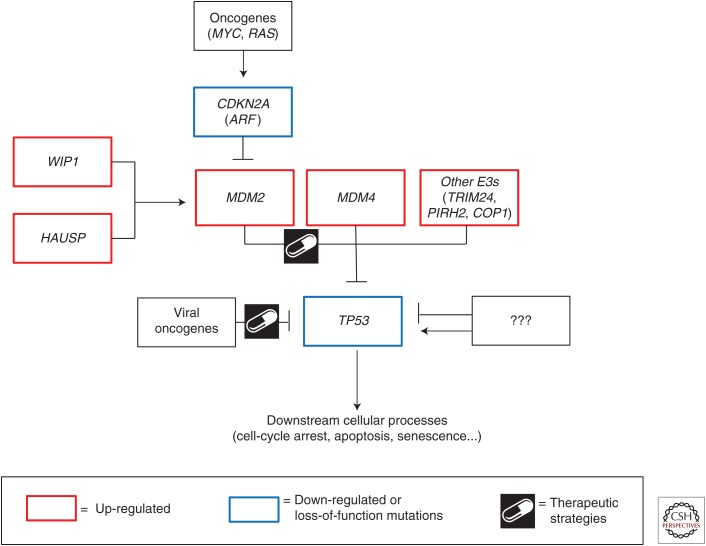
The p53 pathway. Diagrammatic representation of effectors (positive and negative) of the p53 pathway discussed in this review.
Figure 2.
Figure 2.
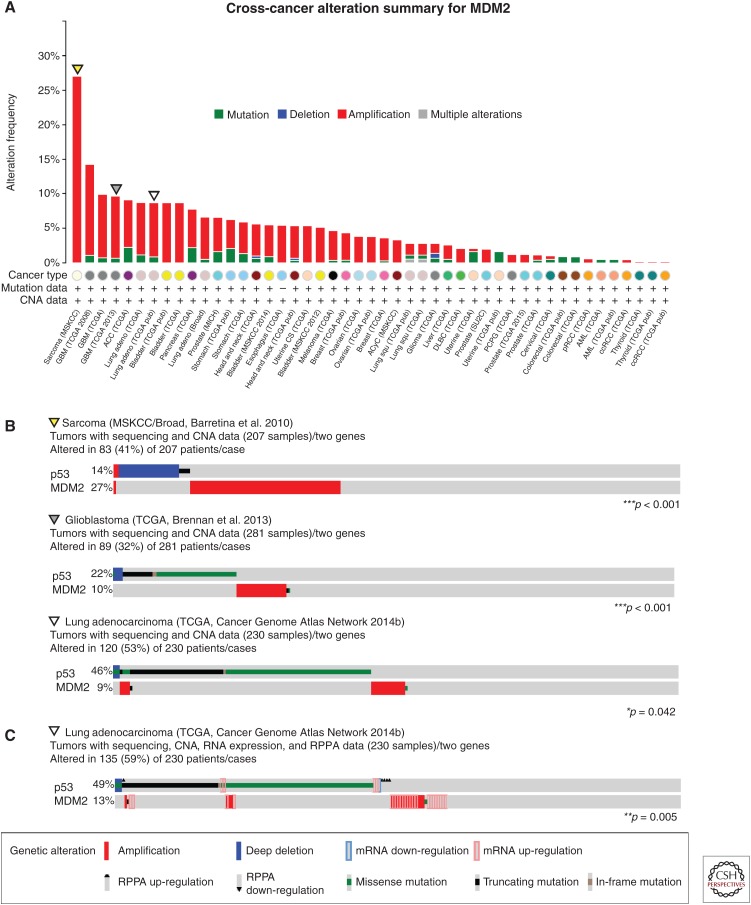
MDM2 alterations in cancer. Analyses of genomic data of tumors with p53 mutation or deletion and high levels of MDM2 from data sets accessed and prepared using the cBioPortal for Cancer Genetics (www.cbioportal.org) (Cerami et al. 2012; Gao et al. 2013). (A) Frequency of MDM2 copy number alterations and mutations across tumor types. Data sets derived from cell lines or xenografts, as well as studies without copy number data, were excluded. (B) Detailed analyses of MDM2 amplification and p53 mutation of the three tumors (sarcoma, glioblastoma, and lung adenocarcinoma) with high levels of MDM2 amplification in A. Statistically significant mutually exclusive relationships between p53 and MDM2 alterations are observed in all three of these data sets. (C) Combined analysis of MDM2 amplification and RNA and protein expression data with p53 mutation in lung adenocarcinoma. CNA, Copy number alterations; RPPA, reverse phase protein array. *p < 0.05, **p < 0.01, ***p < 0.001. Data were accessed on July 16, 2015.
Figure 3.
Figure 3.
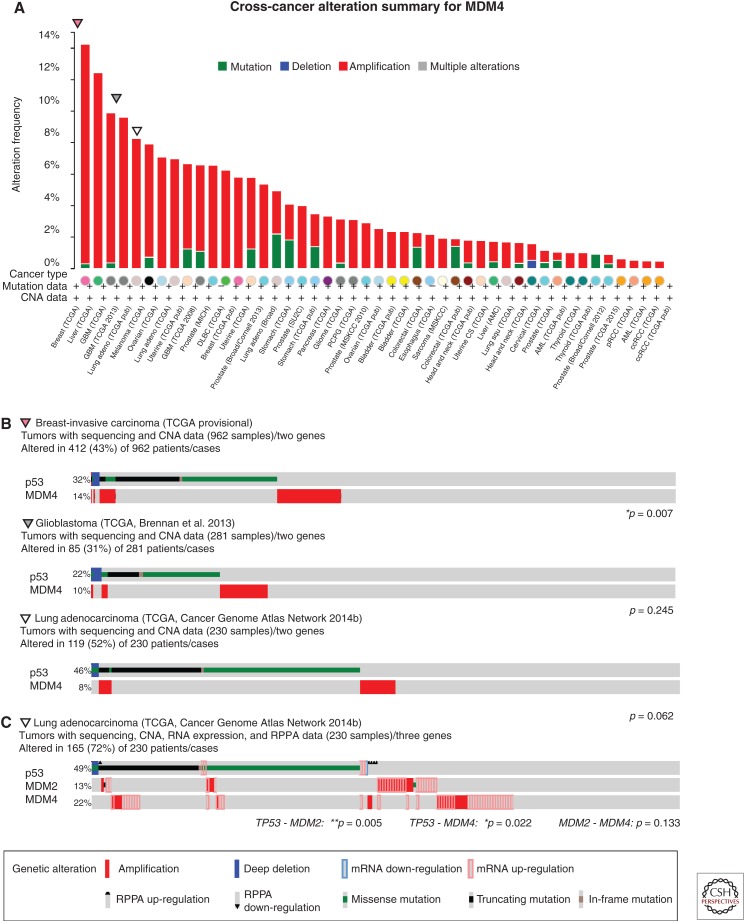
MDM4 alterations in cancer. Analyses of genomic data of tumors with high levels of MDM4 and p53 mutation or deletion from data sets accessed and prepared using the cBioPortal for Cancer Genetics (www.cbioportal.org) (Cerami et al. 2012; Gao et al. 2013). (A) Frequency of MDM4 copy number alterations and mutations across tumor types. Data sets derived from cells lines or xenografts, as well as studies without copy number data, were excluded. (B) Detailed analyses of MDM4 amplification and p53 mutation of the three tumors (breast, glioblastoma, and lung adenocarcinoma) with high levels of MDM4 in A. MDM4 and p53 alterations show statistically significant mutual exclusivity in breast cancer, and a noted trend in glioblastoma and lung adenocarcinoma. (C) Combined analysis of MDM2 and MDM4 amplification and overexpression data with p53 mutation status. CNA, Copy number alteration; RPPA, reverse phase protein array. *p < 0.05, **p < 0.01. Data were accessed on July 16, 2015.
Figure 4.
Figure 4.
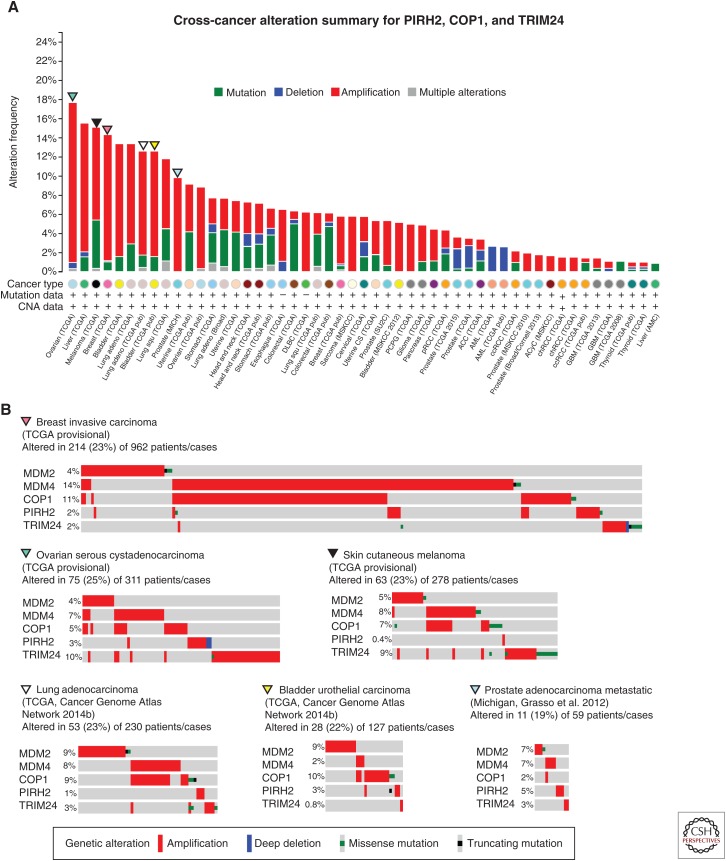
PIRH2, COP1, and TRIM24 alterations in cancer. Analyses of genomic data of tumors with high levels of p53 inhibitors COP1, PIRH2, and TIRM24 from data sets accessed and prepared using the cBioPortal for Cancer Genetics (www.cbioportal.org) (Cerami et al. 2012; Gao et al. 2013). (A) Frequency of COP1, PIRH2, and TRIM24 alterations across tumor types. (B) Detailed analyses of amplification data for five p53 inhibitors (MDM2, MDM4, COP1, PIRH2, and TRIM24) in tumors with high levels of amplification in A (breast-invasive carcinoma, glioblastoma, ovarian, melanoma, and lung adenocarcinoma). For B, because of the relatively low frequency of alterations in each regulator, only tumors with alterations were included. CNA, Copy number alteration; RPPA, reverse phase protein array. Data were accessed on July 16, 2015.
Figure 5.
Figure 5.
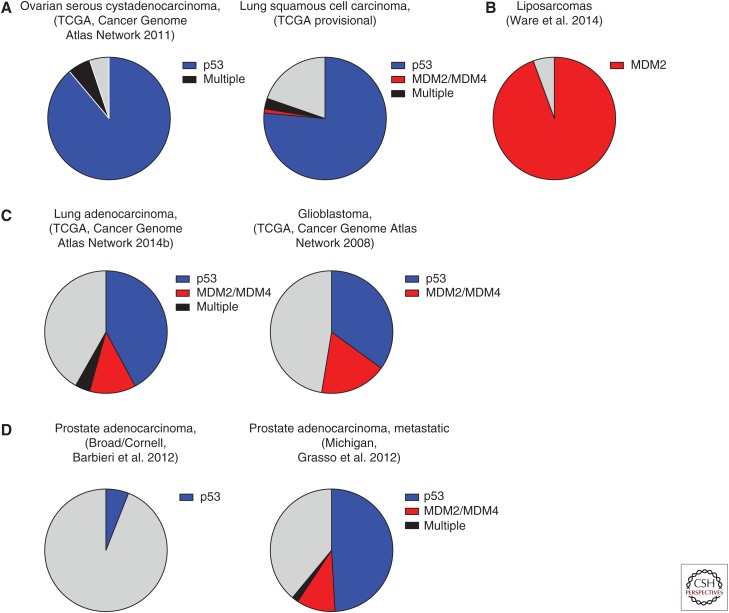
Summary of p53-pathway alterations in cancer. Pie charts summarizing the alteration spectrums in p53-pathway components seen across different cancer types. For simplicity, only p53, MDM2, and MDM4 are included in this representation. Blue, p53 mutation/deletion; red, Mdm2/Mdm4 amplification; black, alterations in more than one of p53, MDM2, and MDM4; gray, tumors with no alterations in these components of the p53 pathway. (A) Tumors with frequent alterations in p53. (B) Tumor with frequent alterations in a p53 regulator. (C) Tumors with alterations in multiple pathway components, as well as a subset with no evidence of pathway attenuation. (D) Comparison of prostate cancer data sets taken from primary and metastatic tumors, suggesting that p53-pathway attenuation occurs late in the pathogenesis of this cancer. Data were accessed on July 16, 2015.

References

    1. Allton K, Jain AK, Herz HM, Tsai WW, Jung SY, Qin J, Bergmann A, Johnson RL, Barton MC. 2009. Trim24 targets endogenous p53 for degradation. Proc Natl Acad Sci 106: 11612–11616. - PMC - PubMed
    1. Anderson LA. 2012. Prophylactic human papillomavirus vaccines: Past, present and future. Pathology 44: 1–6. - PubMed
    1. Baca SC, Prandi D, Lawrence MS, Mosquera JM, Romanel A, Drier Y, Park K, Kitabayashi N, MacDonald TY, Ghandi M, et al. 2013. Punctuated evolution of prostate cancer genomes. Cell 153: 666–677. - PMC - PubMed
    1. Barak Y, Juven T, Haffner R, Oren M. 1993. mdm2 expression is induced by wild type p53 activity. EMBO J 12: 461–468. - PMC - PubMed
    1. Barbieri CE, Baca SC, Lawrence MS, Demichelis F, Blattner M, Theurillat JP, White TA, Stojanov P, Van Allen E, Stransky N, et al. 2012. Exome sequencing identifies recurrent SPOP, FOXA1 and MED12 mutations in prostate cancer. Nat Genet 44: 685–689. - PMC - PubMed