Review
. 2017 Mar 30;322(Pt B):299-310.
doi: 10.1016/j.bbr.2016.06.035. Epub 2016 Jun 18.

Conserved regulators of cognitive aging: From worms to humans

Affiliations
Review

Conserved regulators of cognitive aging: From worms to humans

Rachel N Arey et al. Behav Brain Res. .

Abstract

Cognitive decline is a major deficit that arises with age in humans. While some research on the underlying causes of these problems can be done in humans, harnessing the strengths of small model systems, particularly those with well-studied longevity mutants, such as the nematode C. elegans, will accelerate progress. Here we review the approaches being used to study cognitive decline in model organisms and show how simple model systems allow the rapid discovery of conserved molecular mechanisms, which will eventually enable the development of therapeutics to slow cognitive aging.

Keywords: Aging; Cognitive aging; Cognitive decline; Longevity; Model systems.


Figures

Figure 1
Figure 1
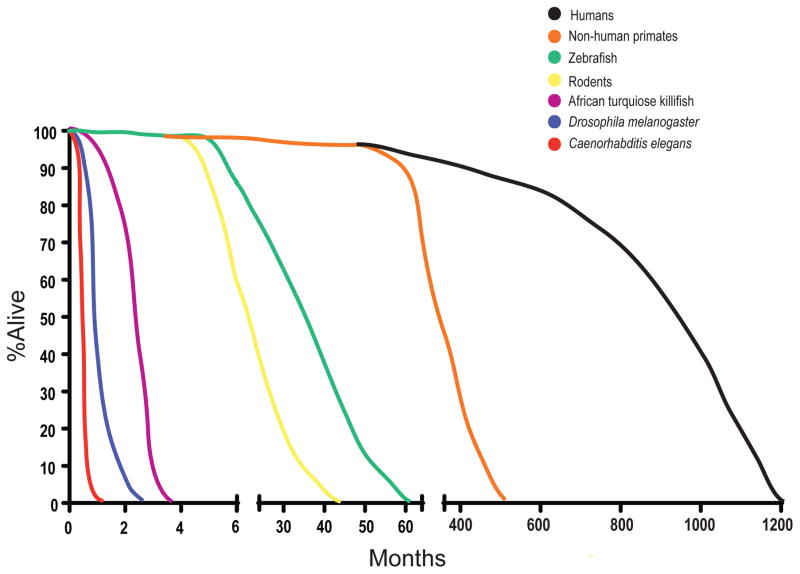
Model systems allow for rapid study of longevity. Because of the long life of humans (black line), model systems are necessary to study regulators of aging. Non-human primates (orange line) still live for decades and thus are impractical for many aging studies. Simpler vertebrate models, such as rodents (yellow line) and zebrafish (green line), are short-lived relative to humans and non-human primates, but take years to reach an “aged” state. Turquoise killifish live for about 3 months, which is significantly shorter than other vertebrate models. Invertebrate models such as Drosophila (blue line) and C. elegans (red line) live for 3 months or 3 weeks, respectively, making them ideal systems for the rapid identification of genes and molecules involved in aging and age-related cognitive decline.
Figure 2
Figure 2
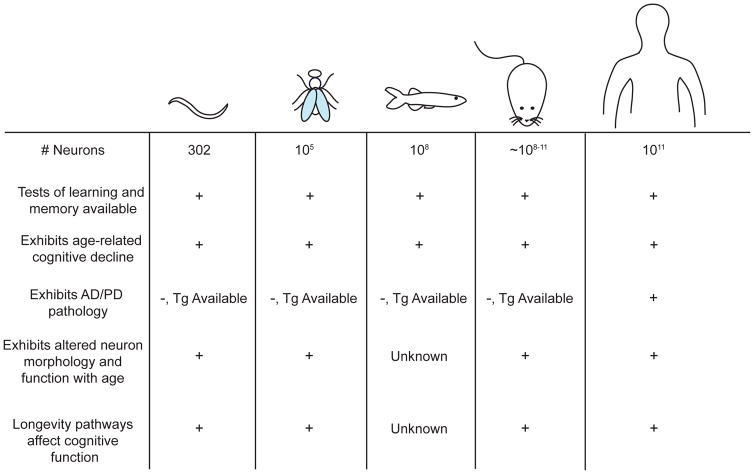
Summary of neuronal aging phenotypes across model organisms. Despite having simpler nervous systems than humans, features of neuronal aging and age-related cognitive decline are evolutionarily conserved across model systems. Transgenic (Tg) models allow for the study of complex human neurological disease, even if the pathology does not normally occur in the model organism. Longevity pathways affect cognitive function in all organisms in which they have been examined.

References

    1. Adams MM, Shi L, Linville MC, Forbes ME, Long AB, Bennett C, Newton IG, Carter CS, Sonntag WE, Riddle DR, Brunso-Bechtold JK. Caloric restriction and age affect synaptic proteins in hippocampal CA3 and spatial learning ability. Exp Neurol. 2008;211(1):141–149. - PMC - PubMed
    1. Alberini CM, Ghirardi M, Huang YY, Nguyen PV, Kandel ER. A molecular switch for the consolidation of long-term memory: cAMP-inducible gene expression. Ann N Y Acad Sci. 1995;758:261–286. - PubMed
    1. Amano H, Maruyama IN. Aversive olfactory learning and associative long-term memory in Caenorhabditis elegans. Learn Mem. 2011;18(10):654–665. - PMC - PubMed
    1. Amdam GV. Social context, stress, and plasticity of aging. Aging Cell. 2011;10(1):18–27. - PubMed
    1. Ardiel EL, Rankin CH. An elegant mind: learning and memory in Caenorhabditis elegans. Learn Mem. 2010;17(4):191–201. - PubMed