


Bridging the gaps: a global review of intersections of violence against women and violence against children
- PMID: 27329936
- PMCID: PMC4916258
- DOI: 10.3402/gha.v9.31516
Bridging the gaps: a global review of intersections of violence against women and violence against children
Abstract
Background: The international community recognises violence against women (VAW) and violence against children (VAC) as global human rights and public health problems. Historically, research, programmes, and policies on these forms of violence followed parallel but distinct trajectories. Some have called for efforts to bridge these gaps, based in part on evidence that individuals and families often experience multiple forms of violence that may be difficult to address in isolation, and that violence in childhood elevates the risk of violence against women.
Methods: This article presents a narrative review of evidence on intersections between VAC and VAW - including sexual violence by non-partners, with an emphasis on low- and middle-income countries.
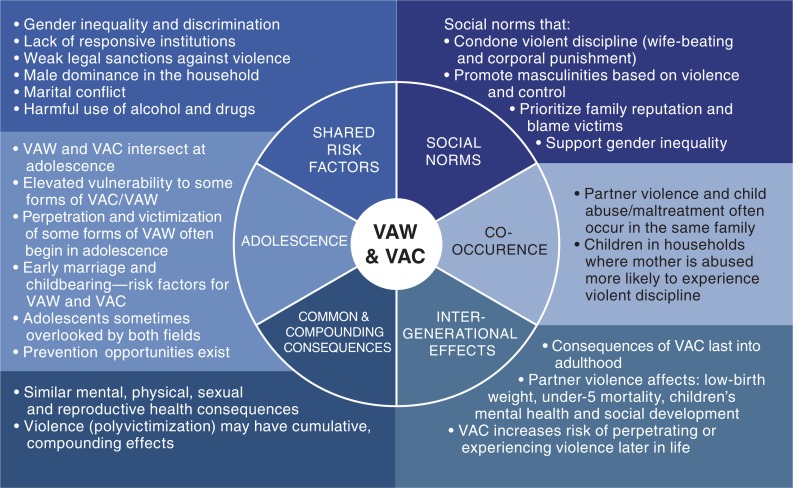
Results: We identify and review evidence for six intersections: 1) VAC and VAW have many shared risk factors. 2) Social norms often support VAW and VAC and discourage help-seeking. 3) Child maltreatment and partner violence often co-occur within the same household. 4) Both VAC and VAW can produce intergenerational effects. 5) Many forms of VAC and VAW have common and compounding consequences across the lifespan. 6) VAC and VAW intersect during adolescence, a time of heightened vulnerability to certain kinds of violence.
Conclusions: Evidence of common correlates suggests that consolidating efforts to address shared risk factors may help prevent both forms of violence. Common consequences and intergenerational effects suggest a need for more integrated early intervention. Adolescence falls between and within traditional domains of both fields and deserves greater attention. Opportunities for greater collaboration include preparing service providers to address multiple forms of violence, better coordination between services for women and for children, school-based strategies, parenting programmes, and programming for adolescent health and development. There is also a need for more coordination among researchers working on VAC and VAW as countries prepare to measure progress towards 2030 Sustainable Development Goals.
Keywords: adolescents; child abuse; child maltreatment; intimate partner violence; sexual violence.
Figures
References
-
- UN. Report of the Secretary-General. New York: United Nations General Assembly; 2006. Ending violence against women: from words to action. In-depth study on all forms of violence against women.
-
- UNICEF. Hidden in plain sight: a statistical analysis of violence against children. New York: UNICEF; 2014.
-
- WHO. Global and regional estimates of violence against women: prevalence and health effects of intimate partner violence and non-partner sexual violence. Geneva: World Health Organization (WHO), Department of Reproductive Health and Research, London School of Hygiene and Tropical Medicine, South African Medical Research Council; 2013.
-
- Stoltenborgh M, van Ijzendoorn MH, Euser EM, Bakermans-Kranenburg MJ. A global perspective on child sexual abuse: meta-analysis of prevalence around the world. Child Maltreat. 2011;16:79–101. - PubMed
Publication types
Grants and funding
LinkOut - more resources
Full Text Sources
Other Literature Sources
