


Relative Contributions of Socioeconomic, Local Environmental, Psychosocial, Lifestyle/Behavioral, Biophysiological, and Ancestral Factors to Racial/Ethnic Disparities in Type 2 Diabetes
- PMID: 27330127
- PMCID: PMC4915558
- DOI: 10.2337/dc15-2255
Relative Contributions of Socioeconomic, Local Environmental, Psychosocial, Lifestyle/Behavioral, Biophysiological, and Ancestral Factors to Racial/Ethnic Disparities in Type 2 Diabetes
Abstract
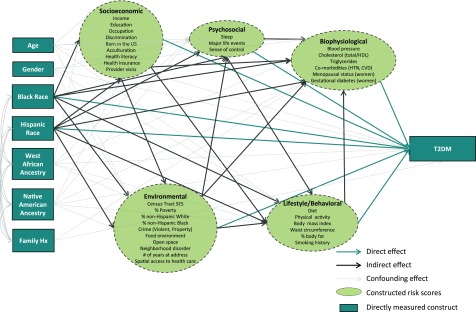
Objective: Racial/ethnic minorities in the U.S. have a higher prevalence of type 2 diabetes mellitus (T2DM) than white adults. While many independent risk factors for T2DM have been identified, these determinants are often viewed in isolation without considering the joint contributions of competing risk factors. The objective of this study was to assess the relative contributions of six domains of influence to racial/ethnic disparities in T2DM.
Research design and methods: Cross-sectional analyses were conducted using the Boston Area Community Health III Survey (2010-2012), the third wave of a population-based sample of men and women from three racial/ethnic groups (black, Hispanic, white) living in Boston, Massachusetts (N = 2,764). Prevalent diabetes was defined by self-report of T2DM, fasting glucose >125 mg/dL, or HbA1c ≥6.5%. Structural equation models were constructed to evaluate the direct effects of each conceptual domain of influence on T2DM prevalence, as well as their indirect effects on the race/ethnicity-T2DM relationship. All direct and indirect pathways were included.
Results: The final model indicated that 38.9% and 21.8% of the total effect of black race and Hispanic ethnicity, respectively, on T2DM prevalence was mediated by the socioeconomic, environmental, psychosocial, and lifestyle/behavioral risk scores. The largest mediating influence was the socioeconomic risk score, which explained 21.8% and 26.2% of the total effect of black race and Hispanic ethnicity, respectively.
Conclusions: Our study found that socioeconomic factors had the greatest impact on explaining the excess prevalence of T2DM among racial/ethnic minorities.
© 2016 by the American Diabetes Association. Readers may use this article as long as the work is properly cited, the use is educational and not for profit, and the work is not altered.
Figures

References
-
- National diabetes fact sheet 2011 [report online], 2011. Atlanta, GA, Centers for Disease Control and Prevention. Available from http://www.cdc.gov/diabetes/pubs/pdf/ndfs_2011.pdf. Accessed 6 April 2016
-
- American Diabetes Association Economic costs of diabetes in the U.S. in 2007. Diabetes Care 2008;31:596–615 - PubMed
MeSH terms
Grants and funding
LinkOut - more resources
Full Text Sources
Other Literature Sources
Medical
