


Age and executive ability impact the neural correlates of race perception
- PMID: 27330185
- PMCID: PMC5091673
- DOI: 10.1093/scan/nsw081
Age and executive ability impact the neural correlates of race perception
Abstract
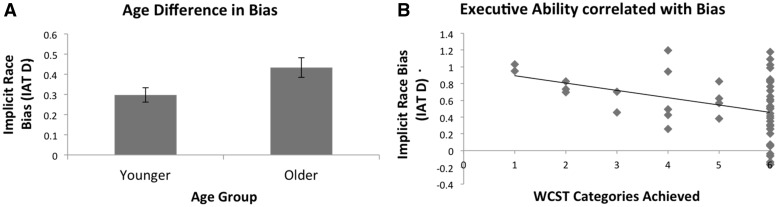
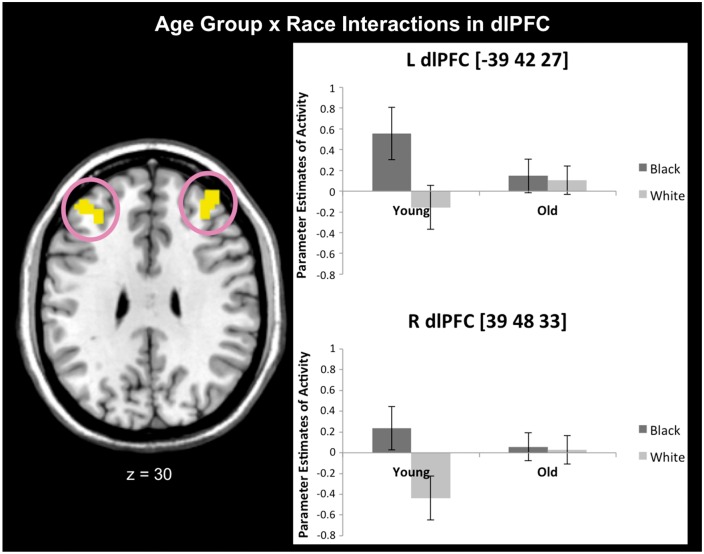
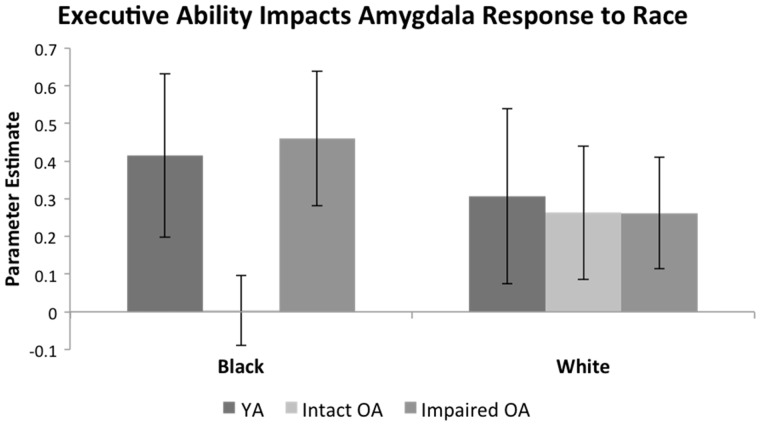
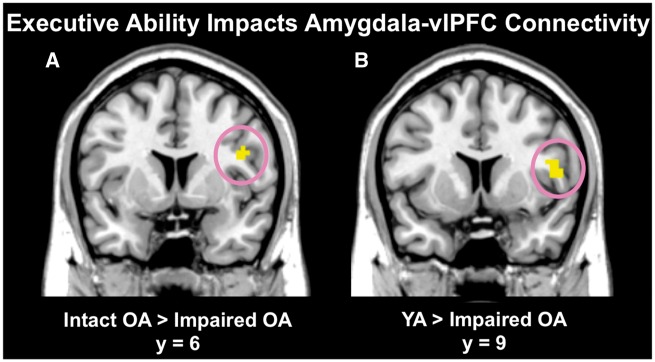
Decreased executive ability elicits racial bias. We clarified the neural correlates of how executive ability contributes to race perception by comparing young adults (YA) to a population with highly variable executive ability: older adults (OA). After replicating work showing higher race bias in OA vs YA and a negative association between bias and executive ability, a subsample of White YA and OA perceived Black and White faces and cars during functional magnetic resonance imaging. YA had higher executive ability than OA, and OA had higher variability in executive ability. When perceiving Black vs White faces, YA exhibited more dorsolateral prefrontal cortex recruitment-a region previously implicated in regulating prejudiced responses-than OA. Moreover, OA with relatively impaired executive ability had more amygdala activity toward Black faces vs OA with relatively intact executive ability, whereas responses to White faces did not differ. Both YA and OA with relatively intact executive ability had stronger amygdala-ventrolateral prefrontal cortex connectivity when perceiving Black vs White faces. These findings are the first to disentangle age from executive ability differences in neural recruitment when perceiving race, potentially informing past behavioral work on aging and race perception.
Keywords: aging; amygdala; dorsolateral prefrontal cortex; executive ability; race perception.
© The Author (2016). Published by Oxford University Press. For Permissions, please email: journals.permissions@oup.com.
Figures
References
-
- Amodio D. (2010). Coordinated roles of motivation and perception in the regulation of intergroup responses: frontal cortical asymmetry effects on the P2 event-related potential and behavior. Journal of Cognitive Neuroscience, 22(11), 2609–17. - PubMed
-
- Amodio D. (2014). The neuroscience of prejudice and stereotyping. Nature Reviews Neuroscience, 15(10), 670–82. - PubMed
-
- Amodio D., Devine P., Harmon-Jones E. (2007). A dynamic model of guilt: implications for motivation and self-regulation in the context of prejudice. Psychological Science, 18, 524–30. - PubMed
-
- Amodio D., Devine P., Harmon-Jones E. (2008). Individual differences in the regulation of intergroup bias: the role of conflict monitoring and neural signals for control. Journal of Personality and Social Psychology, 94(1), 60–74. - PubMed
-
- Amodio D., Harmon-Jones E., Devine P. (2003). Individual differences in the activation and control of affective race bias as assessed by startle eyeblink response and self-report. Journal of Personality and Social Psychology, 84(4), 738–53. - PubMed
Publication types
MeSH terms
Grants and funding
LinkOut - more resources
Full Text Sources
Other Literature Sources
Medical
Miscellaneous
