


MIND Demons for MR-to-CT Deformable Image Registration In Image-Guided Spine Surgery
- PMID: 27330239
- PMCID: PMC4909372
- DOI: 10.1117/12.2208621
MIND Demons for MR-to-CT Deformable Image Registration In Image-Guided Spine Surgery
Abstract
Purpose: Localization of target anatomy and critical structures defined in preoperative MR images can be achieved by means of multi-modality deformable registration to intraoperative CT. We propose a symmetric diffeomorphic deformable registration algorithm incorporating a modality independent neighborhood descriptor (MIND) and a robust Huber metric for MR-to-CT registration.
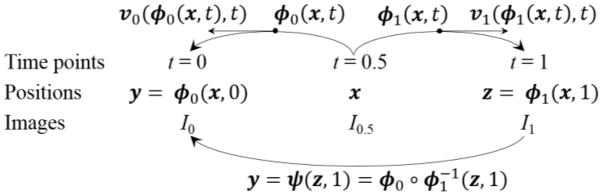
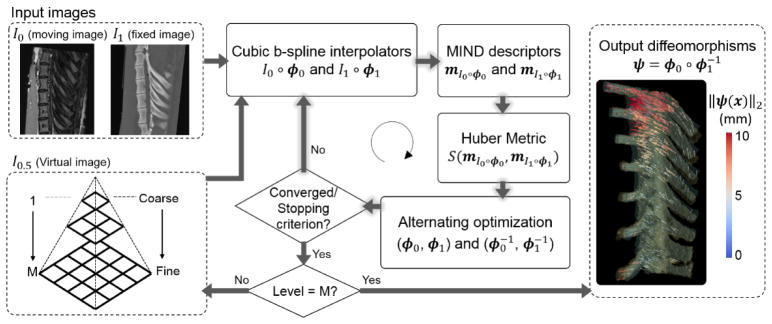
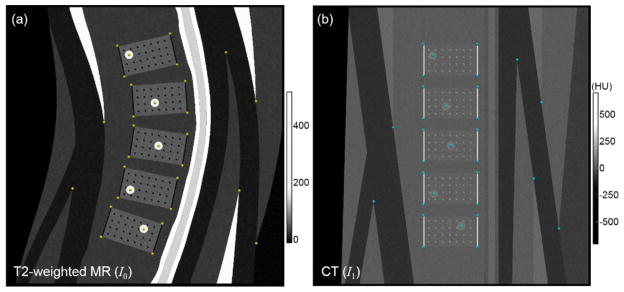
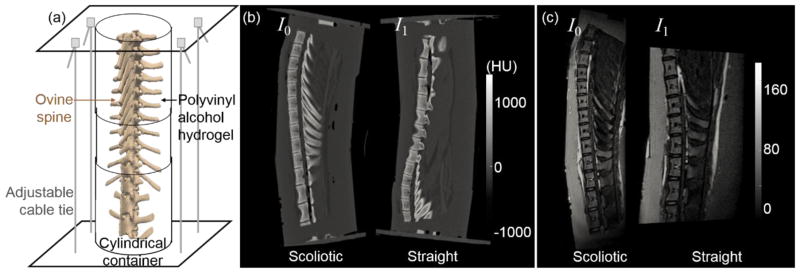
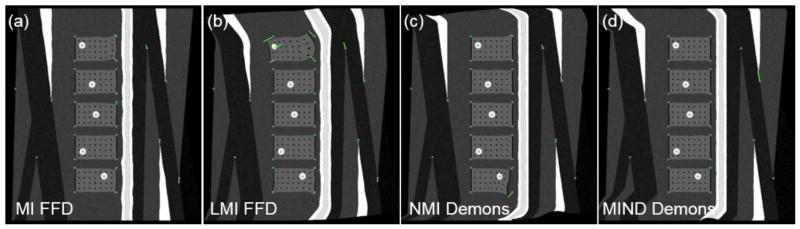
Method: The method, called MIND Demons, solves for the deformation field between two images by optimizing an energy functional that incorporates both the forward and inverse deformations, smoothness on the velocity fields and the diffeomorphisms, a modality-insensitive similarity function suitable to multi-modality images, and constraints on geodesics in Lagrangian coordinates. Direct optimization (without relying on an exponential map of stationary velocity fields used in conventional diffeomorphic Demons) is carried out using a Gauss-Newton method for fast convergence. Registration performance and sensitivity to registration parameters were analyzed in simulation, in phantom experiments, and clinical studies emulating application in image-guided spine surgery, and results were compared to conventional mutual information (MI) free-form deformation (FFD), local MI (LMI) FFD, and normalized MI (NMI) Demons.
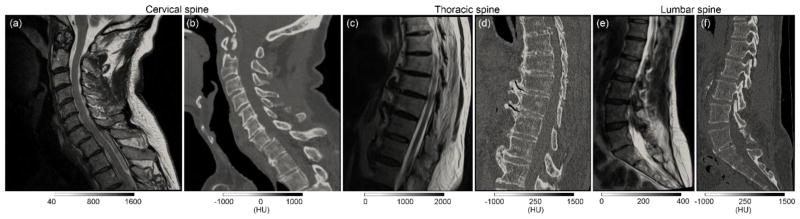
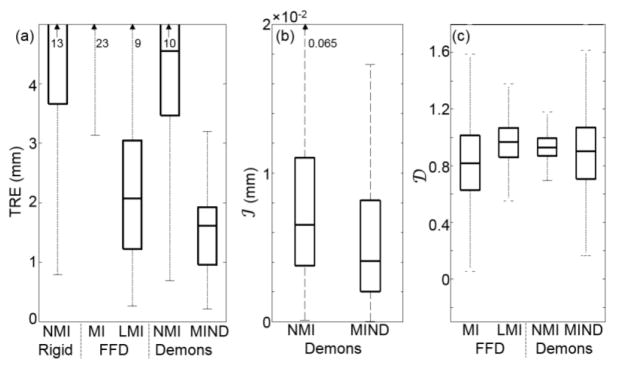
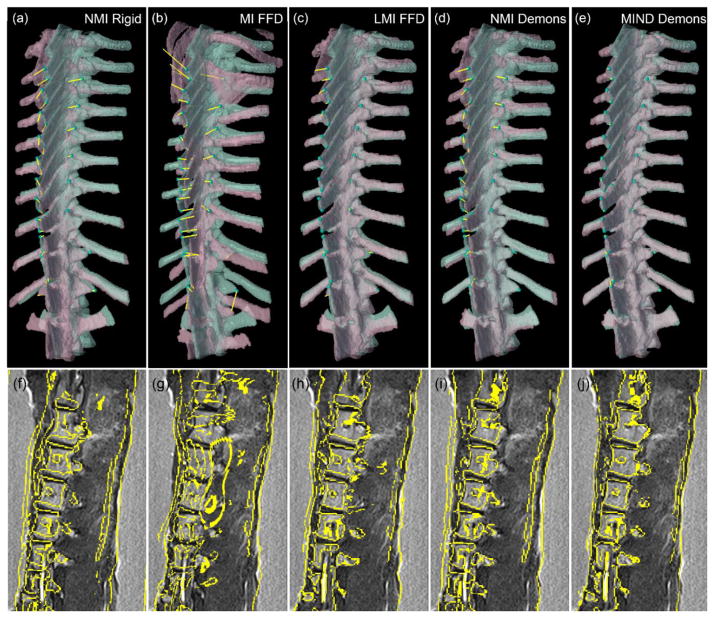
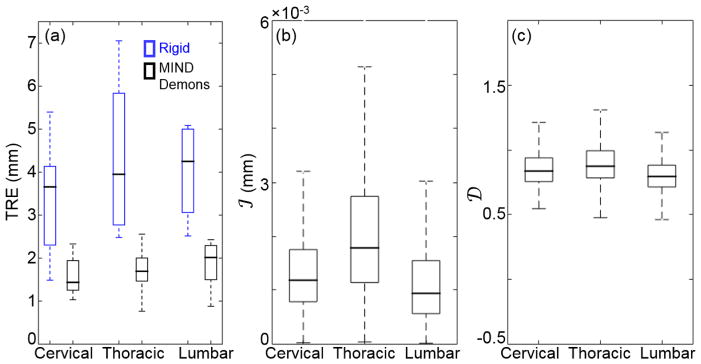
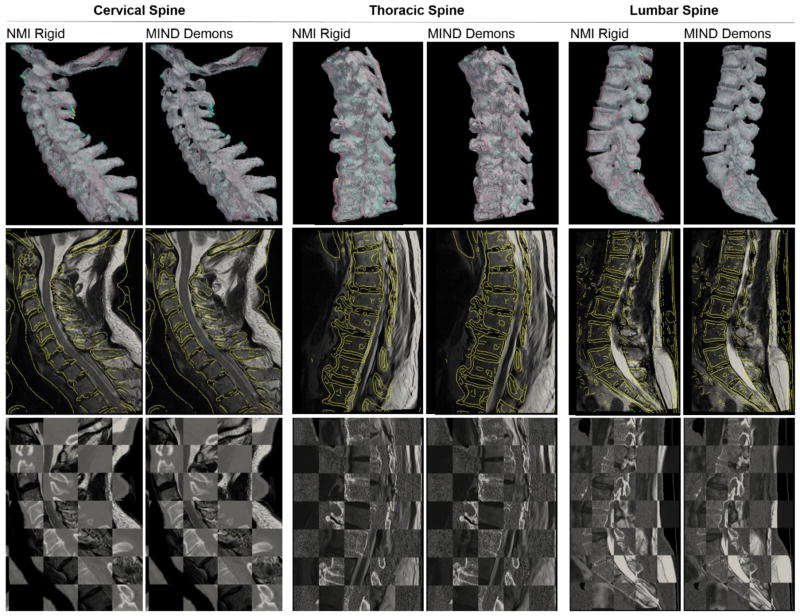
Result: The method yielded sub-voxel invertibility (0.006 mm) and nonsingular spatial Jacobians with capability to preserve local orientation and topology. It demonstrated improved registration accuracy in comparison to the reference methods, with mean target registration error (TRE) of 1.5 mm compared to 10.9, 2.3, and 4.6 mm for MI FFD, LMI FFD, and NMI Demons methods, respectively. Validation in clinical studies demonstrated realistic deformation with sub-voxel TRE in cases of cervical, thoracic, and lumbar spine.
Conclusions: A modality-independent deformable registration method has been developed to estimate a viscoelastic diffeomorphic map between preoperative MR and intraoperative CT. The method yields registration accuracy suitable to application in image-guided spine surgery across a broad range of anatomical sites and modes of deformation.
Keywords: CT; Demons algorithm; MIND; MRI; deformable image registration; image-guided surgery; multimodality image registration; symmetric diffeomorphism.
Figures
References
-
- Haldeman S, Kopansky-Giles D, Hurwitz EL, Hoy D, Mark Erwin W, Dagenais S, Kawchuk G, Strömqvist B, Walsh N. Advancements in the Management of Spine Disorders. Best Pract Res Clin Rheumatol. 2012;26(2):263–280. - PubMed
-
- Smith JS, Shaffrey CI, Glassman SD, Berven SH, Schwab FJ, Hamill CL, Horton WC, Ondra SL, Sansur CA, et al. Risk-benefit assessment of surgery for adult scoliosis: an analysis based on patient age. Spine (Phila Pa 1976) 2011;36(10):817–824. 2010/08/05 ed. - PubMed
-
- Larson AN, Polly DWJ, Guidera KJ, Mielke CH, Santos ERG, Ledonio CGT, Sembrano JN. The Accuracy of Navigation and 3D Image-Guided Placement for the Placement of Pedicle Screws in Congenital Spine Deformity. J Pediatr Orthop. 2012;32(6):e23–e29. - PubMed
Grants and funding
LinkOut - more resources
Full Text Sources
Other Literature Sources