


The role of household chaos in understanding relations between early poverty and children's academic achievement
- PMID: 27330247
- PMCID: PMC4909052
- DOI: 10.1016/j.ecresq.2016.02.004
The role of household chaos in understanding relations between early poverty and children's academic achievement
Abstract
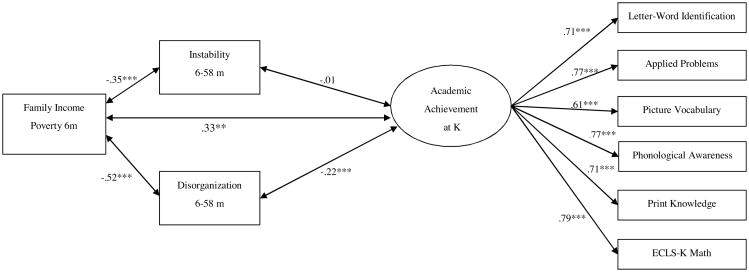
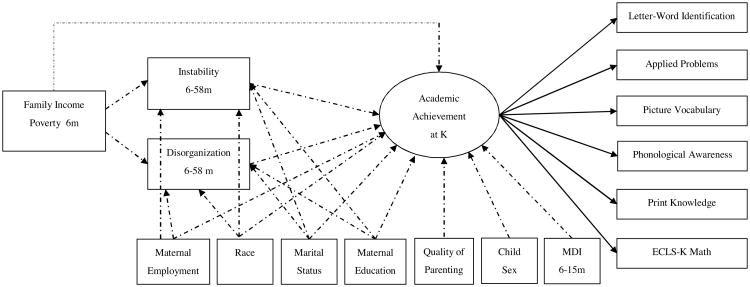
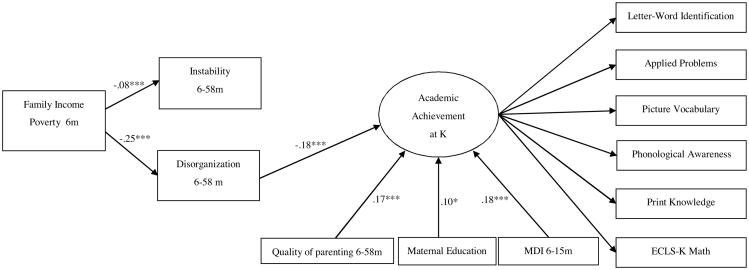
The following prospective longitudinal study used an epidemiological sample (N = 1,236) to consider the potential mediating role of early cumulative household chaos (6-58 months) on associations between early family income poverty (6 months) and children's academic achievement in kindergarten. Two dimensions of household chaos, disorganization and instability, were examined as mediators. Results revealed that, in the presence of household disorganization (but not instability) and relevant covariates, income poverty was no longer directly related to academic achievement. Income poverty was, however, positively related to household disorganization, which was, in turn, associated with lower academic achievement. Study results are consistent with previous research indicating that household chaos conveys some of the adverse longitudinal effects of income poverty on children's outcomes and extend previous findings specifically to academic achievement in early childhood.
Keywords: Academic achievement; Chaos; Disorganization; Early childhood; Instability; Poverty.
Figures
References
-
- Ackerman BP, Kogos J, Youngstrom E, Schoff K, Izard C. Family instability and the problem behaviors of children from economically disadvantaged families. Developmental Psychology. 1999;35:258–268. http://dx.doi.org/10.1037//0012-1649.35.1.258. - DOI - PubMed
-
- Bayley N. Manual for the Bayley scales of infant development-II. San Antonio, TX: The Psychological Corporation; 1993.
-
- Berry D, Blair C, Ursache A, Willoughby M, Garrett-Peters P, Vernon-Feagans L, et al. Child care and cortisol across early childhood: context matters. Developmental Psychology. 2013;50(2):514–525. http://dx.doi.org/10.1037/a0033379. - DOI - PubMed
-
- Bradley RH, Corwyn RF. Socioeconomic status and child development. Annual review of psychology. 2002;53(1):371–399. http://dx.doi.org/10.1146/annurev.psych.53.100901.135233. - DOI - PubMed
-
- Bradley RH, Corwyn RF, Burchinal M, McAdoo HP, Garcia Coll C. The home environments of children in the United States, part II: relations with behavioural development through age thirteen. Child Development. 2001;72:1868–1886. http://dx.doi.org/10.1111/1467-8624.t01-1-00383. - DOI - PubMed
Grants and funding
LinkOut - more resources
Full Text Sources
Other Literature Sources