. 2016 Feb 18;30(2):1445-1461.
doi: 10.1021/acs.energyfuels.5b02879. Epub 2016 Jan 7.

Diesel Surrogate Fuels for Engine Testing and Chemical-Kinetic Modeling: Compositions and Properties

Affiliations

Diesel Surrogate Fuels for Engine Testing and Chemical-Kinetic Modeling: Compositions and Properties

Charles J Mueller et al. Energy Fuels. .

Abstract

The primary objectives of this work were to formulate, blend, and characterize a set of four ultralow-sulfur diesel surrogate fuels in quantities sufficient to enable their study in single-cylinder-engine and combustion-vessel experiments. The surrogate fuels feature increasing levels of compositional accuracy (i.e., increasing exactness in matching hydrocarbon structural characteristics) relative to the single target diesel fuel upon which the surrogate fuels are based. This approach was taken to assist in determining the minimum level of surrogate-fuel compositional accuracy that is required to adequately emulate the performance characteristics of the target fuel under different combustion modes. For each of the four surrogate fuels, an approximately 30 L batch was blended, and a number of the physical and chemical properties were measured. This work documents the surrogate-fuel creation process and the results of the property measurements.


Figures

Figure 1
Figure 1
GC×GC-FID chromatogram for no. 2 diesel certification fuel (CF), acquired using “normal” column configuration. Annotations showing the carbon numbers and boiling points of the individual n-alkanes are provided for reference. The second retention time is proportional to polarity/polarizability. The three-ring aromatic content of CF is difficult to discern because it is so low.
Figure 2
Figure 2
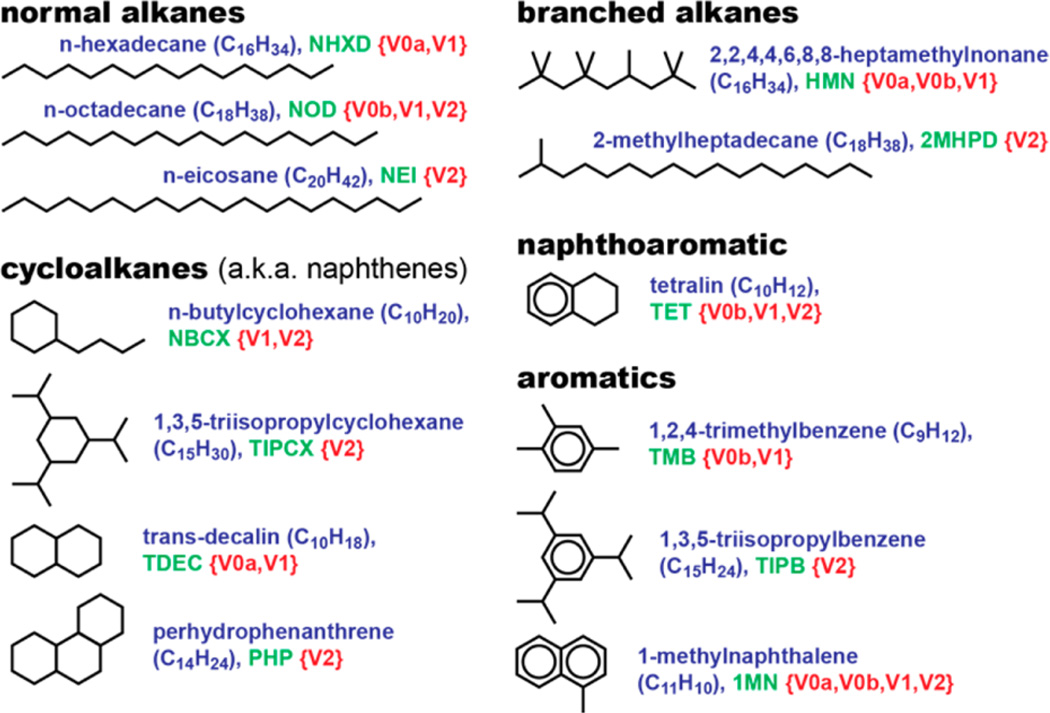
Surrogate palette compounds. For each palette compound, the abbreviation of the compound name is shown in green text after the chemical formula of the compound, and the red text enclosed by curly braces indicates the surrogate fuels that contain the compound.
Figure 3
Figure 3
CT mole fractions for CF target fuel (as quantified by NMR spectroscopy, left-hand vertical bar of each pair) vs CT mole fractions determined from known surrogate composition (right-hand vertical bar of each pair): (a) V0a surrogate; (b) V2 surrogate. Each gray horizontal bar in the background corresponds to a numbered CT, and a structural diagram with the given CT circled in red is provided near the right-hand end of each bar for reference.
Figure 4
Figure 4
GC×GC-FID chromatograms acquired with the “normal” column configuration, showing surrogate palette compounds (in color and labeled) overlaid on CF target-fuel composition (in gray): (a) V0a surrogate; (b) V2 surrogate. The area and color of the circle for each palette compound/isomer correspond to its mass fraction and hydrocarbon class, respectively. The individual isomers of TIPCX and PHP are evident in the chromatogram for the V2 surrogate. Annotations showing the carbon numbers and boiling points of the individual n-alkanes are provided for reference.
Figure 5
Figure 5
Hydrocarbon-class mass fractions in target fuel (left side, as quantified by GC×GC-FID) vs surrogate fuel (right side, from known surrogate composition): (a) V0a surrogate; (b) V2 surrogate.
Figure 6
Figure 6
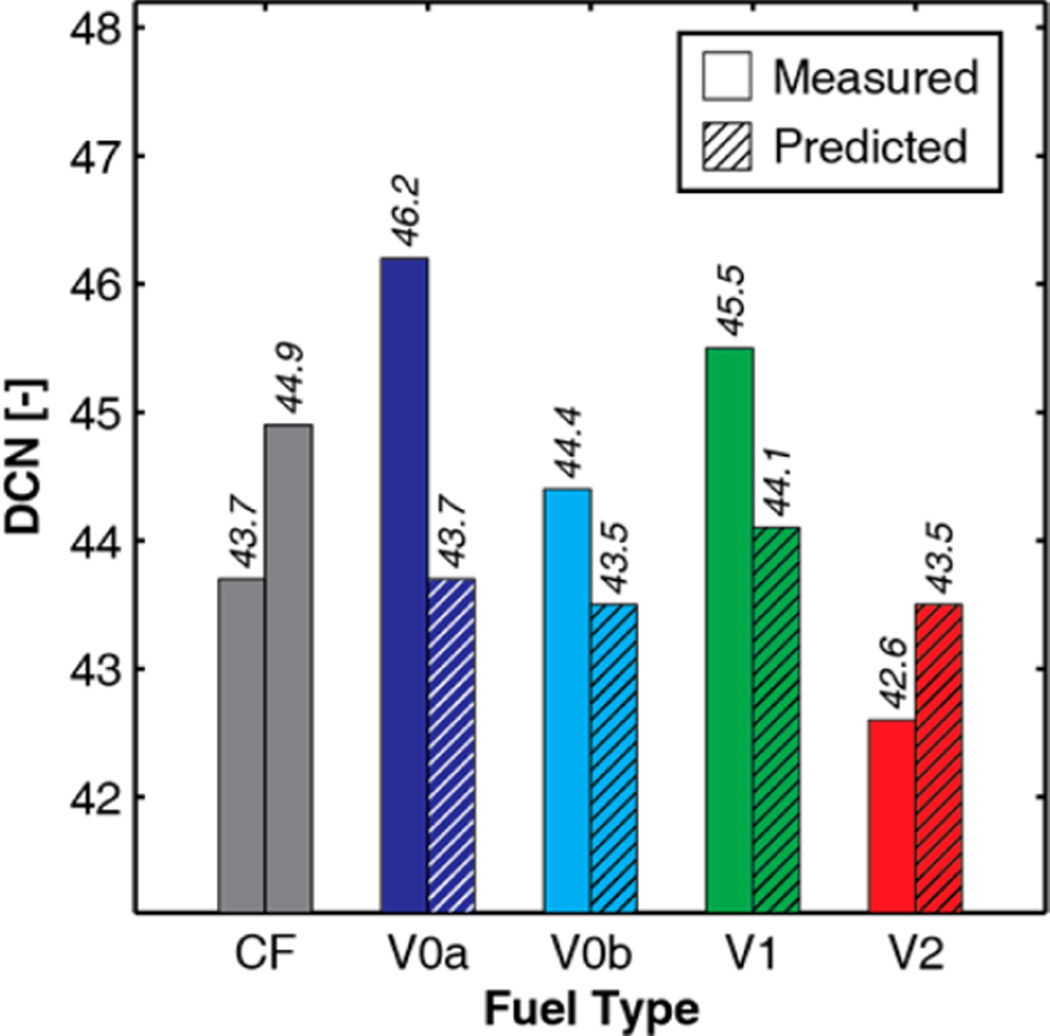
Target- and surrogate-fuel ignition qualities as quantified by derived cetane number (DCN) or estimated using a volume-fraction-weighted linear blending rule.
Figure 7
Figure 7
Target- and surrogate-fuel peroxide contents.
Figure 8
Figure 8
Fuel volatility as quantified by the ADC technique: (a) V0a surrogate; (b) V2 surrogate. Subscripts M, P, MS, and MT denote measured, predicted, measured surrogate-fuel, and measured target-fuel values, respectively.
Figure 9
Figure 9
Fuel volatility as quantified by the simulated distillation (ASTM D2887) technique: (a) V0a surrogate; (b) V2 surrogate. Elution ranges for each palette compound (PCER) in each surrogate are shown and labeled with their corresponding palette-compound abbreviations. Subscripts MS and MT denote measured surrogate-fuel and measured target-fuel values, respectively.
Figure 10
Figure 10
Fuel volatility as quantified by the standard distillation (ASTM D86) technique: (a) V0a surrogate; (b) V2 surrogate. Subscripts MS and MT denote measured surrogate-fuel and measured target-fuel values, respectively.
Figure 11
Figure 11
Measured target-fuel densities, as well as measured and predicted surrogate-fuel densities at 20 °C and ~0.1 MPa ambient pressure. For CF, both bars represent measured values, with the left- and right-hand bars corresponding to measurements made by different testing laboratories in 2009 and 2014, respectively. Each non-cross-hatched bar represents a single measurement acquired per the ASTM D4052 test method.
Figure 12
Figure 12
Measured target-fuel net heats of combustion, as well as measured and predicted surrogate-fuel net heats of combustion. For CF, both bars represent measured values, with the left- and right-hand bars corresponding to measurements made by different testing laboratories in 2009 and 2014, respectively. Each non-cross-hatched bar represents a single measurement acquired per the ASTM D4809 test method.
Figure 13
Figure 13
Target- and surrogate-fuel lubricities measured using ASTM D6079. Each bar represents a single measurement acquired per the test method. Dashed line indicates the maximum wear-scar diameter of 520 µm for grade no. 2-D S15 diesel fuel from the ASTM D975 specification. A small batch of each surrogate fuel created without LI additive was tested to give the values shown by the cross-hatched bars. As indicated in Table S1 of the Supporting Information, CF was provided with LI already added, and no further LI was added to this fuel.
Figure 14
Figure 14
Target- and surrogate-fuel cloud points and final melting points. Each bar represents a single measurement acquired per the corresponding test method (at ~0.1 MPa ambient pressure).
Figure 15
Figure 15
Target- and surrogate-fuel carbon and hydrogen mass fractions. Measured values represent a single replicate determined using ASTM D5291, whereas predicted values were determined using the known compositions of the surrogate fuels. The two columns for the CF target fuel correspond to measurements made in 2009 (left-hand side) and 2015 (right-hand side). Some of the measured values do not sum to 100.0 wt % because this is not a requirement of the test method.
Figure 16
Figure 16
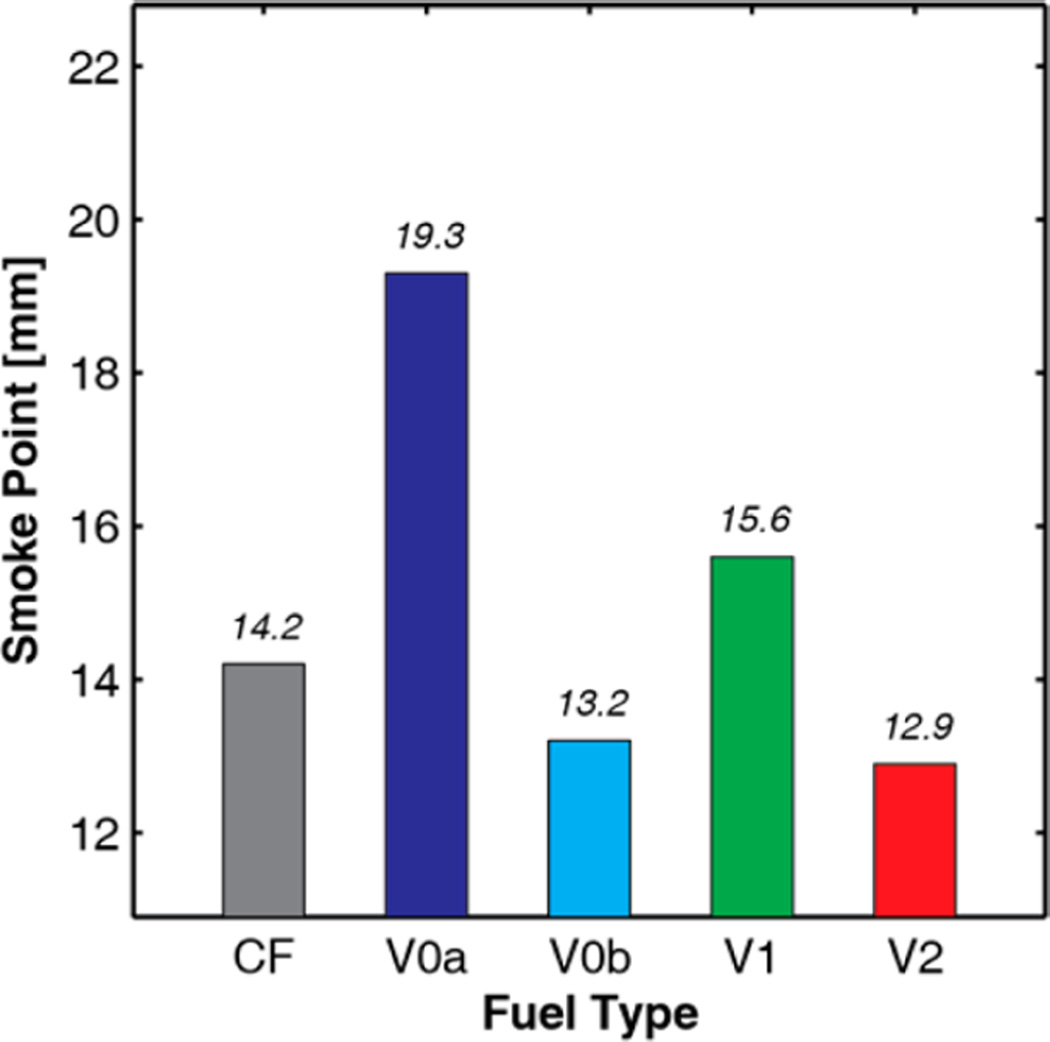
Target- and surrogate-fuel smoke points as measured using the ASTM D1322 test method. The value for CF is an average of measurements of 13.4 and 15.0 mm from 2011 and 2014, respectively. The values for the surrogate fuels are from single replicates of the test method.

References

    1. Gieleciak R, Fairbridge C. Detailed Hydrocarbon Analysis of FACE Diesel Fuels Using Comprehensive Two-Dimensional Gas Chromatography; CDEV-2013-2065-RT. CanmetENERGY; Devon, Alberta, Canada: 2013. http://www.crcao.org/publications/advancedVehiclesFuelsLubricants/FACE/G....
    1. Gieleciak R, Oro N. A Study of FID Response Factor of GC×GC Systems for Hydrocarbon Compound Classes Existing in Diesel Fractions; CDEV-2013-1979-RT. Devon, Alberta, Canada: CanmetENERGY; 2013.
    1. Lemmon EW, Huber ML, McLinden MO. NIST Reference fluid thermodynamic and transport properties database (REFPROP), NIST Standard Reference Database 23, Version 9.1. Gaithersburg, MD, USA: National Institute of Standards and Technology; 2013.
    1. Reiter AM, Wallek T, Pfennig A, Zeymer M. Surrogate Generation and Evaluation for Diesel Fuel. Energy Fuels. 2015;29(7):4181–4192.
    1. Pitz WJ, Mueller CJ. Recent progress in the development of diesel surrogate fuels. Prog. Energy Combust. Sci. 2011;37(3):330–350.