


Family Relationships and Latina Teen Suicide Attempts: Reciprocity, Asymmetry, and Detachment
- PMID: 27330263
- PMCID: PMC4909330
- DOI: 10.1606/1044-3894.4131
Family Relationships and Latina Teen Suicide Attempts: Reciprocity, Asymmetry, and Detachment
Abstract
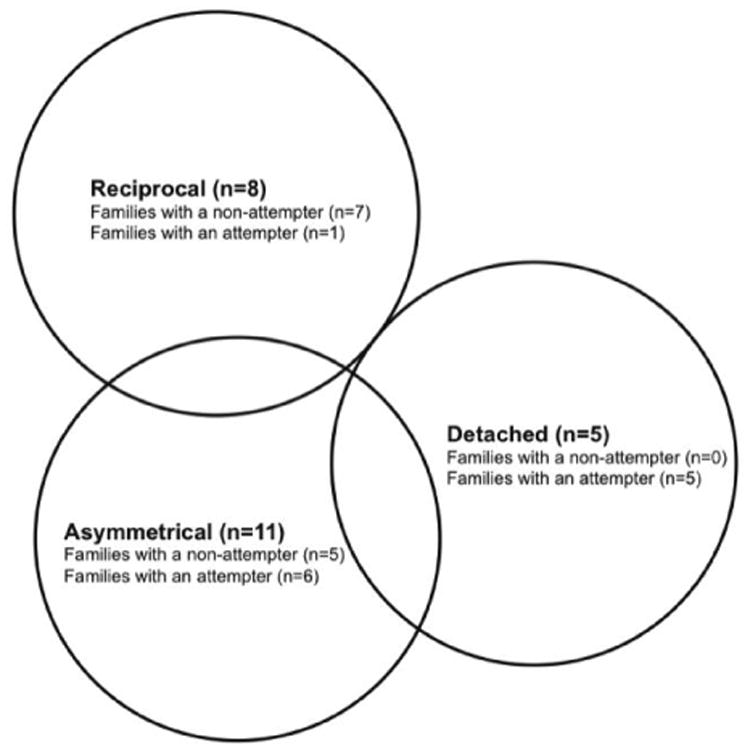
Using qualitative data collected from adolescent Latinas and their parents, this article describes ways in which family relationships are organized within low-income Latino families (n = 24) with and without a daughter who attempted suicide. Based on a family-level analysis approach, we present a framework that categorizes relationships as reciprocal, asymmetrical, or detached. Clear differences are identified: Families of non-attempters primarily cluster in reciprocal families, whereas families with an adolescent suicide attempter exhibit characteristics of asymmetrical or detached families. Our results highlight the need for detailed clinical attention to family communication patterns, especially in Latino families. Clinicians may reduce the likelihood of an attempt or repeated attempts by raising mutual, reciprocal exchanges of words and support between parents and daughter.
Figures
References
-
- Ayres L, Kavanaugh K, Knafl KA. Within-case and across-case approaches to qualitative data analysis. Qualitative Health Research. 2003;13:871–883. - PubMed
-
- Berne JE. The management of patients post-suicide attempt in an urban municipal hospital. Psychiatria Fennica. 1983:45–54. Suppl.
-
- Blair S, Blair M, Madamba A. Racial/ethnic differences in high school students' academic performance: Understanding the interweave of social class and ethnicity in the family context. Journal of Comparative Family Studies. 1999;30:539–555.
-
- Borgatti SP. ANTHROPAC (Version 4.0) Natick, MA: Analytic Technologies; 1996. Computer software.
Grants and funding
LinkOut - more resources
Full Text Sources