


State-of-the-art practices in farmland biodiversity monitoring for North America and Europe
- PMID: 27334103
- PMCID: PMC5102971
- DOI: 10.1007/s13280-016-0799-0
State-of-the-art practices in farmland biodiversity monitoring for North America and Europe
Abstract
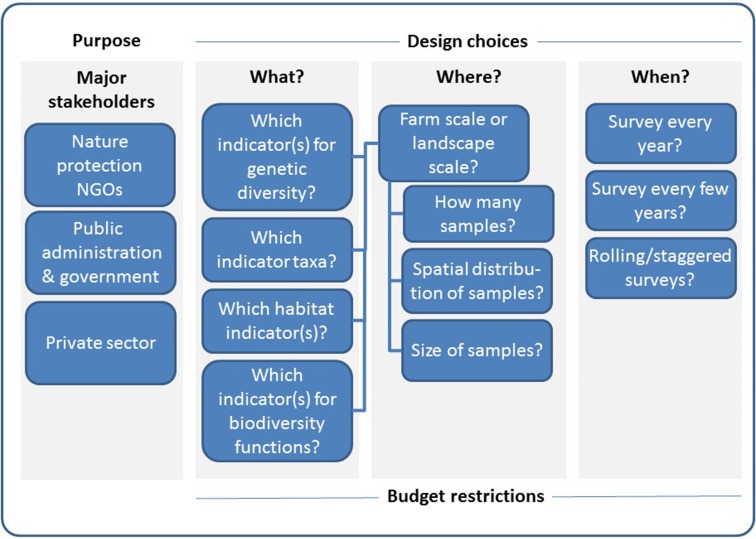
Policy makers and farmers need to know the status of farmland biodiversity in order to meet conservation goals and evaluate management options. Based on a review of 11 monitoring programs in Europe and North America and on related literature, we identify the design choices or attributes of a program that balance monitoring costs and usefulness for stakeholders. A useful program monitors habitats, vascular plants, and possibly faunal groups (ecosystem service providers, charismatic species) using a stratified random sample of the agricultural landscape, including marginal and intensive regions. The size of landscape samples varies with the grain of the agricultural landscape; for example, samples are smaller in Europe and larger in North America. Raw data are collected in a rolling survey, which distributes sampling over several years. Sufficient practical experience is now available to implement broad monitoring schemes on both continents. Technological developments in remote sensing, metagenomics, and social media may offer new opportunities for affordable farmland biodiversity monitoring and help to lower the overall costs of monitoring programs.
Keywords: Agricultural landscape; Ecosystem service; Essential biodiversity variables; Monitoring budget; Stakeholder need; Survey design.
Figures
References
-
- Austin MP, Heyligers PC. Vegetation survey design for conservation: Gradsect sampling of forests in North-eastern New South Wales. Biological Conservation. 1989;50:13–32. doi: 10.1016/0006-3207(89)90003-7. - DOI
-
- BDM Coordination Office. 2014. Swiss Biodiversity Monitoring BDM. Description of Methods and Indi-cators. Federal Office for the Environment, Bern. Environmental Studies No. 1410, 103 pp. Retrieved 14 January, 2014, from http://www.bafu.admin.ch/publikationen/publikation/01766/index.html?lang=en.
-
- Benton TG, Vickery JA, Wilson JD. Farmland biodiversity: Is habitat heterogeneity the key? Trends in Ecology & Evolution. 2003;18:182–188. doi: 10.1016/S0169-5347(03)00011-9. - DOI
-
- Bonter DN, Cooper CB. Data validation in citizen science: A case study from Project FeederWatch. Frontiers in Ecology and the Environment. 2012;10:305–307. doi: 10.1890/110273. - DOI
-
- Bradley, R.S., and P.D. Jones (eds). 1992. Climate since A.D. 1500. London: Routledge, 707 pp.
Publication types
MeSH terms
LinkOut - more resources
Full Text Sources
Other Literature Sources
