


Implementation Of Prescription Drug Monitoring Programs Associated With Reductions In Opioid-Related Death Rates
- PMID: 27335101
- PMCID: PMC5155336
- DOI: 10.1377/hlthaff.2015.1496
Implementation Of Prescription Drug Monitoring Programs Associated With Reductions In Opioid-Related Death Rates
Abstract
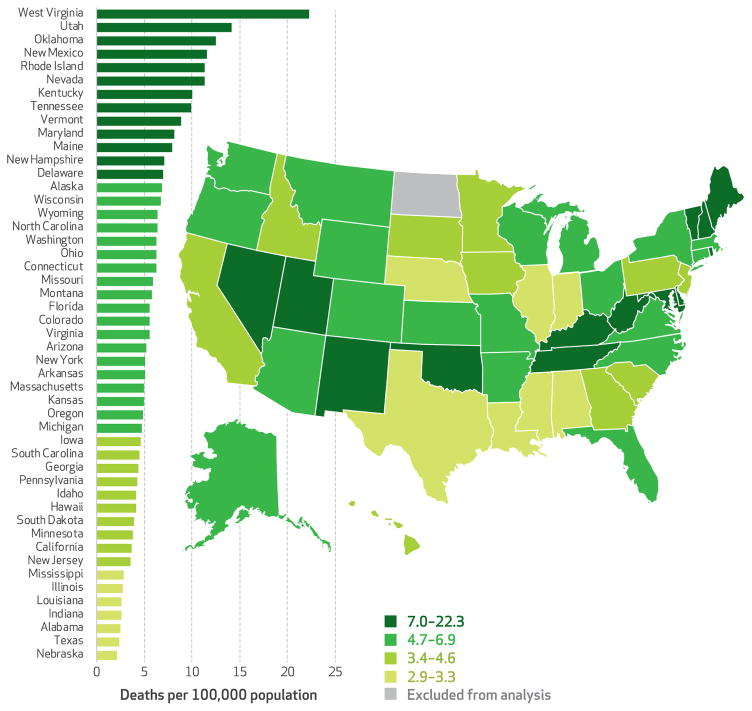
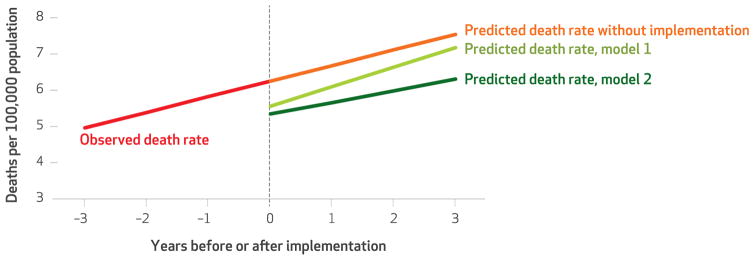
Over the past two decades the number of opioid pain relievers sold in the United States rose dramatically. This rise in sales was accompanied by an increase in opioid-related overdose deaths. In response, forty-nine states (all but Missouri) created prescription drug monitoring programs to detect high-risk prescribing and patient behaviors. Our objectives were to determine whether the implementation or particular characteristics of the programs were effective in reducing opioid-related overdose deaths. In adjusted analyses we found that a state's implementation of a program was associated with an average reduction of 1.12 opioid-related overdose deaths per 100,000 population in the year after implementation. Additionally, states whose programs had robust characteristics-including monitoring greater numbers of drugs with abuse potential and updating their data at least weekly-had greater reductions in deaths, compared to states whose programs did not have these characteristics. We estimate that if Missouri adopted a prescription drug monitoring program and other states enhanced their programs with robust features, there would be more than 600 fewer overdose deaths nationwide in 2016, preventing approximately two deaths each day.
Keywords: Epidemiology; Health Promotion/Disease Prevention; Mental Health/Substance Abuse; Pharmaceuticals; Public Health.
Project HOPE—The People-to-People Health Foundation, Inc.
Figures
References
-
- Centers for Disease Control and Prevention. Vital Signs: overdoses of prescription opioid pain relievers—United States, 1999–2008. MMWR Morb Mortal Wkly Rep. 2011;60(43):1487–92. - PubMed
-
- Patrick SW, Schumacher RE, Benneyworth BD, Krans EE, McAllister JM, Davis MM. Neonatal abstinence syndrome and associated health care expenditures: United States, 2000–2009. JAMA. 2012;307(18):1934–40. - PubMed
-
- Patrick SW, Davis MM, Lehman CU, Cooper WO. Increasing incidence and geographic distribution of neonatal abstinence syndrome: United States 2009 to 2012. J Perinatol. 2015;35(8):667. - PubMed
Publication types
MeSH terms
Substances
Grants and funding
LinkOut - more resources
Full Text Sources
Other Literature Sources
Medical
Miscellaneous
