. 2016 Sep;33(9):2417-28.
doi: 10.1093/molbev/msw120. Epub 2016 Jun 22.

The Evolution of Photoperiod-Insensitive Flowering in Sorghum, A Genomic Model for Panicoid Grasses

Affiliations

The Evolution of Photoperiod-Insensitive Flowering in Sorghum, A Genomic Model for Panicoid Grasses

Hugo E Cuevas et al. Mol Biol Evol. 2016 Sep.

Abstract

Of central importance in adapting plants of tropical origin to temperate cultivation has been selection of daylength-neutral genotypes that flower early in the temperate summer and take full advantage of its long days. A cross between tropical and temperate sorghums [Sorghum propinquum (Kunth) Hitchc.×S. bicolor (L.) Moench], revealed a quantitative trait locus (QTL), FlrAvgD1, accounting for 85.7% of variation in flowering time under long days. Fine-scale genetic mapping placed FlrAvgD1 on chromosome 6 within the physically largest centiMorgan in the genome. Forward genetic data from "converted" sorghums validated the QTL. Association genetic evidence from a diversity panel delineated the QTL to a 10-kb interval containing only one annotated gene, Sb06g012260, that was shown by reverse genetics to complement a recessive allele. Sb06g012260 (SbFT12) contains a phosphatidylethanolamine-binding (PEBP) protein domain characteristic of members of the "FT" family of flowering genes acting as a floral suppressor. Sb06g012260 appears to have evolved ∼40 Ma in a panicoid ancestor after divergence from oryzoid and pooid lineages. A species-specific Sb06g012260 mutation may have contributed to spread to temperate regions by S. halepense ("Johnsongrass"), one of the world's most widespread invasives. Alternative alleles for another family member, Sb02g029725 (SbFT6), mapping near another flowering QTL, also showed highly significant association with photoperiod response index (P = 1.53×10 (-) (6)). The evolution of Sb06g012260 adds to evidence that single gene duplicates play large roles in important environmental adaptations. Increased knowledge of Sb06g012260 opens new doors to improvement of sorghum and other grain and cellulosic biomass crops.

Keywords: FT domain; Sorghum halepense (“Johnsongrass”); conversion; flowering; photoperiod; single gene duplication..


Figures

Fig. 1
Fig. 1
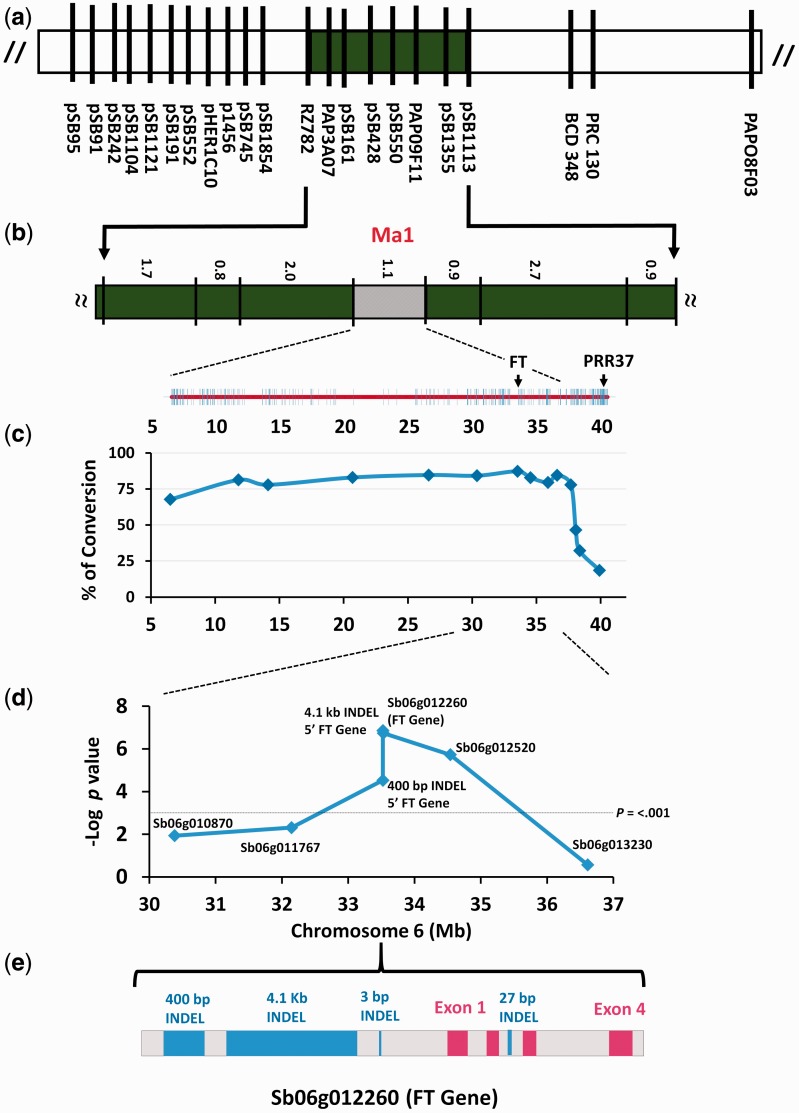
Genetic dissection of Ma1. (a) Linkage mapping of FlrAvgD1 to sorghum chromosome 6 (LG D; Lin et al. 1995); (b) progeny testing in 30 F3 families that were recombinant in the interval containing FlrAvgD1 delineated the locus to a 1.1-cM region including ∼400 genes; (c) analysis of 90 diverse exotic sorghums and their corresponding converted derivatives delimited FlrAvgD1 to a 4.1-Mb region including ∼63 genes. (d) Association genetics implicated Sb06g012260 in short-day flowering conferred by FlrAvgD1. (e) The day-neutral haplotype of Sb06g012260 contains three deletions in the 5′ region, one removing a CAAT box essential to many eukaryotic promoters.
Fig. 2
Fig. 2
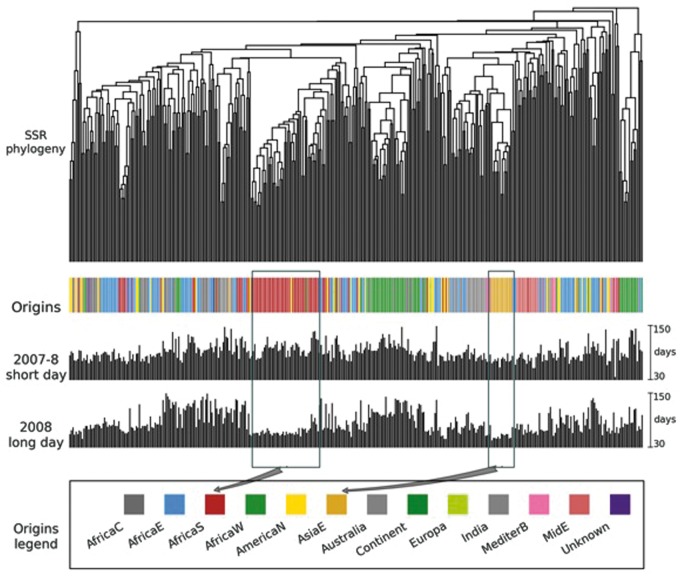
Biogeography of day-neutral flowering. Flowering of 384 diverse sorghums were compared in the 2007–2008 post-rainy (short day), and 2008 rainy (long day) seasons in peninsular India to determine “photoperiod response index” (as described in methods). Hierarchical clustering of sorghum accessions was based on distances between SSR genotypes (number of bands NOT shared). While short-day sorghums experience delayed flowering under long days (>12 h), long days accelerated flowering by ∼30 days for many genotypes from South Africa, the most temperate part of the natural range. East Asian (AsiaE) sorghums, the largest temperate-adapted group from the northern hemisphere, also had accelerated long day flowering.
Fig. 3
Fig. 3
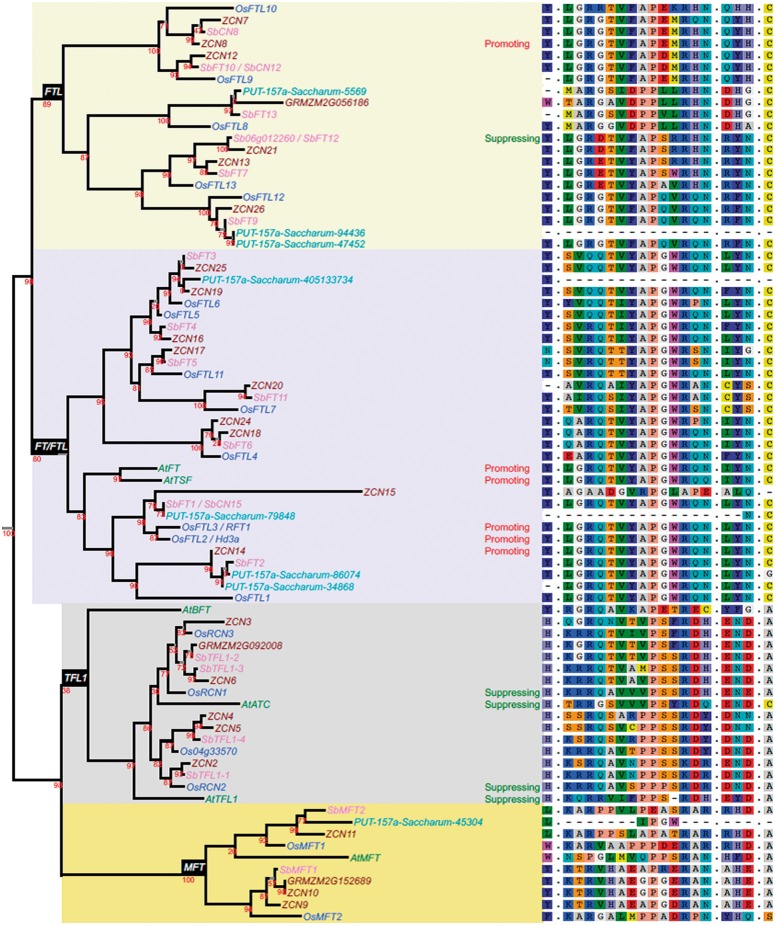
Homologs of Sb06g012260. Six homologs were found in Arabidopsis (prefixed At, including FT; Kardailsky et al. 1999), 19 in rice (Os, including Hd3a; Kojima et al. 2002), 19 in sorghum (Sb), 26 in maize (GRM or AC) and 8 in sugarcane (PUT-157a-Saccharum_officinarum), identified by BLAST from http://www.plantgdb.org/prj/ESTCluster/progress.php>PlantGDB, last accessed June 22, 2016. A phylogenetic tree of inferred homologous protein sequences was made at http://www.phylogeny.fr/, last accessed June 22, 2016, using MUSCLE for alignment and maximum-likelihood (PHYML) to determine the tree. Numbers on internal nodes indicate support values with 1000 bootstrap samples. Four distinct sub-families including FTL-like, FT/FTL-like, TFL1-like and MFT-like proteins, are highlighted on the tree. The impact on flowering (“promoting” or “suppressing”) are shown for several well studied PEBP genes (reviewed in Klintenäs et al. 2012) and for Sb06g012260/SbFT12. The panel on the right along the tree shows multiple alignments based on the Arabidopsis FT protein at amino acid position 85 at exon 2, positions 128–141 (P-loop domain), positions 150–152 and position 164 that were shown to have critical regulatory roles. For full alignments across the entire length of these proteins, see supplementary figure S4, Supplementary Material online.
Fig. 4
Fig. 4
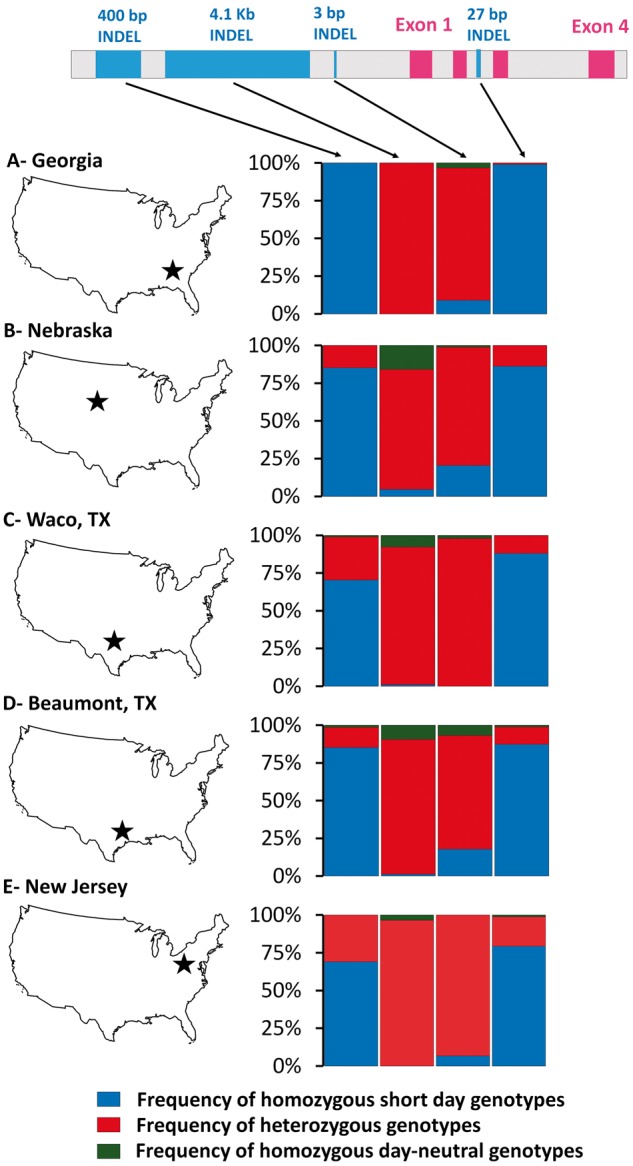
Genotype distributions of five US Johnson grass populations near the Sb06g012260 gene. Among 480 plants sampled equally from GA, TX (2), NE, and NJ populations (Morrell et al. 2005), 81.6% and 88.2% were homozygous for the short-day haplotype (blue bars) at two terminal loci (423 nt, 27 bp intron indels), but only 1.1% and 8.0% at two internal loci (4,186 and 3 nt indels). Homozygosity for day-neutral alleles (green) is nearly absent from the GA sample (from the region where Johnson grass is thought to have been introduced to USA), but exceeds 10% in the two northerly populations (NE, NJ) where day-neutral flowering would be most advantageous, and is intermediate in the two TX populations.
Fig. 5
Fig. 5
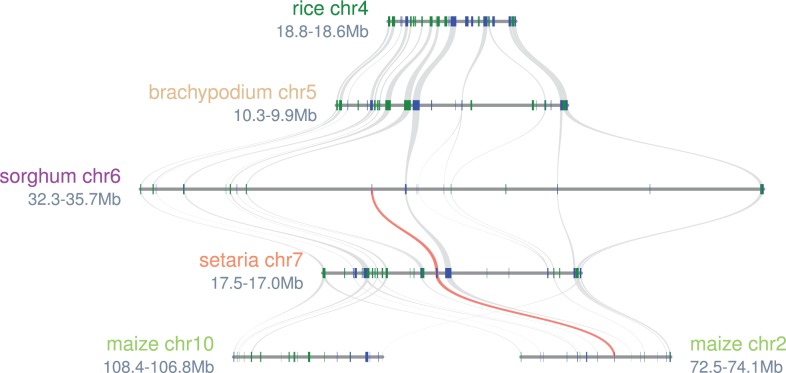
Microsynteny pattern around Sb06g012260 across five grasses. Sb06g012260 and associated orthologs in Setaria and maize are highlighted in red. No syntenic orthologs of Sb06g012260 can be found in rice or Brachypodium. Rectangles represent predicted gene models with colors showing relative orientations (blue: same strand, green: opposite strand). Matching gene pairs are displayed as connecting shades.

References

    1. Allard R. 1956. Formulas and tables to facilitate the calculation of recombination values in heredity. Hilgardia 24:235–278.
    1. Berg JM, Tymoczko JL, Stryer L. 2002. Biochemistry. 5th ed New York: W.H: Freeman.
    1. Bowers JE, Abbey C, Anderson S, Chang C, Draye X, Hoppe AH, Jessup R, Lemke C, Lennington J, Li Z, et al. 2003. A high-density genetic recombination map of sequence-tagged sites for sorghum, as a framework for comparative structural and evolutionary genomics of tropical grains and grasses. Genetics 165:367–386. - PMC - PubMed
    1. Bowers JE, Arias MA, Asher R, Avise JA, Ball RT, Brewer GA, Buss RW, Chen AH, Edwards TM, Estill JC, et al. 2005. Comparative physical mapping links conservation of microsynteny to chromosome structure and recombination in grasses. Proc Natl Acad Sci U S A. 102:13206–13211. - PMC - PubMed
    1. Brady JA. 2006. Sorghum Ma5 and Ma6 maturity genes. College Station (TX: ): Texas A&M University.

Publication types

MeSH terms