


Large herbivores surf waves of green-up during spring
- PMID: 27335416
- PMCID: PMC4936031
- DOI: 10.1098/rspb.2016.0456
Large herbivores surf waves of green-up during spring
Abstract
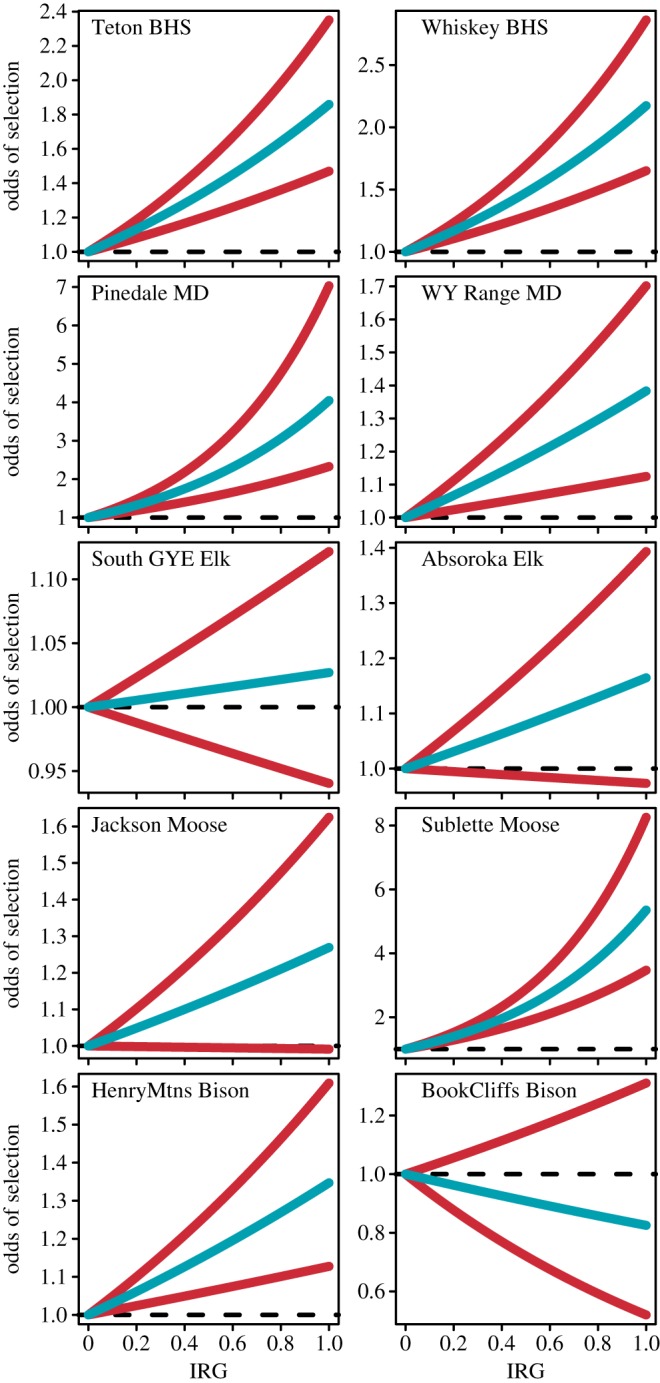
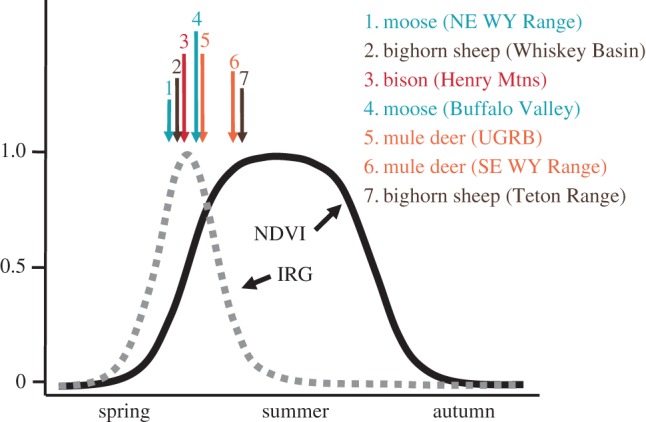
The green wave hypothesis (GWH) states that migrating animals should track or 'surf' high-quality forage at the leading edge of spring green-up. To index such high-quality forage, recent work proposed the instantaneous rate of green-up (IRG), i.e. rate of change in the normalized difference vegetation index over time. Despite this important advancement, no study has tested the assumption that herbivores select habitat patches at peak IRG. We evaluated this assumption using step selection functions parametrized with movement data during the green-up period from two populations each of bighorn sheep, mule deer, elk, moose and bison, totalling 463 individuals monitored 1-3 years from 2004 to 2014. Accounting for variables that typically influence habitat selection for each species, we found seven of 10 populations selected patches exhibiting high IRG-supporting the GWH. Nonetheless, large herbivores selected for the leading edge, trailing edge and crest of the IRG wave, indicating that other mechanisms (e.g. ruminant physiology) or measurement error inherent with satellite data affect selection for IRG. Our evaluation indicates that IRG is a useful tool for linking herbivore movement with plant phenology, paving the way for significant advancements in understanding how animals track resource quality that varies both spatially and temporally.
Keywords: forage maturation hypothesis; green wave hypothesis; habitat selection; large herbivores; migration; normalized difference vegetation index.
© 2016 The Author(s).
Figures
References
-
- Van der Graaf A, Stahl J, Klimkowska A, Bakker JP, Drent RH. 2006. Surfing on a green wave–how plant growth drives spring migration in the Barnacle Goose Branta leucopsis. Ardea 94, 567–577.
-
- Drent R, Ebbinge B, Weijand B. 1978. Balancing the energy budgets of arctic-breeding geese throughout the annual cycle: a progress report. Verh. Ornithol. Ges. Bayern. 23, 239–264.
-
- Fryxell JM. 1991. Forage quality and aggregation by large herbivores. Am. Nat. 138, 478–498. (10.1086/285227) - DOI
MeSH terms
LinkOut - more resources
Full Text Sources
Other Literature Sources
