


Specific KRAS amino acid substitutions and EGFR mutations predict site-specific recurrence and metastasis following non-small-cell lung cancer surgery
- PMID: 27336603
- PMCID: PMC4973154
- DOI: 10.1038/bjc.2016.182
Specific KRAS amino acid substitutions and EGFR mutations predict site-specific recurrence and metastasis following non-small-cell lung cancer surgery
Abstract
Background: We aimed to evaluate whether EGFR mutations (mEGFR) and KRAS amino acid substitutions can predict first site of recurrence or metastasis after non-small-cell lung cancer (NSCLC) surgery.
Methods: Data were reviewed from 481 patients who underwent thoracic surgery for NSCLC between 2007 and 2012.
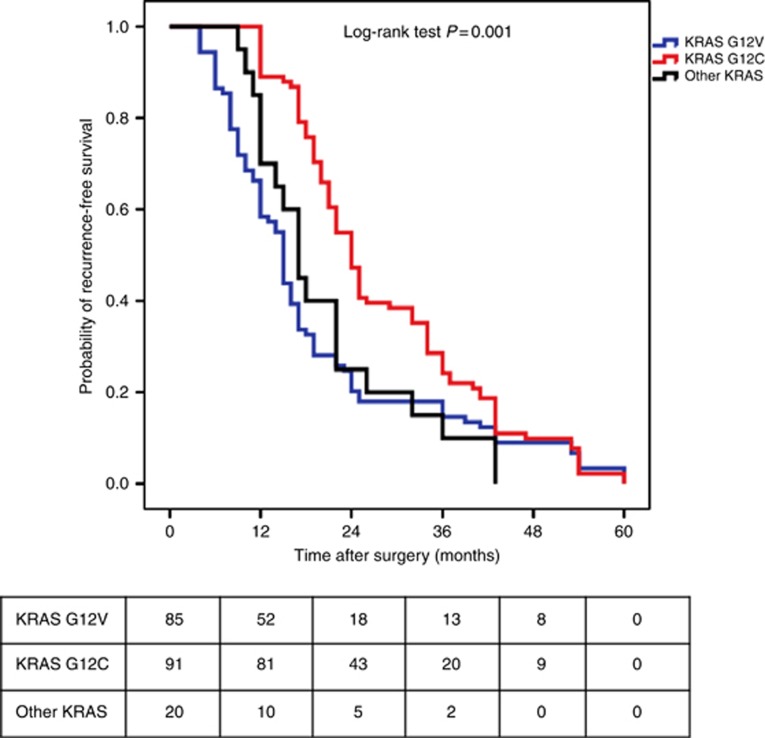
Results: Patients with KRAS G12C developed significantly more bone metastases compared with the remainder of the cohort (59% vs 16%, P<0.0001). This was confirmed in multivariate analysis (MA) (odds ratio (OR): 0.113 (95% confidence interval (CI): 0.055-0.231), P<0.0001). Significantly, more patients with mEGFR developed liver and brain metastases compared with the remainder of the cohort (30% vs 10%, P=0.006; 59% vs 1%, P<0.0001, respectively). These were confirmed in MA (OR: 0.333 (95% CI: 0.095-0.998), P=0.05; OR: 0.032 (95% CI: 0.008-0.135), P<0.0001, respectively). Patients with KRAS G12V developed significantly more pleuro-pericardial metastases compared with the remainder of the cohort (94% vs 12%, P<0.0001). This was confirmed in MA (OR: 0.007 (95% CI: 0.001-0.031), P<0.0001). Wild-type patients developed significantly more lung metastases (35% vs 10%, P<0.0001). This was confirmed in MA (OR: 0.383 (95% CI: 0.193-0.762), P=0.006).
Conclusion: Epidermal growth factor receptor mutation and KRAS amino acid substitutions seem to predict site-specific recurrence and metastasis after NSCLC surgery.
Figures
References
-
- Ashworth AB, Senan S, Palma DA, Riquet M, Ahn YC, Ricardi U, Congedo MT, Gomez DR, Wright GM, Melloni G, Milano MT, Sole CV, De Pas TM, Carter DL, Warner AJ, Rodrigues GB (2014) An individual patient data metaanalysis of outcomes and prognostic factors after treatment of oligometastatic non-small-cell lung cancer. Clin Lung Cancer 15(5): 346–355. - PubMed
-
- Auerbach R (1988) Patterns of tumor metastasis: organ selectivity in the spread of cancer cells. Lab Invest 58(4): 361–364. - PubMed
-
- Bossard N, Velten M, Remontet L, Belot A, Maarouf N, Bouvier AM, Guizard AV, Tretarre B, Launoy G, Colonna M, Danzon A, Molinie F, Troussard X, Bourdon-Raverdy N, Carli PM, Jaffre A, Bessaguet C, Sauleau E, Schvartz C, Arveux P, Maynadie M, Grosclaude P, Esteve J, Faivre J (2007) Survival of cancer patients in France: a population-based study from The Association of the French Cancer Registries (FRANCIM). Eur J Cancer 43(1): 149–160. - PubMed
-
- Charlson ME, Pompei P, Ales KL, MacKenzie CR (1987) A new method of classifying prognostic comorbidity in longitudinal studies: development and validation. J Chronic Dis 40(5): 373–383. - PubMed
-
- D'Angelo SP, Janjigian YY, Ahye N, Riely GJ, Chaft JE, Sima CS, Shen R, Zheng J, Dycoco J, Kris MG, Zakowski MF, Ladanyi M, Rusch V, Azzoli CG (2012) Distinct clinical course of EGFR-mutant resected lung cancers: results of testing of 1118 surgical specimens and effects of adjuvant gefitinib and erlotinib. J Thorac Oncol 7(12): 1815–1822. - PubMed
MeSH terms
Substances
LinkOut - more resources
Full Text Sources
Other Literature Sources
Medical
Research Materials
Miscellaneous
