. 2016 Nov;111(5):790-815.
doi: 10.1037/pspp0000098. Epub 2016 Jun 23.

Genetically-mediated associations between measures of childhood character and academic achievement

Affiliations

Genetically-mediated associations between measures of childhood character and academic achievement

Elliot M Tucker-Drob et al. J Pers Soc Psychol. 2016 Nov.

Abstract

Researchers and the general public have become increasingly intrigued by the roles that systematic tendencies toward thinking, feeling, and behaving might play in academic achievement. Some measures of constructs belonging to this group have been well studied in genetics and psychometrics, while much less is known about measures of other such constructs. The current study focuses on 7 character traits prominently featured in influential intervention-oriented and/or socialization theories of academic achievement: grit, intellectual curiosity, intellectual self-concept, mastery orientation, educational value, intelligence mindset, and test motivation. In a population-based sample of 811 school-aged twins and triplets from the Texas Twin Project, we tested (a) how each measure relates to indices of the Big Five personality traits, (b) how the measures relate to one another, (c) the extent to which each measure is associated with genetic and environmental influences and whether such influences operate through common dimensions of individual differences, and (d) the extent to which genetic and environmental factors mediate the relations between fluid intelligence, character measures, verbal knowledge, and academic achievement. We find moderate relations among the measures that can be captured by a highly heritable common dimension representing a mixture of Openness and Conscientiousness. Moreover, genetically influenced variance in the character measures is associated with multiple measures of verbal knowledge and academic achievement, even after controlling for fluid intelligence. In contrast, environmentally influenced variance in character is largely unrelated to knowledge and achievement outcomes. We propose that character measures popularly used in education may be best conceptualized as indexing facets of personality that are of particular relevance to academic achievement. (PsycINFO Database Record


Figures

Figure 1
Figure 1
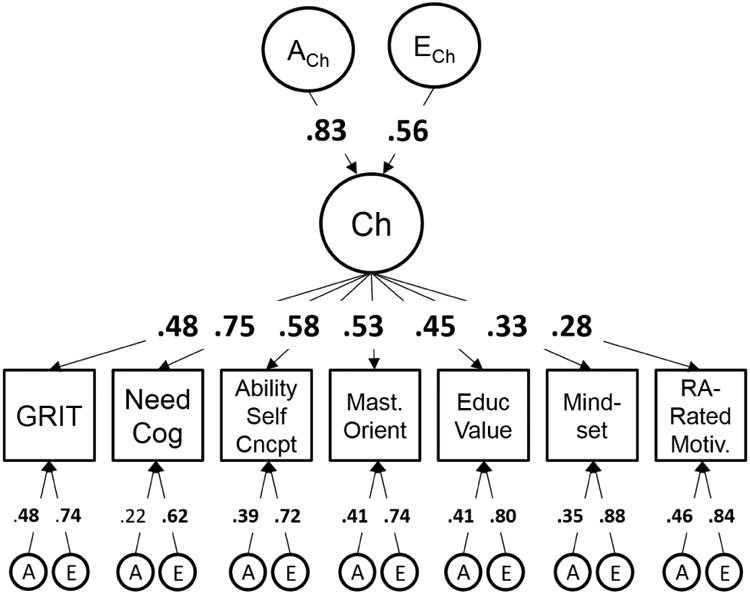
Biometric factor model of character (Ch). All paths are standardized. Bolded parameters are statistically significant at p<.05. All indicators were residualized for age, sex, and age × sex prior to model-fitting.
Figure 2
Figure 2
Biometric factor model of latent Openness (O) and Conscientiousness (C) factors. All paths are standardized. Bolded parameters are statistically significant at p<.05. All indicators were residualized for age, sex, and age × sex prior to model-fitting.
Figure 3
Figure 3
Biometric decomposition of genetic and environmental associations among fluid intelligence (Gf), the character factor (Ch), and a common knowledge/achievement factor (Ach). The red and blue colors represent the key paths of interest: the genetic and environmental links between the character factor and achievement, incremental to fluid intelligence. Dotted lines represent nonsignificant paths. All paths are standardized. All indicators were residualized for age, sex, and age × sex prior to model-fitting.
Figure 4
Figure 4
Biometric decomposition of genetic and environmental associations among fluid intelligence (Gf), the latent Openness factor (O), the latent Conscientiousness factor (C), and a common knowledge/achievement factor (Ach). The red and blue colors represent the key paths of interest: the genetic and environmental links of both Openness and Conscientiousness with achievement, incremental to fluid intelligence. Dotted lines represent nonsignificant paths. All paths are standardized. All indicators were residualized for age, sex, and age × sex prior to model-fitting.
Figure 5
Figure 5
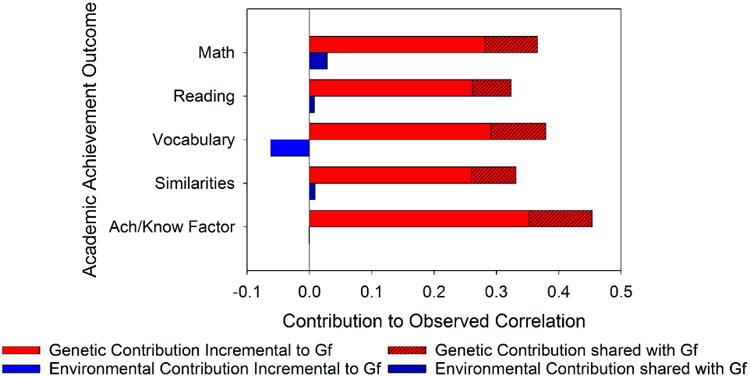
Barplot representing correlations between the single general character factor and the academic achievement outcomes. The sum of the paired red (i.e., genetically-mediated contribution) and blue (i.e., environmentally-mediated contribution) bars represents the model-implied phenotypic correlation. The cross-hatched portion of the red and blue bars represents genetic and environmental contributions to associations between character and achievement shared with fluid intelligence. The solid portion of the red and blue bars represents genetic and environmental contributions to associations between the character and achievement incremental to fluid intelligence.
Figure 6
Figure 6
Barplot representing correlations between the character/BFI scores and the latent achievement/knowledge factor. The sum of the paired red (i.e., genetically-mediated contribution) and blue (i.e., environmentally-mediated contribution) bars represents the model-implied phenotypic correlation. The cross-hatched portion of the red and blue bars represents genetic and environmental contributions to associations between character and achievement shared with fluid intelligence. The solid portion of the red and blue bars represents genetic and environmental contributions to associations between the character and achievement incremental to fluid intelligence.

References

    1. Asparouhov T, Muthén B. Exploratory structural equation modeling. Structural Equation Modeling: A Multidisciplinary Journal. 2009;16:397–438.
    1. Blackwell LS, Trzesniewski KH, Dweck CS. Implicit theories of intelligence predict achievement across an adolescent transition: A longitudinal study and an intervention. Child Development. 2007;78:246–263. - PubMed
    1. Bouchard TJ. Experience producing drive theory: How genes drive experience and shape personality. Acta Paediatrica. 1997;86:60–64. - PubMed
    1. Bouchard TJ, McGue M. Genetic and environmental influences on human psychological differences. Journal of Neurobiology. 2003;54:4–45. - PubMed
    1. Briley DA, Domiteaux M, Tucker-Drob EM. Achievement-relevant personality: Relations with the Big Five and validation of an efficient instrument. Learning and Individual Differences. 2014;32:26–39. - PMC - PubMed

Publication types