


Molecular Cloning of HbPR-1 Gene from Rubber Tree, Expression of HbPR-1 Gene in Nicotiana benthamiana and Its Inhibition of Phytophthora palmivora
- PMID: 27337148
- PMCID: PMC4940168
- DOI: 10.1371/journal.pone.0157591
Molecular Cloning of HbPR-1 Gene from Rubber Tree, Expression of HbPR-1 Gene in Nicotiana benthamiana and Its Inhibition of Phytophthora palmivora
Abstract
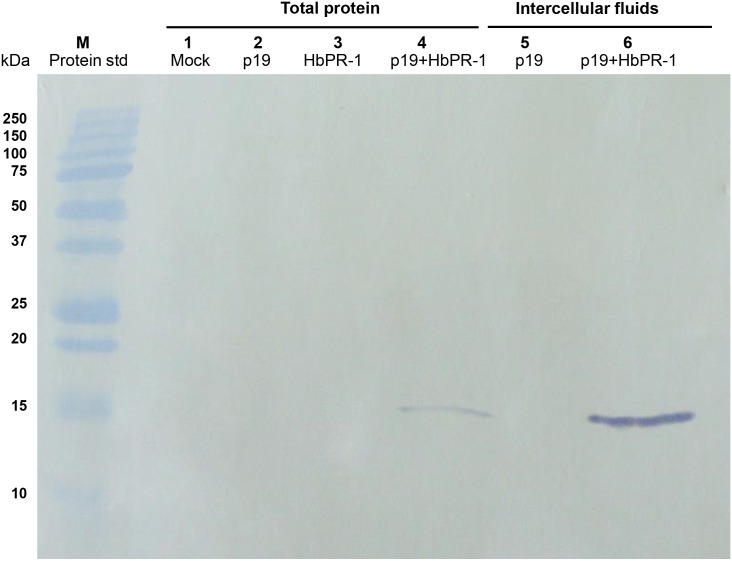
This is the first report to present a full-length cDNA (designated HbPR-1) encoding a putative basic HbPR-1 protein from rubber tree (Hevea brasiliensis) treated with salicylic acid. It was characterized and also expressed in Nicotiana benthamiana using Agrobacterium-mediated transient gene expression system in order to investigate the role of HbPR-1 gene in rubber tree against its oomycete pathogen Phytopthora palmivora and to produce recombinant HbPR-1 protein for microbial inhibition test. The HbPR-1 cDNA was 647 bp long and contained an open reading frame of 492 nucleotides encoding 163 amino acid residues with a predicted molecular mass of 17,681 Da and an isoelectric point (pI) of 8.56, demonstrating that HbPR-1 protein belongs to the basic PR-1 type. The predicted 3D structure of HbPR-1 was composed of four α-helices, three β-sheets, seven strands, and one junction loop. Expression and purification of recombinant HbPR-1 protein were successful using Agrobacterium-mediated transient expression and one-step of affinity chromatography. Heterologous expression of HbPR-1 in N. benthamiana reduced necrosis areas which were inoculated with P. palmivora zoospores, indicating that the expressed HbPR-1 protein played an important role in plant resistance to pathogens. The purified recombinant HbPR-1 protein was found to inhibit 64% of P. palmivora zoospore germination on a water agar plate compared with control, suggesting that it was an antimicrobial protein against P. palmivora.
Conflict of interest statement
Figures




References
-
- Sarowar S, Kim YJ, Kim EN, Kim KD, Hwang BK, Islam R, et al. Overexpression of a pepper basic pathogenesis-related protein 1 gene in tobacco plants enhances resistance to heavy metal and pathogen stresses. Plant Cell Rep. 2005; 24: 216–224. - PubMed
-
- Liu Q, Xue Q. Computational identification of novel PR-1-type genes in Oryza sativa. J. Genet. 2006; 85(3): 193–198. - PubMed
-
- Kim YJ, Hwang BK. Pepper gene encoding a basic pathogenesis-related 1 protein is pathogen and ethylene inducible. Physiol. plant. 2000; 108: 51–60.
-
- Yang RH, Tang K, Liu HT, Huang WD. Effect of salicylic acid on jasmonic acid- related defense response of pea seedlings to wounding. Sci. Hortic. 2011; 128: 166–173.
MeSH terms
Substances
LinkOut - more resources
Full Text Sources
Other Literature Sources
Research Materials
Miscellaneous
