Review
. 2016 Jun;4(3):10.1128/microbiolspec.VMBF-0019-2015.
doi: 10.1128/microbiolspec.VMBF-0019-2015.

Sociomicrobiology and Pathogenic Bacteria

Affiliations
Review

Sociomicrobiology and Pathogenic Bacteria

Joao B Xavier. Microbiol Spectr. 2016 Jun.

Abstract

The study of microbial pathogenesis has been primarily a reductionist science since Koch's principles. Reductionist approaches are essential to identify the causal agents of infectious disease, their molecular mechanisms of action, and potential drug targets, and much of medicine's success in the treatment of infectious disease stems from that approach. But many bacteria-caused diseases cannot be explained by a single bacterium. Several aspects of bacterial pathogenesis will benefit from a more holistic approach that takes into account social interaction among bacteria of the same species and between species in consortia such as the human microbiome. The emerging discipline of sociomicrobiology provides a framework to dissect microbial interactions in single and multi-species communities without compromising mechanistic detail. The study of bacterial pathogenesis can benefit greatly from incorporating concepts from other disciplines such as social evolution theory and microbial ecology, where communities, their interactions with hosts, and with the environment play key roles.


Figures
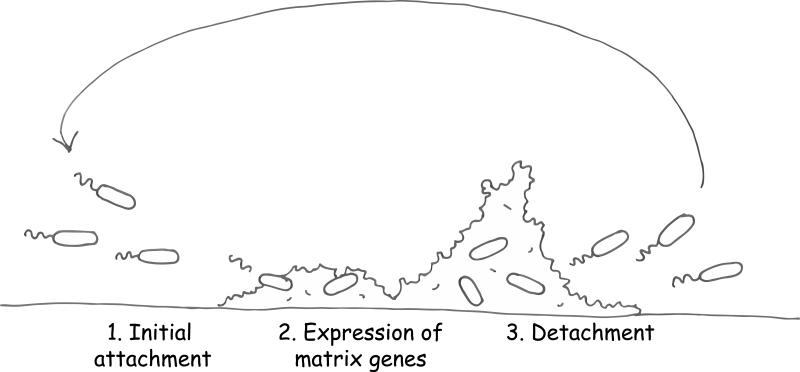
Figure 1
Figure 1
A model of biofilm development and life cycle proposed in [18]. Planktonic bacteria attach to surfaces, initiate expression of biofilm genes such as synthesis of extracellular polymeric matrices and grow a biofilm. Cell can detach from a mature biofilm back to the planktonic state, closing the biofilm life cycle.
Figure 2
Figure 2
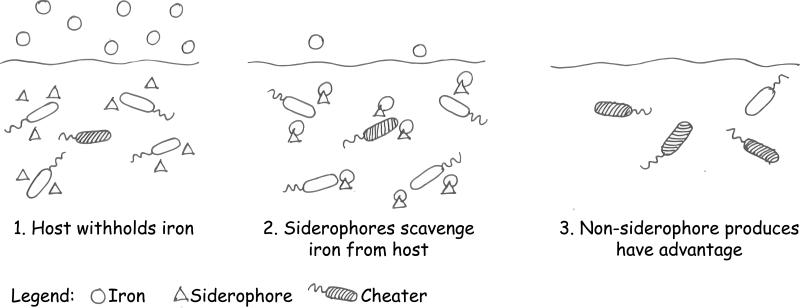
Siderophore production as a cooperative trait [74]. Bacterial pathogens such as P. aeruginosa can secrete siderophores to scavenge iron in iron-limited environments such as host tissues (panel 1). The siderophores have high affinity to iron and can be taken up by bacteria including non-siderophore producers that still have the siderophores receptors (panel 2). Non-siderophore producers exploit wild-type producers by not paying the cost of siderophores production, but this can lead to the extinction of siderophores production in the population (panel 3).
Figure 3
Figure 3
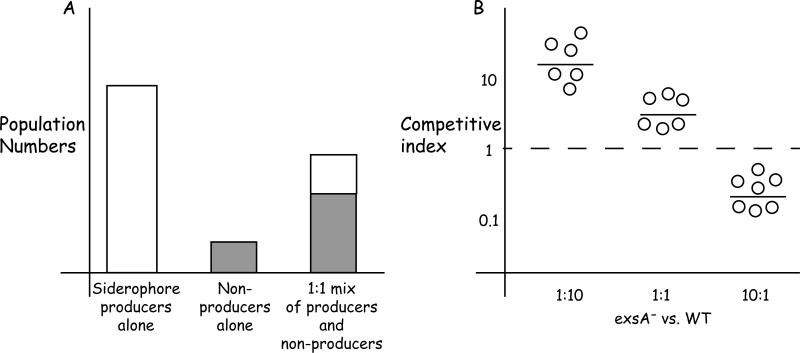
Laboratory experiments that reveal the hallmarks of cheating. A) Siderophore producing P. aeruginosa grow reasonably well in iron-depleted media by increasing iron uptake thanks to sideophore scavenging (Fig. 2). Non-siderophore producers (cheaters) grow poorly in the same environment when alone, but do better when mixed with producers by not paying the cost of siderophore production. The advantage of non-producers comes at the expense of the whole population [74]. B) The competitive advantage of cheaters decreases as their frequency increases because there are less cooperators to exploit in the population. This example is taken from a study of type III secretion systems in where P. aeruginosa where exsA mutants lacking the type III system could cheat over wild-type bacteria (WT), but their measured competitive index decreased as cheater numbers increased in the population [53].
Figure 4
Figure 4
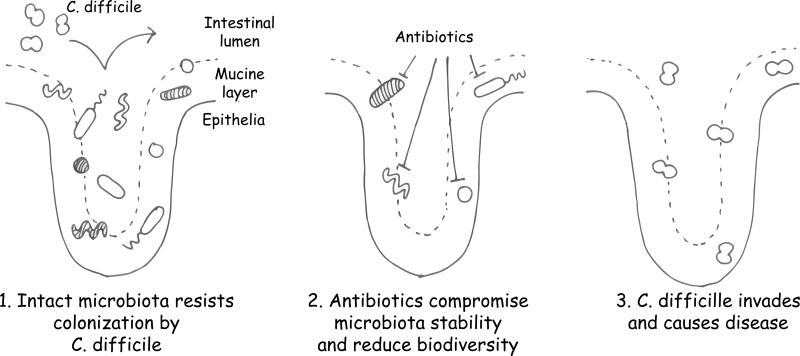
Colonization resistance in the gut microbiota and the harmful effect of antibiotics. 1) The gut microbiota can resist colonization by pathogens such as Clostridium difficile. 2) Antibiotics disrupt the ecology of the commensal microbiota. 3) Antibiotic challenged microbiota open the way to colonization.

References

    1. Peterson J, Garges S, Giovanni M, McInnes P, Wang L, Schloss JA, Bonazzi V, McEwen JE, Wetterstrand KA, Deal C. The NIH human microbiome project. Genome research. 2009;19(12):2317–2323. - PMC - PubMed
    1. Turnbaugh PJ, Ley RE, Hamady M, Fraser-Liggett CM, Knight R, Gordon JI. The human microbiome project. Nature. 2007;449(7164):804–810. - PMC - PubMed
    1. A framework for human microbiome research. Nature. 2012;486(7402):215–221. - PMC - PubMed
    1. Eckburg PB, Bik EM, Bernstein CN, Purdom E, Dethlefsen L, Sargent M, Gill SR, Nelson KE, Relman DA. Diversity of the Human Intestinal Microbial Flora. Science. 2005;308(5728):1635–1638. - PMC - PubMed
    1. Turnbaugh PJ, Hamady M, Yatsunenko T, Cantarel BL, Duncan A, Ley RE, Sogin ML, Jones WJ, Roe BA, Affourtit JP. A core gut microbiome in obese and lean twins. nature. 2009;457(7228):480–484. - PMC - PubMed

Publication types

LinkOut - more resources