


Two-year-olds interpret novel phonological neighbors as familiar words
- PMID: 27337510
- PMCID: PMC4920137
- DOI: 10.1037/dev0000114
Two-year-olds interpret novel phonological neighbors as familiar words
Abstract
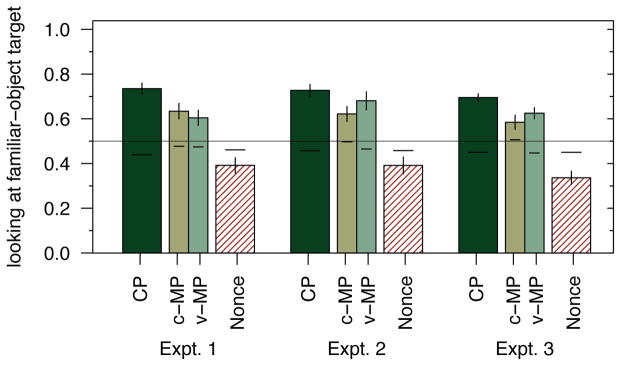
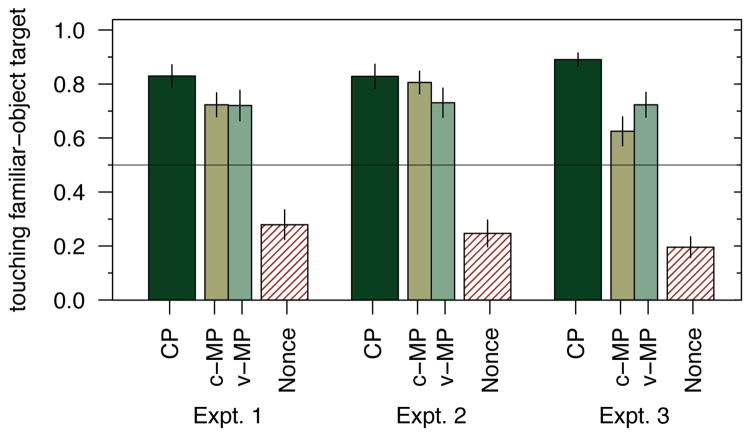
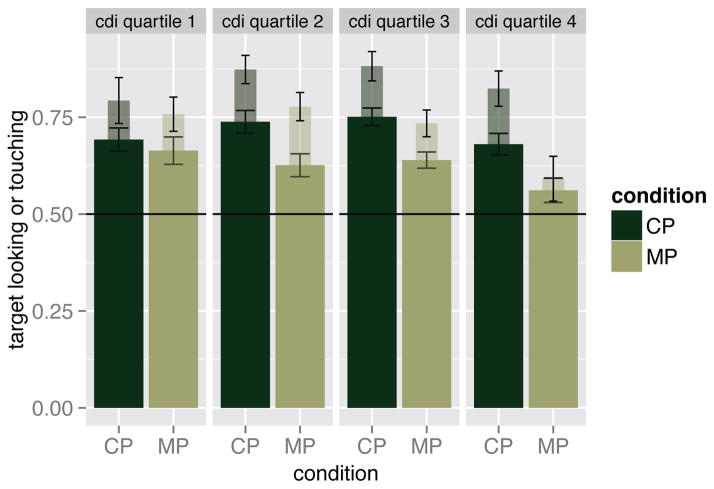
When children hear a novel word in a context presenting a novel object and a familiar one, they usually assume that the novel word refers to the novel object. In a series of experiments, we tested whether this behavior would be found when 2-year-olds interpreted novel words that differed phonologically from familiar words in only 1 sound, either a vowel or consonant. Under these conditions children almost always chose the familiar object, though examination of eye movements showed that children did detect the tested phonological distinctions. Thus, children discounted perceptible phonological variations when doing so permitted a resolution of the speaker's meaning without postulating a new word. Children with larger vocabularies made novel-word interpretations more often than children with smaller vocabularies did. The results suggest that although young children do interpret speech in terms of a learned phonological system, this does not mean that children assume that phonological distinctions imply lexical distinctions. (PsycINFO Database Record
(c) 2016 APA, all rights reserved).
Figures
References
-
- Bailey TM, Plunkett K. Phonological specificity in early words. Cognitive Development. 2002;17:1265–1282. doi: 10.1016/s0885-2014(02)00116-8. - DOI
-
- Creel SC, Aslin RN, Tanenhaus MK. Acquiring an artificial lexicon: segment type and order information in early lexical entries. Journal of Memory and Language. 2006;54:1–19. doi: 10.1016/j.jml.2005.09.003. - DOI
MeSH terms
Grants and funding
LinkOut - more resources
Full Text Sources
Other Literature Sources
