


Body mass index distribution in rheumatoid arthritis: a collaborative analysis from three large German rheumatoid arthritis databases
- PMID: 27338263
- PMCID: PMC4918111
- DOI: 10.1186/s13075-016-1043-9
Body mass index distribution in rheumatoid arthritis: a collaborative analysis from three large German rheumatoid arthritis databases
Abstract
Background: METARTHROS (Metabolic impact on joint and bone disease) is a nationwide German network to investigate the overlap between inflammatory and metabolic diseases. The objective of this study was to compare the body mass index (BMI) distribution in patients with early and established rheumatoid arthritis (RA) with data from the general population, and to evaluate the association of BMI with patient characteristics and clinical markers.
Methods: The BMI distribution was examined with data collected at inclusion of patients in the early arthritis cohort CAPEA, the biologics register RABBIT, and the National database of the German Collaborative Arthritis Centers. A data source with a representative sample of the German population (German Ageing Survey) was used as a comparator. BMI categories of <18.5 kg/m(2) (underweight), 18.5 to <25 kg/m(2) (normal weight), 25 to <30 kg/m(2) (overweight), and ≥30 kg/m(2) (obese) were used. Patients were stratified by age and sex, and compared to controls from the German Ageing Survey. Associations between BMI and markers of disease activity were analysed with non-parametric tests and linear models.
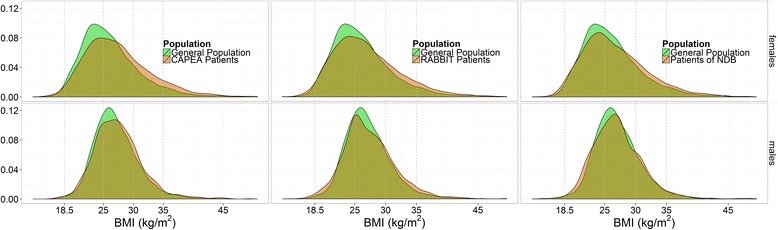
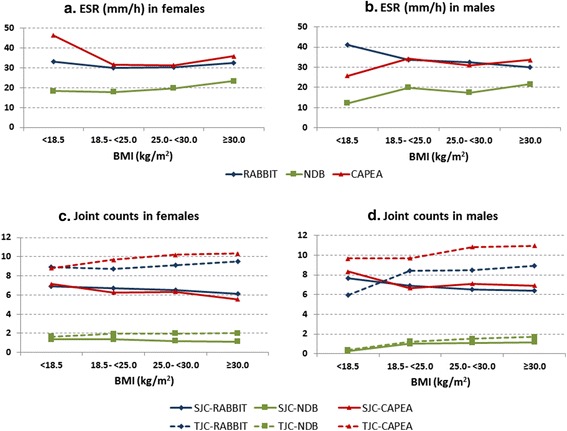
Results: Data from 1207 (CAPEA), 12,230 (RABBIT), and 3424 (National database) RA patients and 6202 population controls were evaluated. The mean age was 56, 56, 62, and 62 years, respectively, the mean disease duration was 13 weeks, 9.9 years, and 13.5 years, respectively, and the mean disease activity score (DAS28) was 5.1, 5.2, and 3.1, respectively. In all RA cohorts, obesity was more frequent (23.8 %, 23.4 %, 21.4 %, respectively) than in controls (18.2 %). This applied to all age groups <70 years, was independent of disease duration, and was more pronounced in females. In all cohorts, the age at RA onset was associated with BMI, being higher in overweight/obese patients compared to normal-weight patients. Current smoking was negatively associated with BMI. Linear analyses revealed increased erythrocyte sedimentation rate (ESR) values in underweight and obese females, and an increasing disparity between tender joint counts (TJCs) and swollen joint counts (SJCs) in higher BMI categories.
Conclusions: Compared to the general population, a higher prevalence of obesity was observed in all RA cohorts. The dominance of obesity in females and the different behaviour of disease activity markers in relation to the BMI in females indicate that additional parameters need to be considered when analysing the impact of obesity on inflammation in RA.
Keywords: Body mass index; Epidemiology; Obesity; Rheumatoid arthritis.
Figures
Comment in
-
High body mass index in rheumatoid arthritis: why we should promote physical activity.Arthritis Res Ther. 2017 Jan 10;19(1):2. doi: 10.1186/s13075-016-1209-5. Arthritis Res Ther. 2017. PMID: 28073369 Free PMC article. No abstract available.
References
-
- Elkan AC, Engvall IL, Cederholm T, et al. Rheumatoid cachexia, central obesity and malnutrition in patients with low-active rheumatoid arthritis: feasibility of anthropometry, Mini Nutritional Assessment and body composition techniques. Eur J Nutr. 2009;48:315–22. doi: 10.1007/s00394-009-0017-y. - DOI - PubMed
Publication types
MeSH terms
LinkOut - more resources
Full Text Sources
Other Literature Sources
Medical
Miscellaneous
