


Nutraceuticals and Bioactive Components from Fish for Dyslipidemia and Cardiovascular Risk Reduction
- PMID: 27338419
- PMCID: PMC4926072
- DOI: 10.3390/md14060113
Nutraceuticals and Bioactive Components from Fish for Dyslipidemia and Cardiovascular Risk Reduction
Abstract
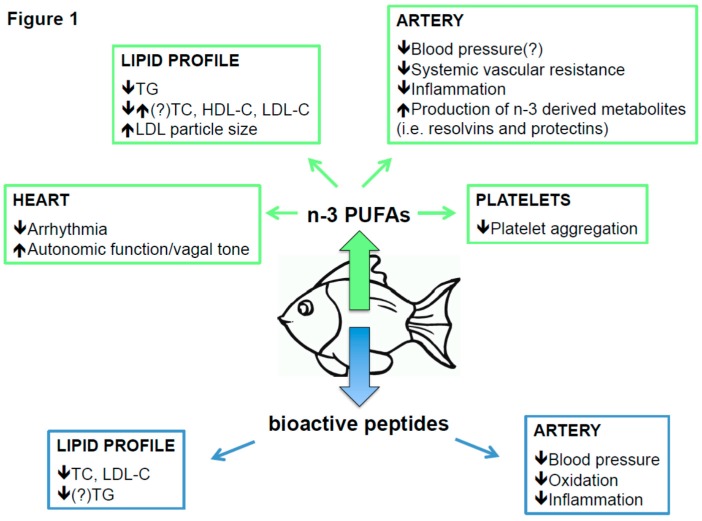
Cardiovascular disease remains the most common health problem in developed countries, and residual risk after implementing all current therapies is still high. Permanent changes in lifestyle may be hard to achieve and people may not always be motivated enough to make the recommended modifications. Emerging research has explored the application of natural food-based strategies in disease management. In recent years, much focus has been placed on the beneficial effects of fish consumption. Many of the positive effects of fish consumption on dyslipidemia and heart diseases have been attributed to n-3 polyunsaturated fatty acids (n-3 PUFAs, i.e., EPA and DHA); however, fish is also an excellent source of protein and, recently, fish protein hydrolysates containing bioactive peptides have shown promising activities for the prevention/management of cardiovascular disease and associated health complications. The present review will focus on n-3 PUFAs and bioactive peptides effects on cardiovascular disease risk factors. Moreover, since considerable controversy exists regarding the association between n-3 PUFAs and major cardiovascular endpoints, we have also reviewed the main clinical trials supporting or not this association.
Keywords: cardiovascular disease; cholesterol; clinical trials; fish proteins; hypertension; n-3 polyunsaturated fatty acids; triglycerides.
Figures
References
-
- Mozaffarian D., Benjamin E.J., Go A.S., Arnett D.K., Blaha M.J., Cushman M., de Ferranti S., Despres J.P., Fullerton H.J., Howard V.J., et al. Heart disease and stroke statistics-2015 update: A report from the American Heart Association. Circulation. 2015;131:e29–e322. doi: 10.1161/CIR.0000000000000152. - DOI - PubMed
Publication types
MeSH terms
Substances
LinkOut - more resources
Full Text Sources
Other Literature Sources
Research Materials
