Review
. 2016 Jun 22;8(6):174.
doi: 10.3390/v8060174.

Phleboviruses and the Type I Interferon Response

Affiliations
Review

Phleboviruses and the Type I Interferon Response

Jennifer Deborah Wuerth et al. Viruses. .

Abstract

The genus Phlebovirus of the family Bunyaviridae contains a number of emerging virus species which pose a threat to both human and animal health. Most prominent members include Rift Valley fever virus (RVFV), sandfly fever Naples virus (SFNV), sandfly fever Sicilian virus (SFSV), Toscana virus (TOSV), Punta Toro virus (PTV), and the two new members severe fever with thrombocytopenia syndrome virus (SFTSV) and Heartland virus (HRTV). The nonstructural protein NSs is well established as the main phleboviral virulence factor in the mammalian host. NSs acts as antagonist of the antiviral type I interferon (IFN) system. Recent progress in the elucidation of the molecular functions of a growing list of NSs proteins highlights the astonishing variety of strategies employed by phleboviruses to evade the IFN system.

Keywords: NSs protein; PKR; RIG-I; interferon; phlebovirus.


Figures
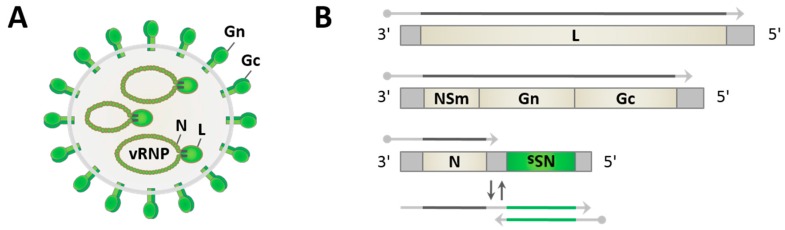
Figure 1
Figure 1
Prototypic phlebovirus virion and genome organization. (A) Virus particles contain the pseudocircularized tripartite single-stranded RNA genome, packaged into virus-sense RNPs (vRNPs) by nucleocapsid protein N and associated with the viral RNA-dependent RNA polymerase (RdRp) L, within a lipid envelope covered by heterodimers of glycoproteins Gn and Gc; and (B) the three viral genome segments large (L), medium (M) (both being purely negative-sense), and small (S) (ambisense) code for the structural proteins L, the Gn and Gc, and N, respectively. Viral mRNAs contain a 5′-cap (dot) and short heterogenous host-derived sequences. mRNAs transcribed from genomic RNAs are shown as grey arrows. The nonstructural protein NSs mRNA (green arrow) is synthesized from antigenomic RNA (two-colored arrow). Dipteran-borne phleboviruses also encode a nonstructural protein on the M segment (NSm).
Figure 2
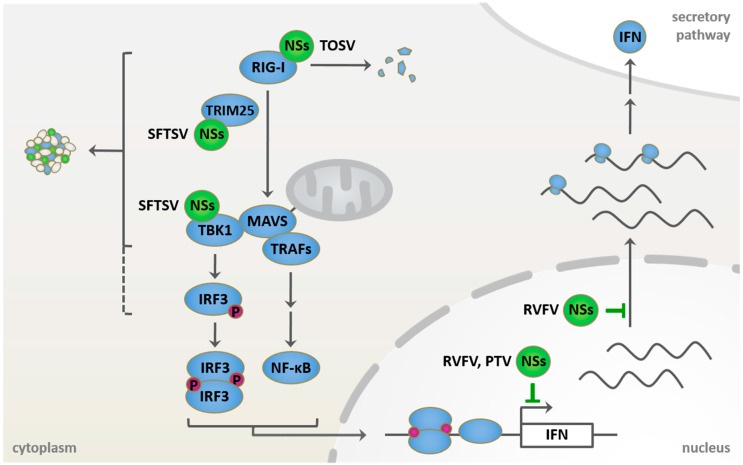
Figure 2
Known host targets of phleboviral NSs proteins in retinoic acid-inducible gene 1 (RIG-I) signaling and type I IFN induction. Incoming phleboviral RNPs are sensed by RIG-I, potentially leading to interferon induction via mitochondrial antiviral signaling (MAVS)-mediated activation of the transcription factors interferon regulatory factor 3 (IRF3) and nuclear factor kappa-light-chain-enhancer of activated B cells (NF-κB). NSs proteins, however, mediate the escape from the induction and the antiviral effects of the IFN system. Rift Valley fever virus (RVFV) NSs acts in the nucleus, where it blocks both the transcription and the export of host mRNAs. Toscana virus (TOSV) NSs localizes to the cytoplasm, where it interacts with and induces proteasomal degradation of RIG-I. Characteristic cytoplasmic structures are formed by severe fever with thrombocytopenia syndrome virus (SFTSV) NSs and serve as site of sequestration for several signaling factors of the RIG-I pathway. Punta Toro virus (PTV) NSs also inhibits host transcription.

References

    1. Walter C.T., Barr J.N. Recent advances in the molecular and cellular biology of bunyaviruses. J. Gen. Virol. 2011;92:2467–2484. doi: 10.1099/vir.0.035105-0. - DOI - PubMed
    1. International Committee on Taxonomy of Viruses Phleboviruses. [(accessed on 15 July 2012)]. Available online: http://ictvonline.org/virusTaxonomy.asp?version=2012.
    1. Alkan C., Alwassouf S., Piorkowski G., Bichaud L., Tezcan S., Dincer E., Ergunay K., Ozbel Y., Alten B., de Lamballerie X., et al. Isolation, genetic characterization, and seroprevalence of Adana virus, a novel phlebovirus belonging to the Salehabad virus complex, in Turkey. J. Virol. 2015;89:4080–4091. doi: 10.1128/JVI.03027-14. - DOI - PMC - PubMed
    1. Alkan C., Kasap O.E., Alten B., de Lamballerie X., Charrel R.N. Sandfly-borne phlebovirus isolations from Turkey: New insight into the sandfly fever Sicilian and sandfly fever Naples species. PLoS Negl. Trop. Dis. 2016;10:174. doi: 10.1371/journal.pntd.0004519. - DOI - PMC - PubMed
    1. Amaro F., Hanke D., Ze-Ze L., Alves M.J., Becker S.C., Hoper D. Genetic characterization of Arrabida virus, a novel phlebovirus isolated in South Portugal. Virus Res. 2016;214:19–25. doi: 10.1016/j.virusres.2016.01.004. - DOI - PubMed

Publication types

MeSH terms

LinkOut - more resources