


Recurrent primary sclerosing cholangitis in the Adult-to-Adult Living Donor Liver Transplantation Cohort Study: Comparison of risk factors between living and deceased donor recipients
- PMID: 27339253
- PMCID: PMC4996691
- DOI: 10.1002/lt.24496
Recurrent primary sclerosing cholangitis in the Adult-to-Adult Living Donor Liver Transplantation Cohort Study: Comparison of risk factors between living and deceased donor recipients
Abstract
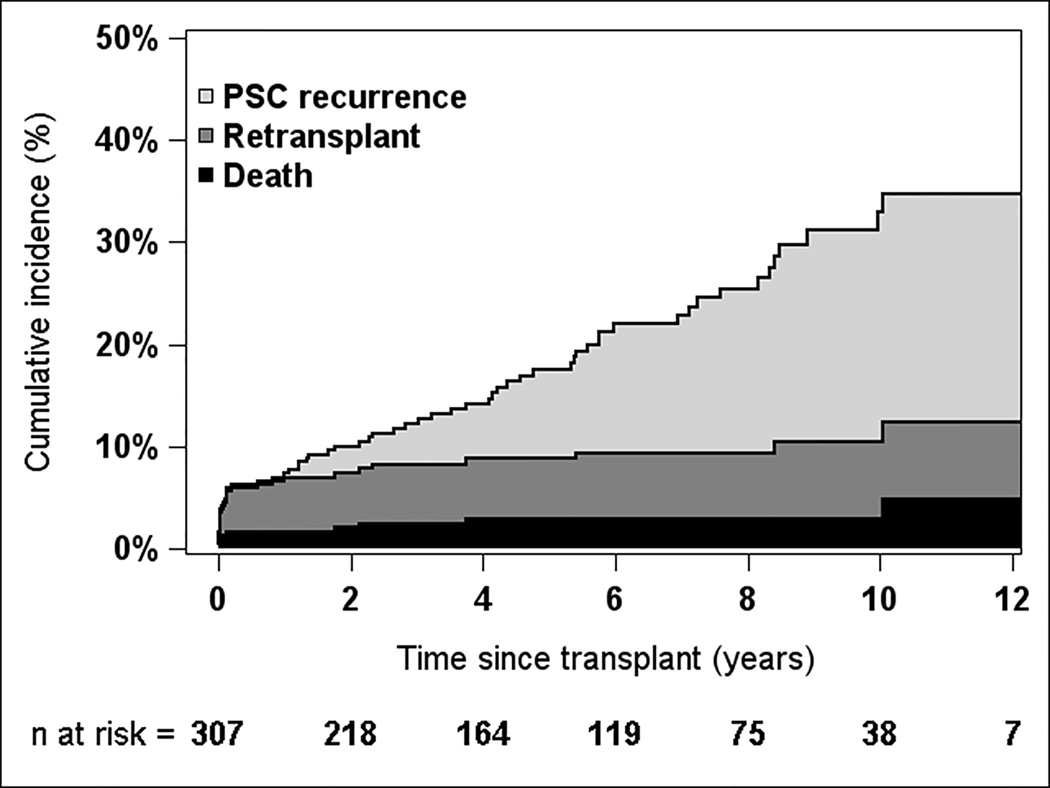
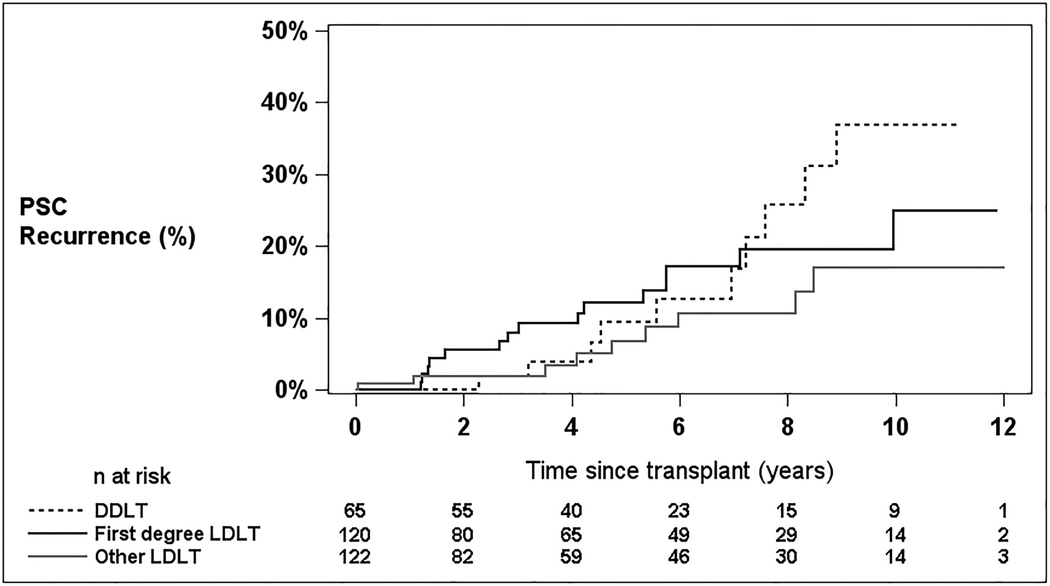
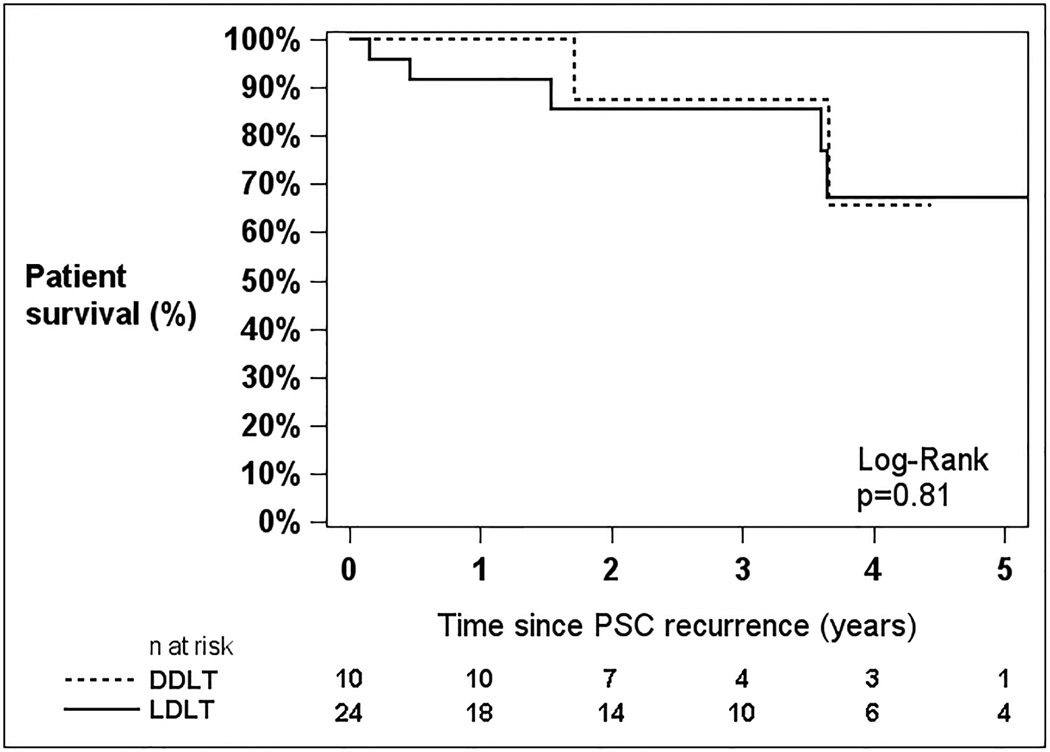
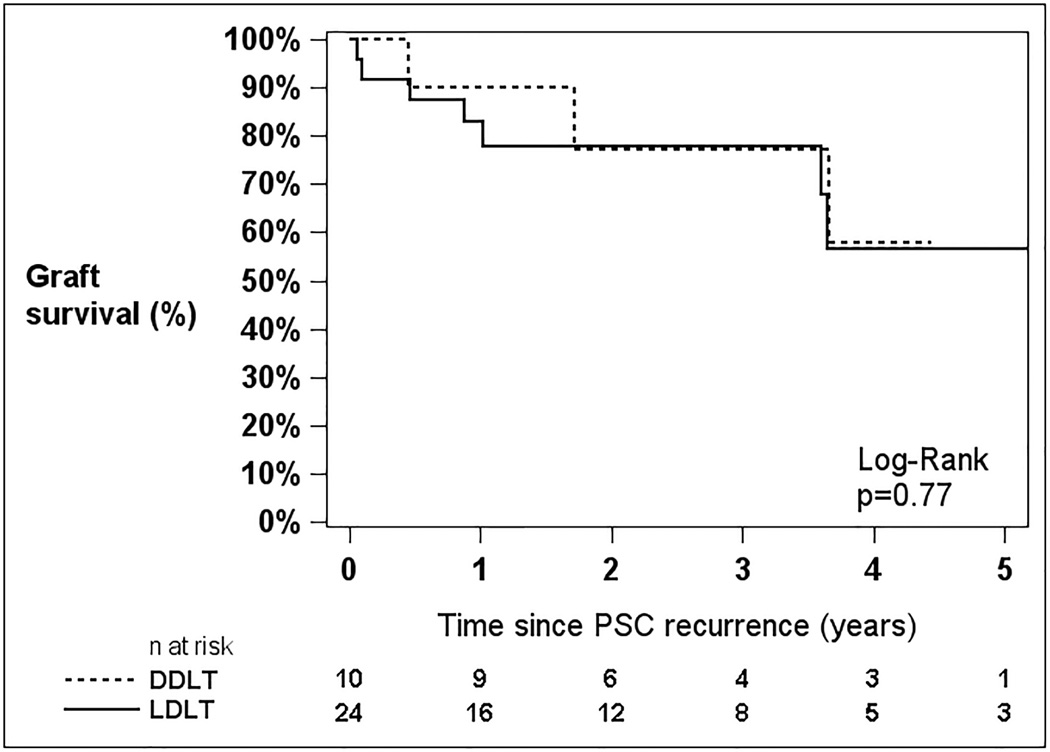
Primary sclerosing cholangitis (PSC) recurs in 15%-25% of patients transplanted for PSC. In the United States, PSC transplant patients are more likely to receive an organ from a living donor (LD) than patients without PSC. Our aims were to (1) compare risk of PSC recurrence in LD versus deceased donor recipients and (2) identify risk factors for PSC recurrence. There were 241 living donor liver transplantations (LDLTs) and 65 deceased donor liver transplantation (DDLT) patients transplanted between 1998 and 2013 enrolled in the Adult-to-Adult Living Donor Liver Transplantation Cohort Study who were evaluated. PSC recurrence risk for LDLT and DDLT recipients was compared using Kaplan-Meier survival curves and log-rank tests. Cox models were used to evaluate PSC risk factors. Overall PSC recurrence probabilities were 8.7% and 22.4% at 5 and 10 years after liver transplantation (LT), respectively. The risk of PSC recurrence was not significantly different for DDLT versus LDLT recipients (P = 0.36). For DDLT versus LDLT recipients, unadjusted 5- and 10-year PSC recurrence was 9.4% versus 9.5% and 36.9% versus 21.1%. Higher laboratory Model for End-Stage Liver Disease (MELD) score at LT, onset of a biliary complication, cholangiocarcinoma, and higher donor age were associated with increased risks of PSC recurrence: for MELD (hazard ratio [HR] = 1.06; 95% confidence interval [CI] 1.02-1.10 per MELD point, P = 0.002); for biliary complication (HR, 2.82; 95% CI, 1.28-6.25; P = 0.01); for cholangiocarcinoma (HR, 3.98; 95% CI, 1.43-11.09; P = 0.008); for donor age (per 5-years donor age; HR, 1.17; 95% CI, 1.02-1.35; P = 0.02). Factors not significantly associated with PSC recurrence included the following: first-degree relative donor (P = 0.11), post-LT cytomegalovirus infection (P = 0.38), and acute rejection (P = 0.22). Risk of recurrent PSC was not significantly different for DDLT and LDLT recipients. Biliary complications, cholangiocarcinoma, MELD, and donor age were significantly associated with risk of PSC recurrence. Liver Transplantation 22 1214-1222 2016 AASLD.
© 2016 by the American Association for the Study of Liver Diseases.
Conflict of interest statement
The authors declare no conflicts of interest.
Figures
References
-
- Egawa H, Ueda Y, Ichida T, Teramukai S, Nakanuma Y, Onishi S, et al. Risk factors for recurrence of primary sclerosing cholangitis after living donor liver transplantation in Japanese registry. Am J Transplant. 2011;11(3):518–527. - PubMed
-
- Graziadei IW. Recurrence of primary sclerosing cholangitis after liver transplantation. Liver Transpl. 2002;8(7):575–581. - PubMed
-
- Weissmuller TJ, Wedenmeyer J, Kubicka S, Strassburg CP, Manns MP. The challenges in primary sclerosing cholangitis – aetiopathogenesis, autoimmunity, management and malignancy. J Hepatol. 2008;48(Suppl1):S38–S57. - PubMed
Publication types
MeSH terms
Grants and funding
- U01 DK062496/DK/NIDDK NIH HHS/United States
- U01 DK062536/DK/NIDDK NIH HHS/United States
- U01 DK062531/DK/NIDDK NIH HHS/United States
- U01 DK062498/DK/NIDDK NIH HHS/United States
- U01 DK062444/DK/NIDDK NIH HHS/United States
- U01 DK085515/DK/NIDDK NIH HHS/United States
- U01 DK062505/DK/NIDDK NIH HHS/United States
- U01 DK062484/DK/NIDDK NIH HHS/United States
- U01 DK062494/DK/NIDDK NIH HHS/United States
- U01 DK062483/DK/NIDDK NIH HHS/United States
- U01 DK062467/DK/NIDDK NIH HHS/United States
- U01 DK085587/DK/NIDDK NIH HHS/United States
- U01 DK085563/DK/NIDDK NIH HHS/United States
LinkOut - more resources
Full Text Sources
Other Literature Sources
Medical
Research Materials
