


Misdiagnosis of narcolepsy
- PMID: 27339629
- PMCID: PMC5155023
- DOI: 10.1007/s11325-016-1365-5
Misdiagnosis of narcolepsy
Abstract
Background: Narcolepsy is a chronic primary sleep disorder, characterized by excessive daytime sleepiness and sleep dysfunction with or without cataplexy. Narcolepsy is uncommon, with a low prevalence rate which makes it difficult to diagnose definitively without a complex series of tests and a detailed history. The aim of this study was to review patients referred to a tertiary sleep centre who had been labelled with a diagnosis of narcolepsy prior to referral in order to assess if the diagnosis was accurate, and if not, to determine the cause of diagnostic misattribution.
Methods: All patients seen at a sleep centre from 2007-2013 (n = 551) who underwent detailed objective testing including an MSLT PSG, as well as wearing an actigraphy watch and completing a sleep diary for 2 weeks, were assessed for a pre-referral and final diagnosis of narcolepsy.
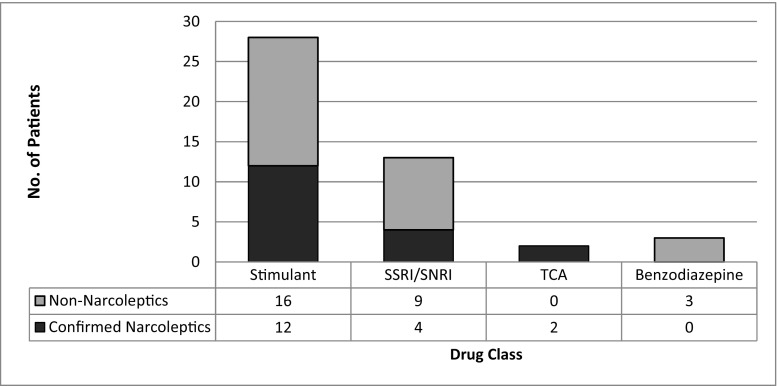
Results: Of the 41 directly referred patients with a diagnostic label of narcolepsy, 19 (46 %) were subsequently confirmed to have narcolepsy on objective testing and assessment by a sleep physician using ICSD-2 criteria.
Conclusions: The diagnosis of narcolepsy was incorrectly attributed to almost 50 % of patients labelled with a diagnosis of narcolepsy who were referred for further opinion by a variety of specialists and generalists. Accurate diagnosis of narcolepsy is critical for many reasons, such as the impact it has on quality of life, driving, employment, insurance and pregnancy in women as well as medication management.
Keywords: Cataplexy; Diagnosis; MSLT; Misdiagnosis; Narcolepsy.
Conflict of interest statement
Compliance with ethical standards Funding No funding was received for this research. Conflict of interest All authors certify that they have no affiliations or involvement with any organization or entity with any financial interest (such as honoraria; educational grants; participation in speakers’ bureaus; membership, employment, consultancies, stock ownership or other equity interest; and exert testimony or patent-licensing arrangements) or non-financial interest (such as personal or professional relationships, affiliations, knowledge or beliefs) in the subject matter or materials discussed in this manuscript. Ethical approval All procedures performed in studies involving human participants were in accordance with the ethical standards of the institutional and/or national research committee and with the 1964 Helsinki declaration and its later amendments or comparable ethical standards. Informed consent This study does not have any informed consent. Authors’ contributions Laura Dunne did the writing, analysis and primary data collection. Pallavi Patel and Emily L Maschauer did the writing and editing. Ian Morrison did the writing, editing and design. Renata Riha did the design, analysis, writing and editing. Disclosures Laura Dunne, Pallavi Patel, Emily L Maschauer, Ian Morrison and Renata Riha report no disclosures with respect to this study.
Figures
Comment in
-
Time for a standardized clinical assessment for narcolepsy with obstructive sleep apnea.Sleep Breath. 2018 Mar;22(1):49-50. doi: 10.1007/s11325-017-1516-3. Epub 2017 Jun 16. Sleep Breath. 2018. PMID: 28623528 No abstract available.
References
MeSH terms
LinkOut - more resources
Full Text Sources
Other Literature Sources
