


Effect of marine protected areas (MPAs) on consumer diet: MPA fish feed higher in the food chain
- PMID: 27340314
- PMCID: PMC4913280
- DOI: 10.3354/meps11487
Effect of marine protected areas (MPAs) on consumer diet: MPA fish feed higher in the food chain
Abstract
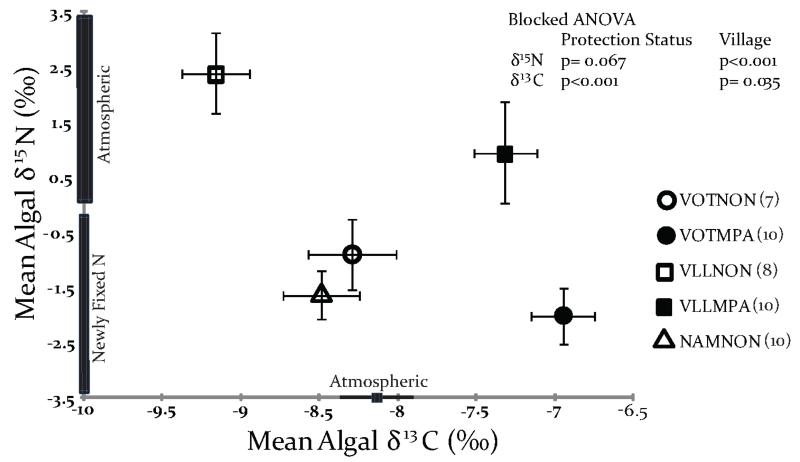
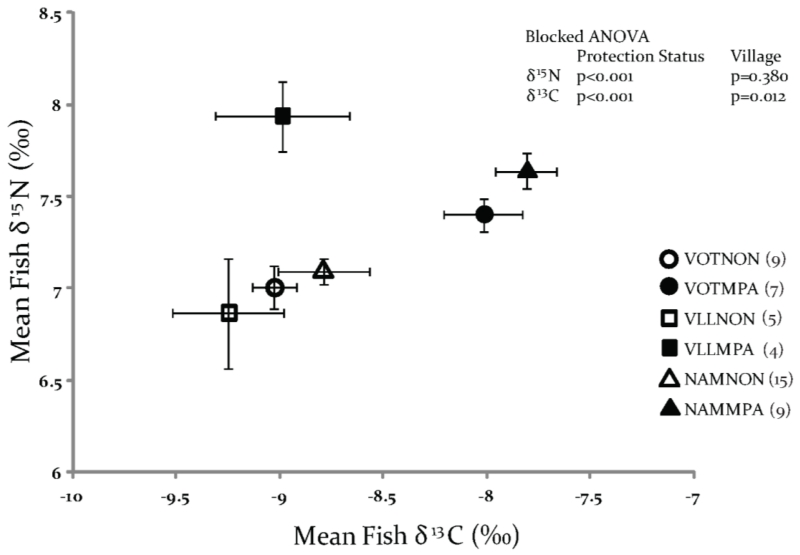
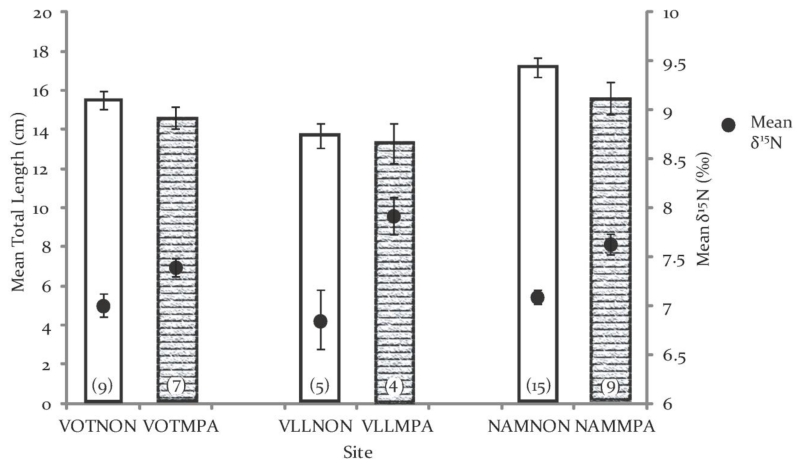
Marine Protected Areas (MPAs) are often established to mitigate the effects of overfishing and other human disturbances. In Fiji these are locally managed and, where enforced, have significantly higher coral cover, higher fish biomass, and lower seaweed cover than in the adjacent, unprotected reefs (non-MPAs). We investigated how the isotopic signatures of a common, mid-level consumer, Epinephelus merra, differed among three small (0.5- 0.8km2) MPAs versus adjacent, unprotected reefs. Isotopic ratios suggested that the fish in the MPAs fed higher in the food chain than those in the adjacent non-MPAs, despite being slightly smaller in size. Calculations using a brown alga as representative of the basal level of the food chain estimate this difference to be about half a trophic level. Thus, the isotopic ratio of a mid-level consumer can be noticeably altered over scales of only a few hundred meters. This may result from more complete food webs and hence greater prey choice and availability in the MPAs and implies that MPAs affect not only species' abundance and diversity, but also diet composition and trophic biology of member individuals. Our findings suggest E. merra exhibits considerable site fidelity in its feeding biology and thus provides a localized isotopic signal of its reef of residence. If the isotopic signal of this mid-level carnivore is reflective of the composition of the food web beneath it, the signal might provide an easily obtained indication of reef conditions in that area.
Keywords: Nitrogen; Phaeophyte; Turbinaria conoides; carbon; grouper; isotope; trophic position.
Figures

References
-
- Bonaldo RM, Pires MM, Bonito V, Hay ME, Roberto-Guimarães P. Small no-take areas benefit fish biomass, species diversity of fish schools, and coral recruitment: evidence from replicated protected and fished coral reefs in Fiji. Submitted to Biodiversity & Conservation.
-
- Bozec Y, Gascuel D, Kulbicki M. Trophic model of lagoonal communities in a large open atoll (Uvea, Loyalty islands, New Caledonia) Aquat Living Resour. 2004;17:151–162.
-
- Briand F, Cohen JE. Environmental correlates of food chain length. Science, New Series. 1987;238:956–960. - PubMed
Grants and funding
LinkOut - more resources
Full Text Sources
Other Literature Sources