Review
. 2016 Jun 23:16:49.
doi: 10.1186/s12935-016-0326-1. eCollection 2016.

Survivin: a unique target for tumor therapy

Affiliations
Review

Survivin: a unique target for tumor therapy

Himani Garg et al. Cancer Cell Int. .

Abstract

Survivin is the smallest member of the Inhibitor of apoptosis (IAP) family of proteins, involved in inhibition of apoptosis and regulation of cell cycle. These functional attributes make Survivin a unique protein exhibiting divergent functions i.e. regulating cell proliferation and cell death. Expression pattern of Survivin is also distinctive; it is prominently expressed during embryonal development, absent in most normal, terminally differentiated tissues but upregulated in a variety of human cancers. Expression of Survivin in tumours correlates with not only inhibition of apoptosis and a decreased rate of cell death, but also resistance to chemotherapy and aggressiveness of tumours. Therefore, Survivin is an important target for cancer vaccines and therapeutics. Survivin has also been found to be prominently expressed on both human and embryonic stem cells and many somatic stem cell types indicating its yet unexplored role in stem cell generation and maintenance. Overall, Survivin emerges as a molecule with much wider role in cellular homeostasis. This review will discuss various aspects of Survivin biology and its role in regulation of apoptosis, cell division, chemo-resistance and tumour progression. Various molecular and immunotherapeutic approaches targeting Survivin will also be discussed.

Keywords: Apoptosis; IAPs; Immunotherapy; Survivin.


Figures

Fig. 1
Fig. 1
Alternative splice variants of Survivin encoded by BIRC5 gene. Schematic representation of exons encoding five isoforms of Survivin. Note the breaks in the middle denote introns 1–3. Wild type (WT) is coded by exons 1–4 and is 142 amino acid (aa) long. An additional 69 bp exon between exons 2 and 3 results in Survivin 2B, making it a total of 67 aa in length. Exon 3 deletion leads to a frame shift variant resulting in a 3′ UTR, forming Survivin ΔEx3, 137 aa in length. Survivin 3B is formed by addition of 7 aa at the C-terminal, exon 3B from intron 3, the first 113 aa are conserved from WT Survivin. Variants 2α and 3α have a 3′UTR along with exons 1–2 and are 74 and 78 aa in length respectively
Fig. 2
Fig. 2
Unique role of Survivin in both apoptosis and cell division. Survivin expression in cytosol or mitochondrion can suppress both extrinsic and intrinsic pathways of apoptosis. Survivin expression in nucleus plays an important role in regulation of cell division by acting as an important component of chromosome passenger complex (CPC)
Fig. 3
Fig. 3
Immunotherapy in cancer. The self-defence of tumors overweighs the anti-tumor immunity leading to clinical manifestations of cancer. The various immunotherapeutic approaches are adopted to reverse this imbalance
Fig. 4
Fig. 4
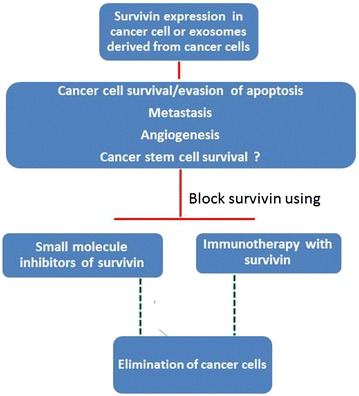
Multiple functions of Survivin. Survivin overexpression suppresses apoptosis or induces abnormal cell division, promotes tumour angiogenesis or metastasis of tumour cells. Survivin may also be expressed extracellularly in form of exosomes and exacerbate disease. Survivin expression may also influence cancer stem cell fate. Therapeutic targeting of Survivin through Survivin inhibitors may serve to block Survivin expression and induce removal of cancer cells. Immunotherapy with Survivin will boost generation of immune response against Survivin by generating Survivin specific CTLs

References

    1. Rothe M, Pan MG, Henzel WJ, Ayres TM, Goeddel DV. The TNFR2-TRAF signaling complex contains two novel proteins related to baculoviral inhibitor of apoptosis proteins. Cell. 1995;83(7):1243–1252. doi: 10.1016/0092-8674(95)90149-3. - DOI - PubMed
    1. Duckett CS, Nava VE, Gedrich RW, Clem RJ, Van Dongen JL, Gilfillan MC, Shiels H, Hardwick JM, Thompson CB. A conserved family of cellular genes related to the baculovirus iap gene and encoding apoptosis inhibitors. EMBO J. 1996;15(11):2685–2694. - PMC - PubMed
    1. Rajcan-Separovic E, Liston P, Lefebvre C, Korneluk RG. Assignment of human inhibitor of apoptosis protein (IAP) genes xiap, hiap-1, and hiap-2 to chromosomes Xq25 and 11q22-q23 by fluorescence in situ hybridization. Genomics. 1996;37(3):404–406. doi: 10.1006/geno.1996.0579. - DOI - PubMed
    1. Liston P, Roy N, Tamai K, Lefebvre C, Baird S, Cherton-Horvat G, Farahani R, McLean M, Ikeda JE, MacKenzie A, et al. Suppression of apoptosis in mammalian cells by NAIP and a related family of IAP genes. Nature. 1996;379(6563):349–353. doi: 10.1038/379349a0. - DOI - PubMed
    1. Ambrosini G, Adida C, Altieri DC. A novel anti-apoptosis gene, Survivin, expressed in cancer and lymphoma. Nat Med. 1997;3(8):917–921. doi: 10.1038/nm0897-917. - DOI - PubMed