Review
. 2016:15:445-488.
doi: 10.1007/s11101-015-9440-2. Epub 2015 Oct 13.

Mass spectrometry imaging for plant biology: a review

Affiliations
Review

Mass spectrometry imaging for plant biology: a review

Berin A Boughton et al. Phytochem Rev. 2016.

Abstract

Mass spectrometry imaging (MSI) is a developing technique to measure the spatio-temporal distribution of many biomolecules in tissues. Over the preceding decade, MSI has been adopted by plant biologists and applied in a broad range of areas, including primary metabolism, natural products, plant defense, plant responses to abiotic and biotic stress, plant lipids and the developing field of spatial metabolomics. This review covers recent advances in plant-based MSI, general aspects of instrumentation, analytical approaches, sample preparation and the current trends in respective plant research.

Keywords: Biochemistry; Lateral resolution; Natural products; Spatial mapping; Spatial metabolomics.


Figures

Fig. 1
Fig. 1
A Number of plant-based MSI papers per annum and B cumulative number of plant-based MSI papers by ionization source showing: green laser ablation methods (LA-ICP, LAESI) and laser desorption ionization, purple SIMS, DESI and other alternative ionization sources, red MALDI source based MSI papers, blue total number of papers. The cumulative number of plant-based papers by ionization source demonstrates the dominance of MALDI-type sources
Fig. 2
Fig. 2
Basics of mass spectrometry imaging for MALDI ionization showing 1 microprobe approach: discrete x, y locations on tissue are sampled forming ions, the m/z of ions is measured, then resulting mass spectra for each x, y location are computationally reconstructed to form a complete dataset; 2 microscope approach: wide areas of tissue are sampled using a broadly focused laser, resulting ions are detected using a position and time sensitive mass time-of-flight (TOF) detector, allowing determination of both m/z and the discrete spatial distribution of ions within the sample area. To cover very large areas of tissue multiple measurements may be conducted across the whole tissue section with data computationally reconstructed to form a complete dataset. Image analysis is conducted in silico on datasets, individual ions may be plotted for their distribution or statistical analysis conducted to determine co-localization of ions
Fig. 3
Fig. 3
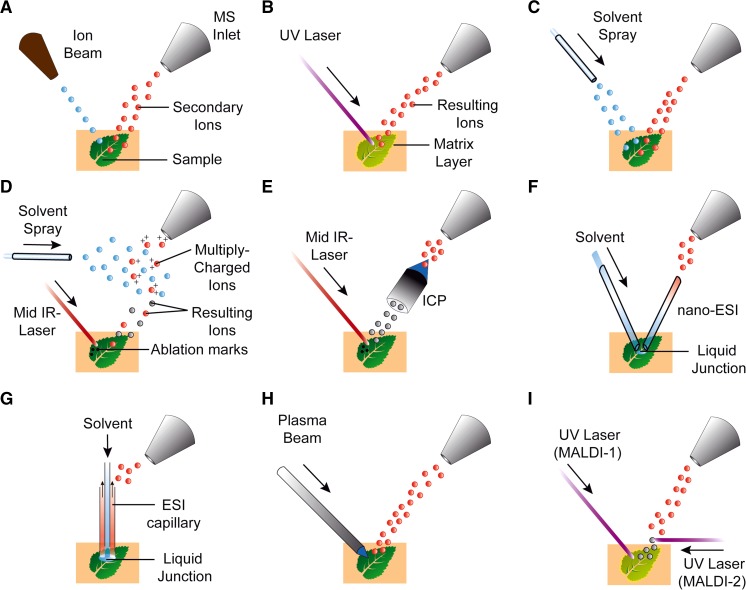
Principals of different ionization sources used for MSI imaging of plant tissues with leaf displayed, for many approaches a tissue section is used to access internal metabolites. A Secondary ion mass spectrometry (SIMS) showing primary ion beam impacting surface and generating secondary ions, B matrix assisted laser desorption ionization (MALDI) with UV laser photons absorbed by matrix layer causing desorption and ionization, C desorption electrospray ionization (DESI) showing electrospray stream and desorbed ions, D laser ablation electrospray ionization (LA-ESI) showing ablation plume and secondary ESI stream generating multiply charged ions, E laser ablation inductively couple plasma showing ablation (LA-ICP) plume transferred through ICP to generate ions, F nano-desorption electrospray ionization (nano-DESI) demonstrating micro-extraction and liquid junction followed by nano-ESI, G liquid extraction surface analysis (LESA) showing localized extraction and ionization through ESI capillary, H low temperature plasma showing plasma beam ionizing surface metabolites, I MALDI-2 showing primary MALDI source coupled to secondary MALDI laser inducing secondary ionization in the ablation plume. MS mass spectrometer, UV ultraviolet, IR infrared, ESI electrospray ionization, ICP inductively coupled plasma [modified from (Addie et al. 2015)]
Fig. 4
Fig. 4
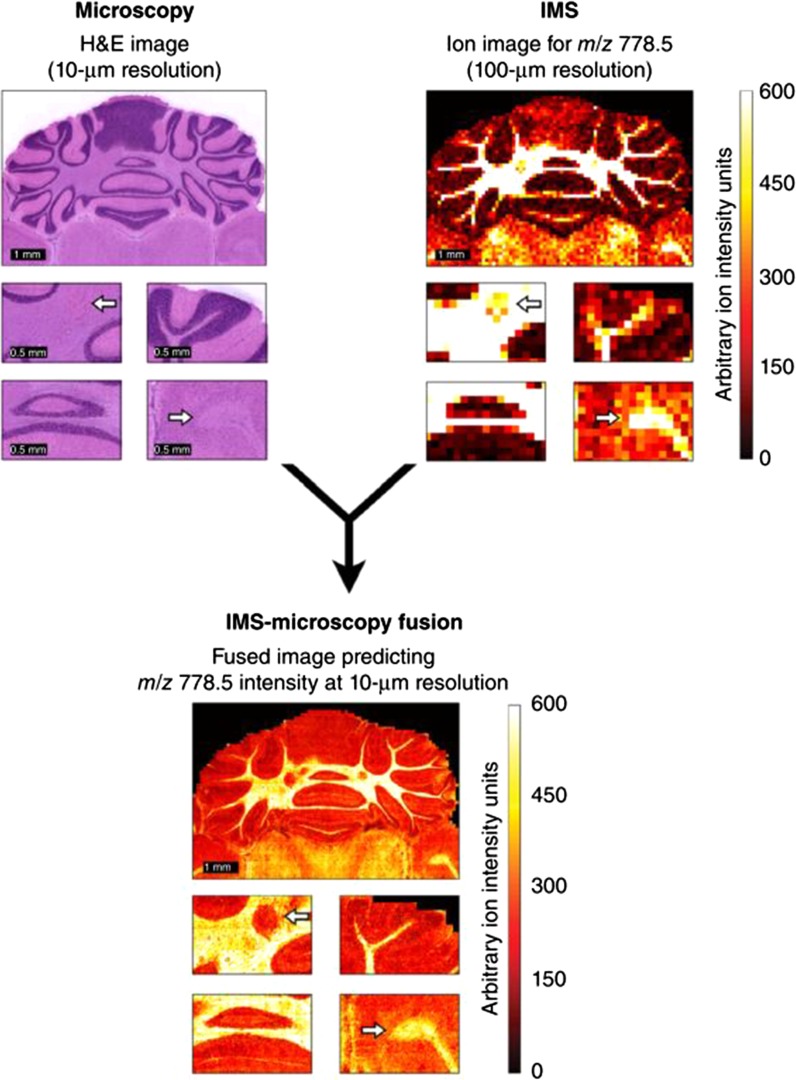
Demonstrates the image fusion approach combing two different image modalities at differing lateral resolutions. By using information contained in the higher lateral resolution image the distribution of a lipid can be predicted. Example of IMS-microscopy fusion. An ion image measured in mouse brain, describing the distribution of m/z 778.5 [identified as lipid (PE(P-40:4)] at 100 µm spatial resolution (top right), is integrated with an H&E microscopy image measured from the same tissue sample at 10 µm resolution (top left), by combing the information from both image types, the image fusion process can predict the ion distribution of m/z 778.5 at 10 µm resolution (bottom). Reprinted by permission from 1629 Macmillan Publishers Ltd: Nature Methods, (Van de Plas et al., 2015) 12(4):366-72, Copyright © 2015
Fig. 5
Fig. 5
Optical image and MS images of various metabolites in a maize leaf cross-section obtained at 5 µm spatial resolution. Images are oriented such that the upward-facing (adaxial) surface of the leaf is at the top. HMBOA-Glc 2-hydroxy-7-methoxy-1,4-benzoxazin-3-one glucoside; DIMBOA-Glc 2,4-dihydroxy-7-methoxy-1,4-benzoxazin-3-one glucoside; HexP hexose phosphate; Hex 2 hexose disaccharide; PG phosphatidylglycerol; SQDG sulfoquinovosyl diacylglycerol. Glutamic acid and HexP are found throughout the tissues with disaccharides concentrated within the vasculature. Ferulic and caffeic acid are found predominantly within the epidermal layers. Flavonoids are found asymmetrically distributed within the epidermal layers of the tissue. Notably, Maysin is found exclusively in the adaxial epidermis consistent with anti-herbivory and UV protectant properties. PG(34:2) was found exclusively in the bundle sheath cells, SQDG found distributed in bundle sheath and mesophyll cells. HMBOA-Glc and DIMBOA-Glc found to be specifically distributed to select mesophyll cells between the vascular bundles. Signals are normalized to TIC on each pixel. Maximum values for generating images are as follows. Glutamic acid: 1 × 10−2. Ascorbic acid: 8 × 10−3. Caffeic acid: 3.5 × 10−2. Ferulic acid: 8 × 10−3. HMBOA-Glc: 3 × 10−2. DIMBOA-Glc: 1 × 10−2. HexP-H2O: 4 × 10−3. Hex2: 6 × 10−3. Luteolin/kaempferol: 5 × 10−2. Quercetin: 4.5 × 10−2. Maysin: 5 × 10−2. Rutin: 2 × 10−2. PG (34:2): 5 × 10−3. SQDG (34:3): 3 × 10−2.Reproduced with kind permission from Springer Science and Business Media, Anal. Bioanal. Chem., (Korte et al., 2015), 407(8):2301–2309, Copyright © 2015
Fig. 6
Fig. 6
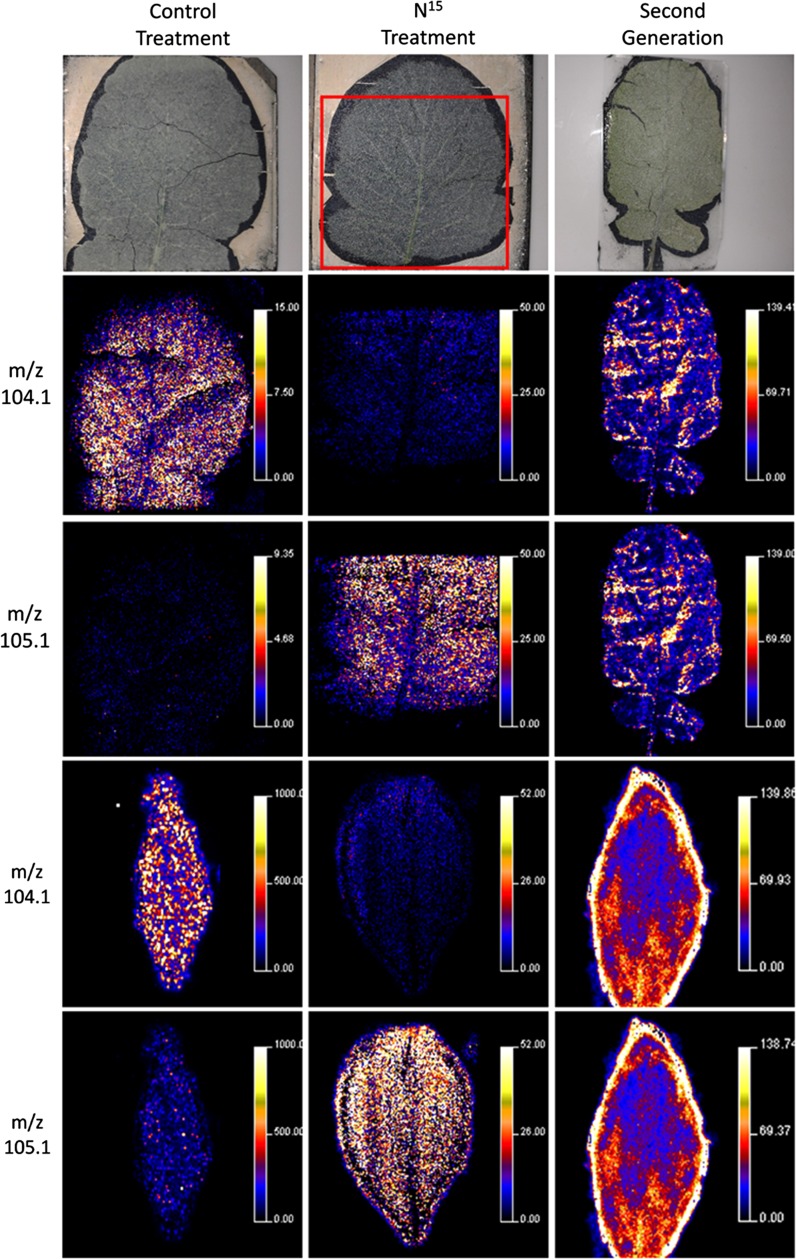
MALDI-MS images showing the distribution of choline at m/z 104 and 105 within the leaf and the bulb of the radish (normalized against TIC) Reprinted with permission from Anal.Chem. (Seaman et al., 2014), 86, 10071–7. Copyright © American Chemical Society
Fig. 7
Fig. 7
Demonstrates immediate response to physical stress and degradation of hydoxynitriles (cyanogenic glucosides) in wounded Lotus japonicas MG20 leaf tissues over time. Visualization of β-glucosidase mediated hydrolysis of hydroxynitrile glucosides in wounded leaves. A The leaves were wounded by pressing with a metal pipe; B indirect DESI-MS images of the wounded leaves: m/z 104 [γ-aminobutyric acid + H]+, 286 [linamarin + K]+, 298 [rhodiocyanoside + K]+ and 300 [lotaustralin + K]+, m/z 219 = [glucose + K]+. Reproduced with kind permission from John Wiley and Sons Ltd, The Plant Journal, (Li et al., 2013b), 74:1059-1071, Copyright © 2013
Fig. 8
Fig. 8
Example of kinetic mass spectrometric imaging—experimental workflow for using kMSI to define spatial heterogeneity of lipid composition and biosynthesis. A A tumor-bearing mouse is administered 2H2O-enriched water to incorporate deuterium into tissue as a result of active metabolism. B The deuterium-enriched tumor is excised, sectioned and imaged using NIMS. An individual mass spectrum is generated for each pixel every 50 µm, with spectra comprised of isotopologues from both 2H-labeled and unlabeled lipid molecules. C Serial sections of the tumor are used for histopathology correlation with kMSI results. D Deconvolution of spectra is performed to separate 2H-labeled and unlabeled lipids. Intensity images are generated to show the spatial distribution for both newly synthesized and pre-existing lipids. Reprinted by permission from Macmillan Publishers Ltd: Scientific Reports, (Louie et al., 2013) 3:1656, Copyright © 2013

References

    1. Addie RD, Balluff B, Bovee JV, Morreau H, McDonnell LA. Current state and future challenges of mass spectrometry imaging for clinical research. Anal Chem. 2015;87:6426. doi: 10.1021/acs.analchem.5b00416. - DOI - PubMed
    1. Aichler M, Walch A. MALDI Imaging mass spectrometry: current frontiers and perspectives in pathology research and practice. Lab Invest. 2015;95:422–431. doi: 10.1038/labinvest.2014.156. - DOI - PubMed
    1. Alexandrov T. MALDI imaging mass spectrometry: statistical data analysis and current computational challenges. BMC Bioinform. 2012;13(Suppl 16):S11. - PMC - PubMed
    1. Alexandrov T, Chernyavsky I, Becker M, von Eggeling F, Nikolenko S. Analysis and interpretation of imaging mass spectrometry data by clustering mass-to-charge images according to their spatial similarity. Anal Chem. 2013;85:11189–11195. doi: 10.1021/ac401420z. - DOI - PubMed
    1. Amstalden van Hove ER, Blackwell TR, Klinkert I, Eijkel GB, Heeren RMA, Glunde K. Multimodal mass spectrometric imaging of small molecules reveals distinct spatio-molecular signatures in differentially metastatic breast tumor models. Cancer Res. 2010;70:9012–9021. doi: 10.1158/0008-5472.CAN-10-0360. - DOI - PMC - PubMed