Review
. 2016:2016:5258727.
doi: 10.1155/2016/5258727. Epub 2016 Jun 1.

Animal Models of Cystic Fibrosis Pathology: Phenotypic Parallels and Divergences

Affiliations
Review

Animal Models of Cystic Fibrosis Pathology: Phenotypic Parallels and Divergences

Gillian M Lavelle et al. Biomed Res Int. 2016.

Abstract

Cystic fibrosis (CF) is caused by mutations in the cystic fibrosis transmembrane conductance regulator (CFTR) gene. The resultant characteristic ion transport defect results in decreased mucociliary clearance, bacterial colonisation, and chronic neutrophil-dominated inflammation. Much knowledge surrounding the pathophysiology of the disease has been gained through the generation of animal models, despite inherent limitations in each. The failure of certain mouse models to recapitulate the phenotypic manifestations of human disease has initiated the generation of larger animals in which to study CF, including the pig and the ferret. This review will summarise the basic phenotypes of three animal models and describe the contributions of such animal studies to our current understanding of CF.


Figures
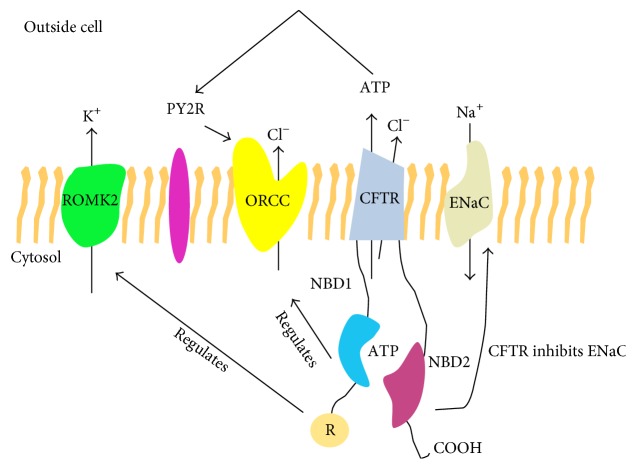
Figure 1
Figure 1
The role of CFTR in regulating additional ion channels. CFTR regulates many ion channels. CFTR primarily functions as a Cl channel. However, it also has a role in regulating the transport of K+ through renal outer medullar potassium channel (ROMK2). ROMK2 interacts with the intracellular cytoplasmic nucleotide-binding domains 1 (NBD1) and the regulatory (R) domain. CFTR can regulate the activity of outwardly rectified Cl channel (ORCC) through the binding of ATP to the purinergic receptor (PY2R). CFTR can also inhibit ENaC, therefore regulating Na+ transport into the cell.
Figure 2
Figure 2
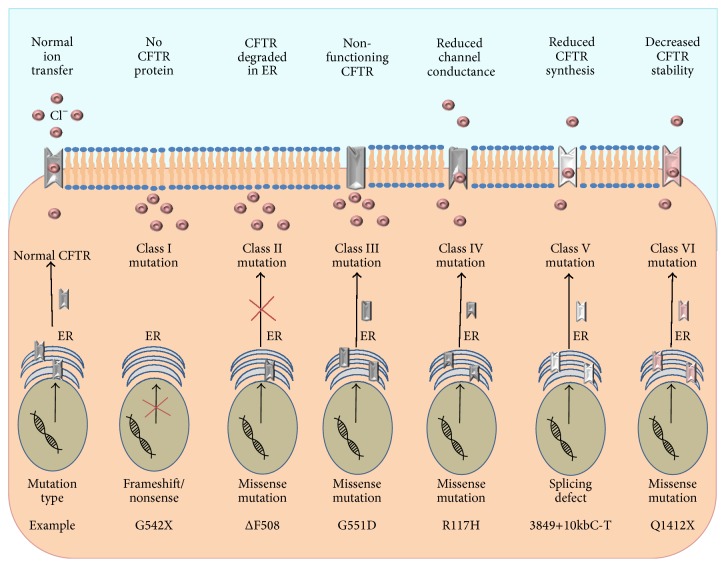
Classification of CFTR mutations. In healthy CFTR sufficient cells, the functional CFTR protein is correctly trafficked to the plasma membrane. Class I mutations result in a lack of CFTR protein synthesis. Class II mutations block CFTR processing, where misfolded protein is degraded in the ER. Class III mutations affect the regulation of the CFTR, where the CFTR channel is less functional. Class IV mutations alter the CFTR conductance of Cl. Class V mutations lead to reduced synthesis of functional CFTR. Class VI mutations result in accelerated turnover of CFTR protein on the cell surface.

References

    1. Yoshimura K., Nakamura H., Trapnell B. C., et al. Expression of the cystic fibrosis transmembrane conductance regulator gene in cells of non-epithelial origin. Nucleic Acids Research. 1991;19(19):5417–5423. doi: 10.1093/nar/19.19.5417. - DOI - PMC - PubMed
    1. Riordan J. R., Rommens J. M., Kerem B.-S., et al. Identification of the cystic fibrosis gene: cloning and characterization of complementary DNA. Science. 1989;245(4922):1066–1073. doi: 10.1126/science.2475911. - DOI - PubMed
    1. The Cystic Fibrosis Registry of Ireland. 2012 Annual Report. Dublin, Ireland: The Cystic Fibrosis Registry of Ireland; 2012.
    1. Cystic Fibrosis Foundation. Patient Registry—Annual Data Report 2012. Bethesda, Md, USA: Cystic Fibrosis Foundation; 2012.
    1. Zhang L., Button B., Gabriel S. E., et al. CFTR delivery to 25% of surface epithelial cells restores normal rates of mucus transport to human cystic fibrosis airway epithelium. PLoS Biology. 2009;7(7) doi: 10.1371/journal.pbio.1000155.e1000155 - DOI - PMC - PubMed

MeSH terms

Substances