


Advancing our understanding of religion and spirituality in the context of behavioral medicine
- PMID: 27342616
- PMCID: PMC5183527
- DOI: 10.1007/s10865-016-9755-5
Advancing our understanding of religion and spirituality in the context of behavioral medicine
Abstract
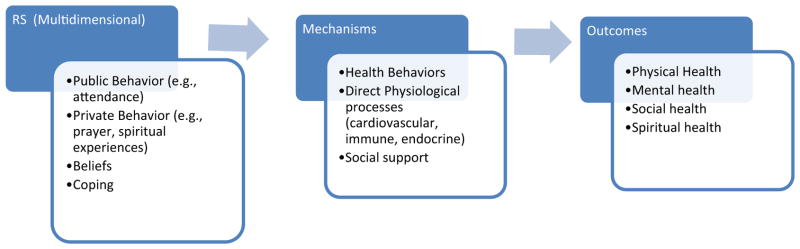
Recognizing and understanding the potentially powerful roles that religiousness and spirituality (RS) may serve in the prevention and amelioration of disease, as well as symptom management and health related quality of life, significantly enhances research and clinical efforts across many areas of behavioral medicine. This article examines the knowledge established to date and suggests advances that remain to be made. We begin with a brief summary of the current knowledge regarding RS as related to three exemplary health conditions: (a) cardiovascular disease; (b) cancer; and, (c) substance abuse. We then focus on particular concerns for future investigations, emphasizing conceptual issues, possible mediators and moderators of relationships or effects, and methodology. Our discussion is framed by a conceptual model that may serve to guide and organize future investigations. This model highlights a number of important issues regarding the study of links between RS and health: (a) RS comprise many diverse constructs, (b) the mechanisms through which RS may influence health outcomes are quite diverse, and (c) a range of different types of health and health relevant outcomes may be influenced by RS. The multidimensional nature of RS and the complexity of related associations with different types of health relevant outcomes present formidable challenges to empirical study in behavioral medicine. These issues are referred to throughout our review and we suggest several solutions to the presented challenges in our summary. We end with a presentation of barriers to be overcome, along with strategies for doing so, and concluding thoughts.
Keywords: Cancer; Cardiovascular disease; Religion; Spirituality; Substance use.
Conflict of interest statement
Crystal L. Park, Kevin S. Masters, John M. Salsman, Amy Wachholtz, Andrea D. Clements, Elena Salmoirago-Blotcher, Kelly Trevino, and Danielle M. Wischenka declare that they have no conflict of interest. Human and animal rights and Informed consent All procedures followed were in accordance with ethical standards of the responsible committee on human experimentation (institutional and national) and with the Helsinki Declaration of 1975, as revised in 2000. Informed consent was obtained from all patients for being included in the study.
Figures
References
-
- Agarwal M, Hamilton JB, Crandell JL, Moore CE. Coping strategies of African American head and neck cancer survivors. Journal of Psychosocial Oncology. 2010;28:526–538. - PubMed
-
- Ai AL, Pargament K, Kronfol Z, Tice TN, Appel H. Pathways to postoperative hostility in cardiac patients: Mediation of coping, spiritual struggle and interleukin-6. Journal of Health Psychology. 2010;15:186–195. - PubMed
-
- Ai AL, Wink P, Shearer M. Secular reverence predicts shorter hospital length of stay among middle-aged and older patients following open-heart surgery. Journal of Behavioral Medicine. 2011;34:532–541. - PubMed
-
- Aldwin CM, Park CL, Jeong YJ, Nath R. Differing pathways between religiousness, spirituality, and health: A self-regulation perspective. Psychology of Religion and Spirituality. 2014;6:9–21.
Publication types
MeSH terms
Grants and funding
LinkOut - more resources
Full Text Sources
Other Literature Sources
