Review
. 2016 Dec;73(23):4397-4413.
doi: 10.1007/s00018-016-2297-8. Epub 2016 Jun 24.

Negative feedback regulation of the ERK1/2 MAPK pathway

Affiliations
Review

Negative feedback regulation of the ERK1/2 MAPK pathway

David Lake et al. Cell Mol Life Sci. 2016 Dec.

Abstract

The extracellular signal-regulated kinase 1/2 (ERK1/2) mitogen-activated protein kinase (MAPK) signalling pathway regulates many cellular functions, including proliferation, differentiation, and transformation. To reliably convert external stimuli into specific cellular responses and to adapt to environmental circumstances, the pathway must be integrated into the overall signalling activity of the cell. Multiple mechanisms have evolved to perform this role. In this review, we will focus on negative feedback mechanisms and examine how they shape ERK1/2 MAPK signalling. We will first discuss the extensive number of negative feedback loops targeting the different components of the ERK1/2 MAPK cascade, specifically the direct posttranslational modification of pathway components by downstream protein kinases and the induction of de novo gene synthesis of specific pathway inhibitors. We will then evaluate how negative feedback modulates the spatiotemporal signalling dynamics of the ERK1/2 pathway regarding signalling amplitude and duration as well as subcellular localisation. Aberrant ERK1/2 activation results in deregulated proliferation and malignant transformation in model systems and is commonly observed in human tumours. Inhibition of the ERK1/2 pathway thus represents an attractive target for the treatment of malignant tumours with increased ERK1/2 activity. We will, therefore, discuss the effect of ERK1/2 MAPK feedback regulation on cancer treatment and how it contributes to reduced clinical efficacy of therapeutic agents and the development of drug resistance.

Keywords: Cancer; Cell signalling; Negative feedback; Pathway modelling; Signalling dynamics; Spatiotemporal regulation.


Figures
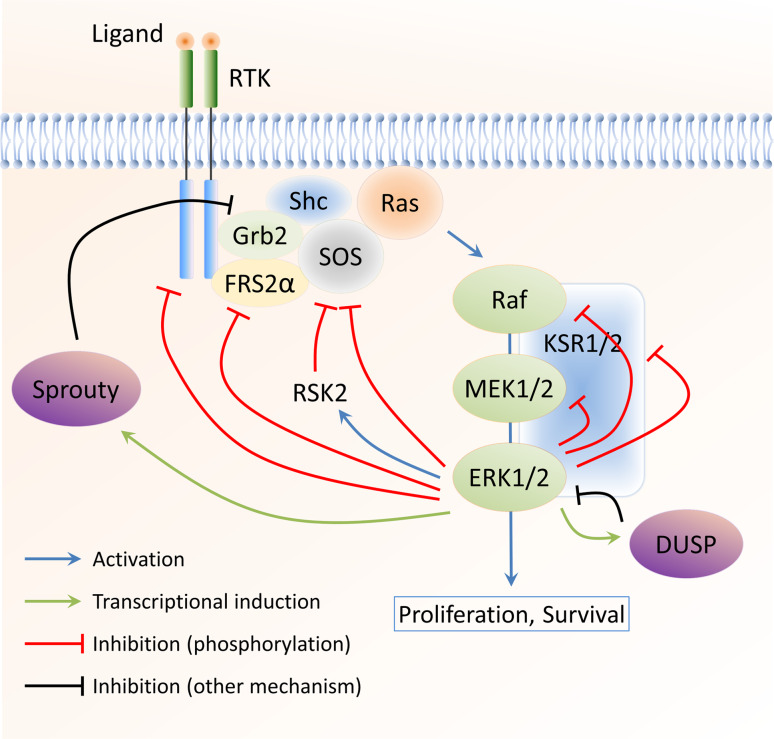
Fig. 1
Fig. 1
Negative feedback regulation of the ERK1/2 MAPK pathway. The ERK1/2 MAPK pathway is subject to a large number of negative feedback loops. These include direct phosphorylation by ERK1/2 (and RSK2) as well as transcriptionally induced feedback regulators, such as DUSPs and Sprouty proteins. The major negative feedback loops acting on the ERK1/2 pathway are shown
Fig. 2
Fig. 2
ERK1/2 MAPK signalling in response to different oncogenic stimuli. a In cells with mutation or amplification of upstream components [e.g., RTKs (1)] and expressing wild-type Raf proteins, negative feedback mechanisms are highly active (2,3) and significantly reduce the activity of several upstream pathway components. This leads to relatively low (but still elevated) steady-state levels of MEK1/2 and ERK1/2 activity. When either Raf or MEK1/2 are inhibited, this negative feedback is reduced. As a result, signal flux is increased, restoring MEK1/2 and ERK1/2 activity and requiring significantly higher inhibitor doses (intrinsic resistance). Loss of negative feedback (2) due to pathway inhibition also results in increased Ras-GTP levels, which promotes the dimerisation of wild-type Raf proteins and results in the paradoxical promotion, rather than inhibition, of ERK1/2 signalling. Finally, the observed transcriptional output (4) of tumour cells with mutated RTKs or Ras is only partially driven by ERK1/2 activity because of the relatively small increase in the overall signalling flux due to extensive negative feedback. Inhibition of Raf or MEK1/2, therefore, does not sufficiently reduce the expression of those mitogenic genes to result in therapeutic changes. b Mutant B-Raf (5) is constitutively active and, therefore, not sensitive to direct feedback phosphorylation by ERK1/2 (6). In addition, as mutated B-Raf is independent of upstream activation, negative feedback to the upstream components has no effect on B-Raf activity (7). Because mutated B-Raf bypasses negative feedback, persistent hyperactivation of MEK1/2 (and ERK1/2) results in significantly increased transcriptional output of mitogenic genes (8). As mitogenic gene expression critically depends on high signalling flux through the pathway, those tumours are sensitive to the inhibition of MEK1/2 or B-Raf. In addition, the increased expression of DUSPs (9) in B-Raf mutant cells leads to the dephosphorylation of ERK1/2 and a reduction of its apparent activity to levels that support oncogenic transformation (rather than senescence). As a result, MEK1/2 (rather than ERK1/2) activity is a major hallmark and determinant of inhibitor selectivity (#)
Fig. 3
Fig. 3
Loss of negative feedback contributes to resistance to Raf and MEK1/2 inhibitors. Raf or MEK1/2 inhibition (1) results in lower levels of negative feedback to upstream components (2). As a result, the cell is returned to an RTK signalling-competent state, where Ras and other upstream factors are able to respond to signal activation (3). Therefore, signal flux is increased (4), promoting higher ERK1/2 activity and requiring higher inhibitor doses. The increased Ras activity can also activate parallel pathways, such as the PI3K/Akt pathway (5). In addition, loss of negative feedback leads to the de-repression of other RTK receptors (6), allowing different growth factors to activate downstream signalling pathways. Activation of the PI3K/Akt pathway can promote cell survival (7) and reduce the dependency of the tumour on ERK1/2 signalling, likely contributing to the acquired resistance to Raf and MEK1/2 inhibitors

References

    1. McKay MM, Morrison DK. Integrating signals from RTKs to ERK/MAPK. Oncogene. 2007;26(22):3113–3121. doi: 10.1038/sj.onc.1210394. - DOI - PubMed
    1. Gureasko J, Galush WJ, Boykevisch S, Sondermann H, Bar-Sagi D, Groves JT, Kuriyan J. Membrane-dependent signal integration by the Ras activator Son of sevenless. Nat Struct Mol Biol. 2008;15(5):452–461. doi: 10.1038/nsmb.1418. - DOI - PMC - PubMed
    1. Chong H, Vikis HG, Guan K-L. Mechanisms of regulating the Raf kinase family. Cell Signal. 2003;15(5):463–469. doi: 10.1016/S0898-6568(02)00139-0. - DOI - PubMed
    1. Lavoie H, Therrien M. Regulation of RAF protein kinases in ERK signalling. Nat Rev Mol Cell Biol. 2015;16(5):281–298. doi: 10.1038/nrm3979. - DOI - PubMed
    1. Hagemann C, Rapp UR. Isotype-specific functions of Raf kinases. Exp Cell Res. 1999;253(1):34–46. doi: 10.1006/excr.1999.4689. - DOI - PubMed

MeSH terms

Substances
