Review
. 2016 Jun:9:19-47.
doi: 10.1016/j.lssr.2016.05.004. Epub 2016 May 21.

Evaluating biomarkers to model cancer risk post cosmic ray exposure

Affiliations
Review

Evaluating biomarkers to model cancer risk post cosmic ray exposure

Deepa M Sridharan et al. Life Sci Space Res (Amst). 2016 Jun.

Abstract

Robust predictive models are essential to manage the risk of radiation-induced carcinogenesis. Chronic exposure to cosmic rays in the context of the complex deep space environment may place astronauts at high cancer risk. To estimate this risk, it is critical to understand how radiation-induced cellular stress impacts cell fate decisions and how this in turn alters the risk of carcinogenesis. Exposure to the heavy ion component of cosmic rays triggers a multitude of cellular changes, depending on the rate of exposure, the type of damage incurred and individual susceptibility. Heterogeneity in dose, dose rate, radiation quality, energy and particle flux contribute to the complexity of risk assessment. To unravel the impact of each of these factors, it is critical to identify sensitive biomarkers that can serve as inputs for robust modeling of individual risk of cancer or other long-term health consequences of exposure. Limitations in sensitivity of biomarkers to dose and dose rate, and the complexity of longitudinal monitoring, are some of the factors that increase uncertainties in the output from risk prediction models. Here, we critically evaluate candidate early and late biomarkers of radiation exposure and discuss their usefulness in predicting cell fate decisions. Some of the biomarkers we have reviewed include complex clustered DNA damage, persistent DNA repair foci, reactive oxygen species, chromosome aberrations and inflammation. Other biomarkers discussed, often assayed for at longer points post exposure, include mutations, chromosome aberrations, reactive oxygen species and telomere length changes. We discuss the relationship of biomarkers to different potential cell fates, including proliferation, apoptosis, senescence, and loss of stemness, which can propagate genomic instability and alter tissue composition and the underlying mRNA signatures that contribute to cell fate decisions. Our goal is to highlight factors that are important in choosing biomarkers and to evaluate the potential for biomarkers to inform models of post exposure cancer risk. Because cellular stress response pathways to space radiation and environmental carcinogens share common nodes, biomarker-driven risk models may be broadly applicable for estimating risks for other carcinogens.

Keywords: Biomarkers; Cancer risk; HZE; Modeling; Space radiation.


Figures

Fig. 1
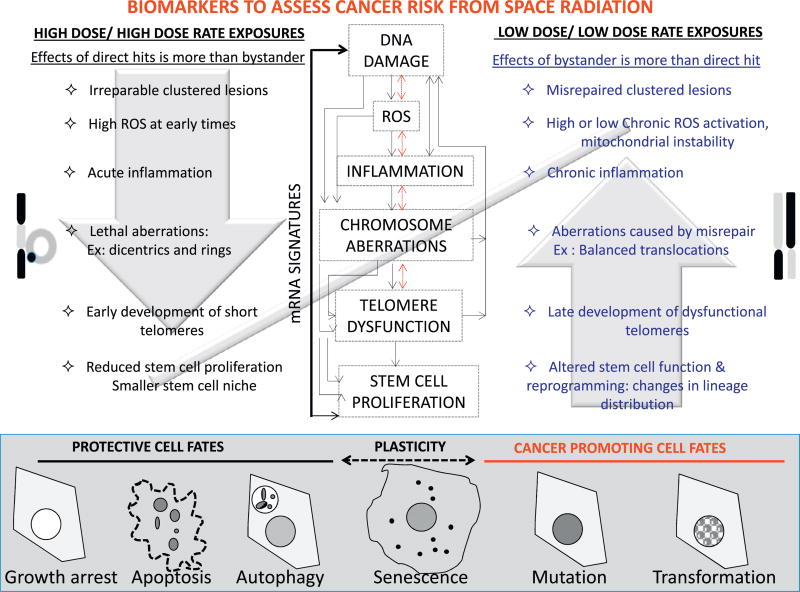
Fig. 1. Schematic representation of known mechanistic links between biomarkers that define cell fates, which promote or protect from cancer risk
We have detailed the feedback network between various biomarkers of cellular stress response at early and late times post radiation exposure. For simplicity biomarkers have been defined as “early” and “late”, although some early biomarkers are also observed at later times. Early biomarkers evaluated include persistent damage, DNA repair foci, alterations in ROS and inflammation. Late biomarkers of genomic instability include mutations, chromosome aberrations and telomere length changes. The phenotype of each of these biomarkers differ post exposure to HD/HDR and LD/LDR radiation. As majority of the current data is based on HD/HDR exposures, biological effects of LD/LDR exposures that mimic GCR are speculative, need to be further validated using GCR simulator at NSRL, and hence are highlighted in blue. Summary of current literature suggests that majority of acute high-dose low-LET exposures cause complex clustered lesions that are irreparable. In contrast, although cells hit with low doses of high-LET radiation also get complex clustered damages due to intense energy deposition along the track, bystander effects appear to play a prominent role in the ensuing biological response, pathways activated and the eventual fate of the cell. Most of the irreparable clustered lesions initiate a cascade of biological processes that are so damaging that the inherent protective mechanisms prevent carcinogenesis by targeting these cells for growth arrest, apoptosis, autophagy or senescence. Cells with fewer numbers of complex clustered lesions and those with non-lethal lesions caused by high-LET radiation may, however, continue to proliferate following misrepair of the lesions. Chromosome aberrations or mutations caused by these lesions perpetuate further DNA damage, chronic ROS, chronic inflammation and telomere dysfunction, resulting in more genomic instability and in some cases cellular transformation. Cell fate choice and distribution may differ between HD/HDR and LD/LDR exposures, and is an essential area that needs further investigation. The nodes of intersection between endpoints that govern the choice between pro- and anti- survival cell fates must be factored in along with temporal mRNA/protein expression profiles, in order to obtain a clear biomarker signature for modeling and early prediction of cancer risk. (For interpretation of the references to color in this figure legend, the reader is referred to the web version of this article.)

References

    1. Abdallah P, Luciano P, Runge KW, Lisby M, Geli V, Gilson E, et al. A two-step model for senescence triggered by a single critically short telomere. Nat. Cell. Biol. 2009;11(8):988–993. - PMC - PubMed
    1. Al-Hajj M, Wicha MS, Benito-Hernandez A, Morrison SJ, Clarke MF. Prospective identification of tumorigenic breast cancer cells. Proc. Natl. Acad. Sci. USA. 2003;100(7):3983–3988. - PMC - PubMed
    1. Albertson DG, Collins C, McCormick F, Gray JW. Chromosome aberrations in solid tumors. Nat. Genet. 2003;34(4):369–376. - PubMed
    1. Albrecht H, Durbin-Johnson B, Yunis R, Kalanetra Karen M, Wu S, Chen R, et al. Transcriptional response of ex vivo human skin to ionizing radiation: comparison between low- and high-dose effects. Radiat. Res. 2012;177(1):69–83. - PMC - PubMed
    1. Amundson SA, Chen DJ. Inverse dose-rate effect for mutation induction by gamma-rays in human lymphoblasts. Int. J. Radiat. Biol. 1996;69(5):555–563. - PubMed

MeSH terms

LinkOut - more resources