


Modeling craniofacial and skeletal congenital birth defects to advance therapies
- PMID: 27346519
- PMCID: PMC5036869
- DOI: 10.1093/hmg/ddw171
Modeling craniofacial and skeletal congenital birth defects to advance therapies
Abstract
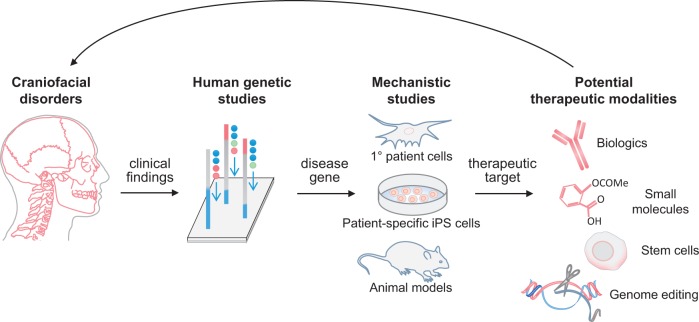
Craniofacial development is an intricate process of patterning, morphogenesis, and growth that involves many tissues within the developing embryo. Genetic misregulation of these processes leads to craniofacial malformations, which comprise over one-third of all congenital birth defects. Significant advances have been made in the clinical management of craniofacial disorders, but currently very few treatments specifically target the underlying molecular causes. Here, we review recent studies in which modeling of craniofacial disorders in primary patient cells, patient-derived induced pluripotent stem cells (iPSCs), and mice have enhanced our understanding of the etiology and pathophysiology of these disorders while also advancing therapeutic avenues for their prevention.
© The Author (2016). Published by Oxford University Press. All rights reserved. For permissions, please e-mail: journals.permissions@oup.com.
Figures
References
-
- Thesleff I. (2006) The genetic basis of tooth development and dental defects. Am. J. Med. Genet. A, 140, 2530–2535. - PubMed
-
- Minoux M., Rijli F.M. (2010) Molecular mechanisms of cranial neural crest cell migration and patterning in craniofacial development. Development, 137, 2605–2621. - PubMed
-
- (2004) Global strategies to reduce the health care burden of craniofacial anomalies: report of WHO meetings on international collaborative research on craniofacial anomalies. Cleft Palate Craniofac. J, 41, 238–243. - PubMed
-
- Rosenthal N., Brown S. (2007) The mouse ascending: perspectives for human-disease models. Nat. Cell Biol., 9, 993–999. - PubMed
-
- Tiscornia G., Vivas E.L., Izpisua Belmonte, J.C. (2011) Diseases in a dish: modeling human genetic disorders using induced pluripotent cells. Nat. Med, 17, 1570–1576. - PubMed
Publication types
Grants and funding
LinkOut - more resources
Full Text Sources
Other Literature Sources
