. 2016 Jun 16;12(Suppl 2):1-12.
doi: 10.4137/EBO.S38518. eCollection 2016.

Bioinformatic Characterization of Mosquito Viromes within the Eastern United States and Puerto Rico: Discovery of Novel Viruses

Affiliations

Bioinformatic Characterization of Mosquito Viromes within the Eastern United States and Puerto Rico: Discovery of Novel Viruses

Kenneth G Frey et al. Evol Bioinform Online. .

Abstract

Mosquitoes are efficient, militarily relevant vectors of infectious disease pathogens, including many RNA viruses. The vast majority of all viruses are thought to be undiscovered. Accordingly, recent studies have shown that viruses discovered in insects are very divergent from known pathogens and that many of them lack appropriate reference sequences in the public databases. Given that the majority of viruses are likely still undiscovered, environ mental sampling stands to provide much needed reference samples as well as genetic sequences for comparison. In this study, we sought to determine whether samples of mosquitoes collected from different sites (the Caribbean and locations on the US East Coast) could be differentiated using metagenomic analysis of the RNA viral fraction. We report here distinct virome profiles, even from samples collected short distances apart. In addition to profiling the previously known viruses from these samples, we detected a number of viruses that have been previously undiscovered.

Keywords: Bunyaviridae; high-throughput sequencing; metagenome sequencing; metagenomics; mosquito virus; novel virus.


Figures
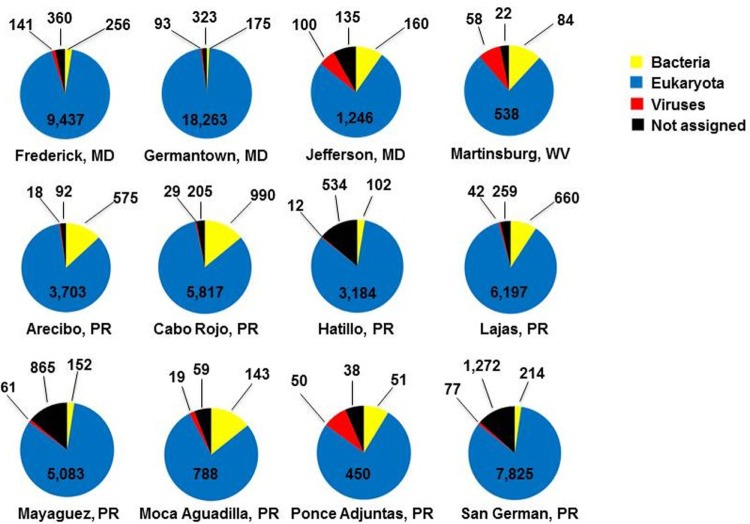
Figure 1
Figure 1
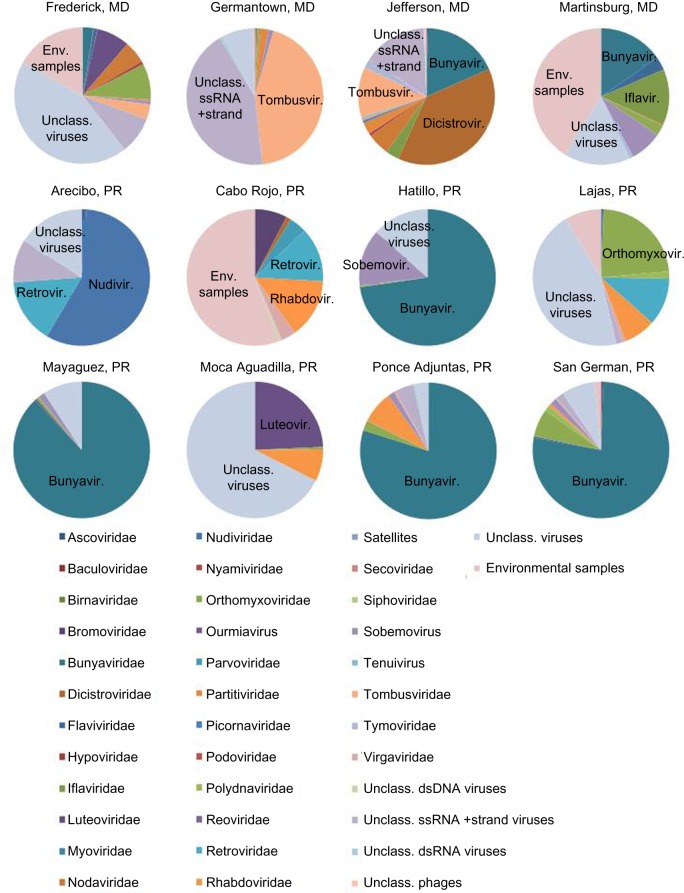
Taxonomic profiling of contigs by location. The numbers indicate raw count of contigs in each category. The de novo assembled contigs were assigned to categories using BLAST.
Figure 2
Figure 2
Virome content by location. The proportion of the identifiable virome contributed by each viral family or group is estimated using a read mapping approach. Briefly, raw reads were mapped back to de novo assembled contigs using CLC Genomics Workbench, and for each of the contigs that was identified by BLAST as being of viral origin, the number of raw reads mapping to that contig was extracted and is presented here.
Figure 3
Figure 3
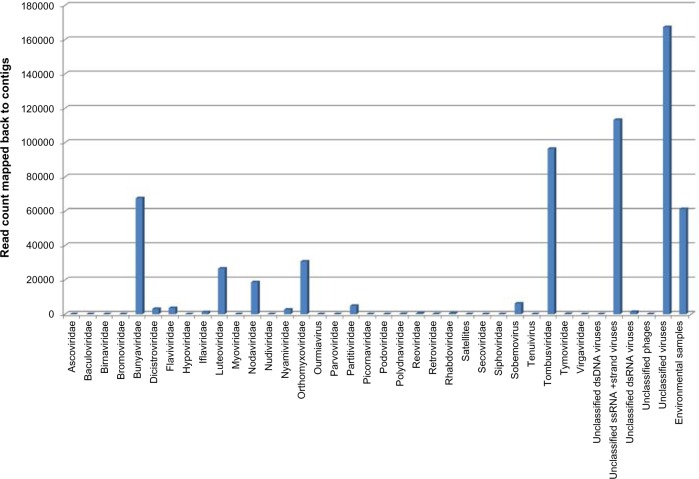
Contribution of virus families to total assembled sequences. The total number of raw reads mapped back to viral contigs using CLC Genomics Workbench per virus family or grouping is presented here, for all samples combined.
Figure 4
Figure 4
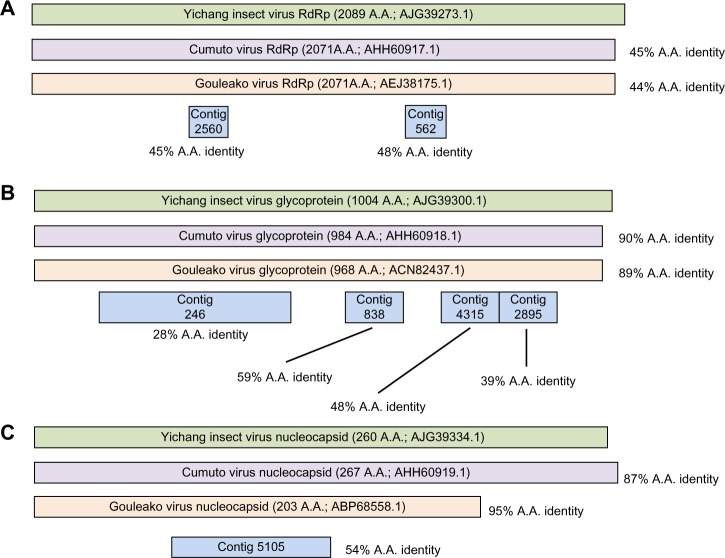
Novel bunyavirus example from Frederick, MD. In this schematic, contigs corresponding to various genes of a proposed novel bunyavirus from mosquitoes collected in Frederick, MD, are shown aligned to the three closest sequenced relatives. (A) The contigs corresponding to RdRP sequences, (B) contigs corresponding to glycoprotein sequences, and (C) contigs corresponding to nucleocapsid sequences. Percent amino acid identity for these contigs and for Cumuto and Gouleako sequences is shown with respect to Yichang insect virus protein sequences.
Figure 5
Figure 5
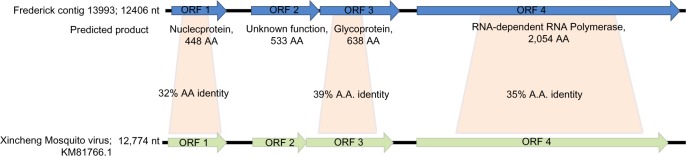
Schematic of virus genome encoded by Frederick contig 13,993. The four ORFs encoded by Frederick contig 13,993 are depicted here along with their putative protein products and the amino acid identity of those products to the sequences of the closest sequenced relative, Xincheng Mosquito virus.

References

    1. Pages F, Faulde M, Orlandi-Pradines E, Parola P. The past and present threat of vector-borne diseases in deployed troops. Clin Microbiol Infect. 2010;16(3):209–24. - PubMed
    1. Junglen S, Kurth A, Kuehl H, et al. Examining landscape factors influencing relative distribution of mosquito genera and frequency of virus infection. Ecohealth. 2009;6(2):239–49. - PMC - PubMed
    1. Li CX, Shi M, Tian JH, et al. Unprecedented genomic diversity of RNA viruses in arthropods reveals the ancestry of negative-sense RNA viruses. Elife. 2015:4. - PMC - PubMed
    1. Chandler JA, Liu RM, Bennett SN. RNA shotgun metagenomic sequencing of northern California (USA) mosquitoes uncovers viruses, bacteria, and fungi. Front Microbiol. 2015;6:185. - PMC - PubMed
    1. Auguste AJ, Carrington CV, Forrester NL, et al. Characterization of a novel Negevirus and a novel Bunyavirus isolated from Culex (Culex) declarator mosquitoes in Trinidad. J Gen Virol. 2014;95:481–5. - PMC - PubMed

LinkOut - more resources