Review
. 2016 Jun 14:5:F1000 Faculty Rev-1370.
doi: 10.12688/f1000research.8466.1. eCollection 2016.

Yersinia virulence factors - a sophisticated arsenal for combating host defences

Affiliations
Review

Yersinia virulence factors - a sophisticated arsenal for combating host defences

Steve Atkinson et al. F1000Res. .

Abstract

The human pathogens Yersinia pseudotuberculosis and Yersinia enterocolitica cause enterocolitis, while Yersinia pestis is responsible for pneumonic, bubonic, and septicaemic plague. All three share an infection strategy that relies on a virulence factor arsenal to enable them to enter, adhere to, and colonise the host while evading host defences to avoid untimely clearance. Their arsenal includes a number of adhesins that allow the invading pathogens to establish a foothold in the host and to adhere to specific tissues later during infection. When the host innate immune system has been activated, all three pathogens produce a structure analogous to a hypodermic needle. In conjunction with the translocon, which forms a pore in the host membrane, the channel that is formed enables the transfer of six 'effector' proteins into the host cell cytoplasm. These proteins mimic host cell proteins but are more efficient than their native counterparts at modifying the host cell cytoskeleton, triggering the host cell suicide response. Such a sophisticated arsenal ensures that yersiniae maintain the upper hand despite the best efforts of the host to counteract the infecting pathogen.

Keywords: Yersinia pestis; ail locus; pH6 antigen; virulence factors; yersiniae.


Conflict of interest statement

Competing interests: The authors declare that they have no competing interests.

No competing interests were disclosed.

Figures
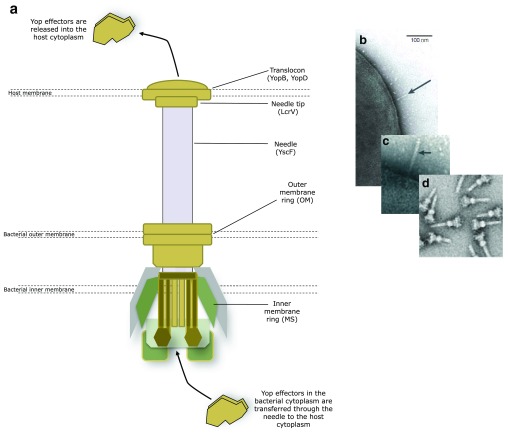
Figure 1.
Figure 1.. Assembly of the type three secretion system (T3SS) needle.
The needle is fixed into the bacterial inner and outer membrane and protrudes from the surface to penetrate the host membrane. The translocon forms a channel through the host membrane and the Yop effectors are transferred into the host from the bacterial cytoplasm via the needle and translocon ( a). The needle protrudes from the bacterial surface prior to host cell penetration ( b, c arrowed). Salmonella typhimurium T3SS needles isolated from the bacterial membrane ( d). ( a) adapted from , ( b) reproduced with permission and taken from reference , ( c) reproduced with permission and taken from reference , and ( d) reproduced from reference .
Figure 2.
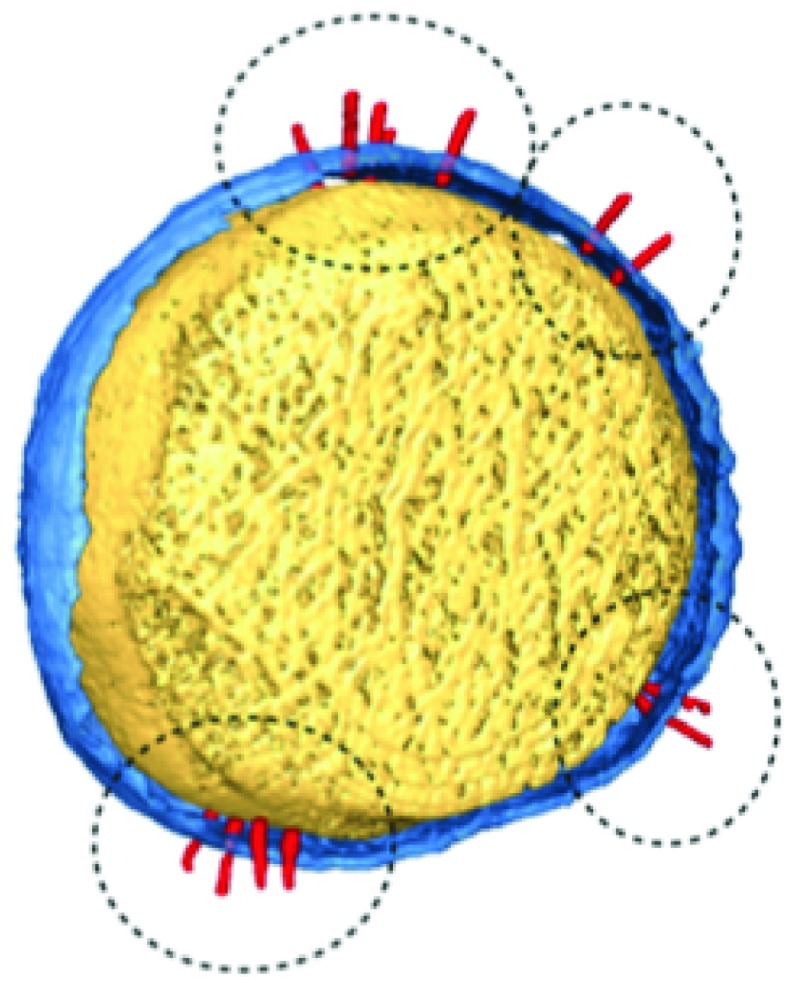
Figure 2.. Type 3 secretion system (T3SS) needles (circled) appear to cluster together as they form at the cell surface.
Reproduced from reference .
Figure 3.
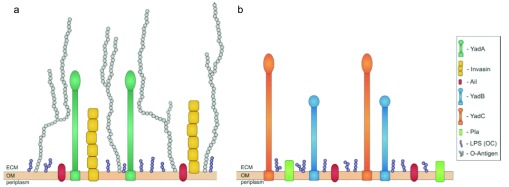
Figure 3.
Virulence factors found on the surface of Yersinia pseudotuberculosis, Yersinia enterocolitica ( a), and Yersinia pestis ( b) Ail, YadB, and YadC are shared by all three pathogens – YadB and YadC are absent from panel (a) for clarity – while Pla is unique to Y. pestis. YadA and invasin are important adhesins in Y. pseudotuberculosis and Y. enterocolitica but are not expressed by Y. pestis. Reproduced from reference .

References

    1. Achtman M, Zurth K, Morelli G, et al. : Yersinia pestis, the cause of plague, is a recently emerged clone of Yersinia pseudotuberculosis. Proc Natl Acad Sci U S A. 1999;96(24):14043–8. 10.1073/pnas.96.24.14043 - DOI - PMC - PubMed
    1. Achtman M, Morelli G, Zhu P, et al. : Microevolution and history of the plague bacillus, Yersinia pestis. Proc Natl Acad Sci U S A. 2004;101(51):17837–42. 10.1073/pnas.0408026101 - DOI - PMC - PubMed
    1. Prentice MB, Rahalison L: Plague. Lancet. 2007;369(9568):1196–207. 10.1016/S0140-6736(07)60566-2 - DOI - PubMed
    1. Stenseth NC, Atshabar BB, Begon M, et al. : Plague: past, present, and future. PLoS Med. 2008;5(1):e3. 10.1371/journal.pmed.0050003 - DOI - PMC - PubMed
    1. Guiyoule A, Gerbaud G, Buchrieser C, et al. : Transferable plasmid-mediated resistance to streptomycin in a clinical isolate of Yersinia pestis. Emerg Infect Dis. 2001;7(1):43–8. - PMC - PubMed

LinkOut - more resources