. 2016 Aug;48(8):959-964.
doi: 10.1038/ng.3599. Epub 2016 Jun 27.

Genomic analysis of local variation and recent evolution in Plasmodium vivax

Affiliations

Genomic analysis of local variation and recent evolution in Plasmodium vivax

Richard D Pearson et al. Nat Genet. 2016 Aug.

Abstract

The widespread distribution and relapsing nature of Plasmodium vivax infection present major challenges for the elimination of malaria. To characterize the genetic diversity of this parasite in individual infections and across the population, we performed deep genome sequencing of >200 clinical samples collected across the Asia-Pacific region and analyzed data on >300,000 SNPs and nine regions of the genome with large copy number variations. Individual infections showed complex patterns of genetic structure, with variation not only in the number of dominant clones but also in their level of relatedness and inbreeding. At the population level, we observed strong signals of recent evolutionary selection both in known drug resistance genes and at new loci, and these varied markedly between geographical locations. These findings demonstrate a dynamic landscape of local evolutionary adaptation in the parasite population and provide a foundation for genomic surveillance to guide effective strategies for control and elimination of P. vivax.


Conflict of interest statement

The authors declare no competing financial interests.

Figures
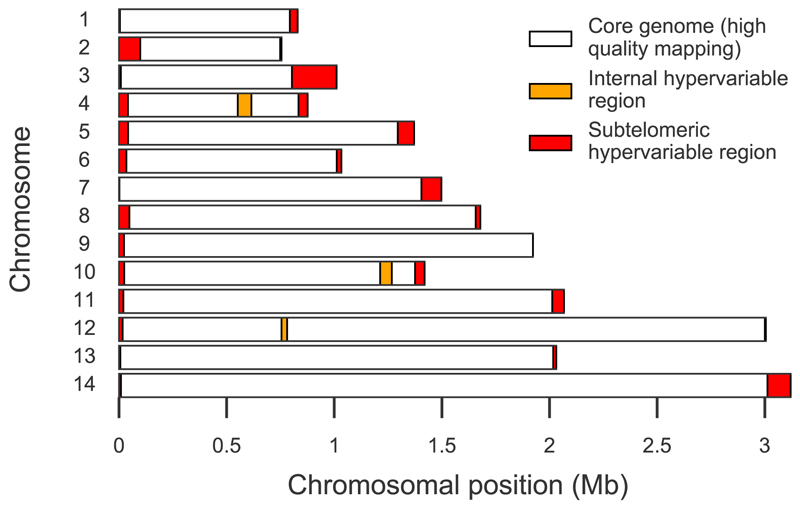
Figure 1
Figure 1. Defining the accessible genome
When short read sequencing data from clinical samples of Plasmodium vivax are aligned to the 14 chromosomes comprising the Sal1 reference genome, there is low coverage and mapping quality in subtelomeric hypervariable regions (red) and three internal hypervariable regions (orange). Excluding these regions, we defined a core genome (white) which comprises 94.4% of the chromosomal sequence; coordinates are given in Supplementary Table 2. Aggregated across all samples, 99% of nucleotide positions in the core genome are alignable (≤10% reads of mapping quality 0) compared to 86% in subtelomeric and 85% in internal hypervariable regions; and 94% of positions in the core genome have ≥5x read depth compared to 37% in subtelomeric and 54% in internal hypervariable regions. When genome assemblies for other P. vivax strains were aligned to the Sal1 reference genome, the genome-wide coverage was 88.5% for India VII, 89.1% for Mauritania I and 89.6% for North Korea strains, whereas the coverage across the core genome was 98.5%, 98.7% and 99.0% respectively.
Figure 2
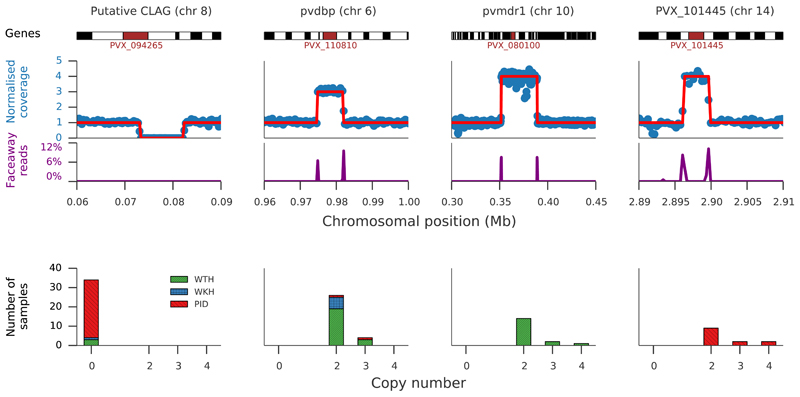
Figure 2. Copy number variation
Common forms of copy number variation in a region of chromosome 8 with a deletion of the first three exons of PVX_094265; in regions of chromosome 6 and 14 with copy number variations of pvdbp and PVX_101445 respectively; and in a region of chromosome 10 region where multiple genes including pvmdr1 are duplicated. Top panel shows an illustrative sample for each genomic region: upper trace shows GC-normalised coverage with inferred copy number marked by red line; lower trace shows the proportion of read pairs mapping in opposing directions, indicating the presumptive breakpoints of a duplication (note that not all samples have identical breakpoints, Supplementary Dataset 2). Lower panel shows number of samples in each population having a copy number other than one: western Thailand (WTH, n=88), western Cambodia (WKH, n=19) and Papua Indonesia (PID, n=41).
Figure 3
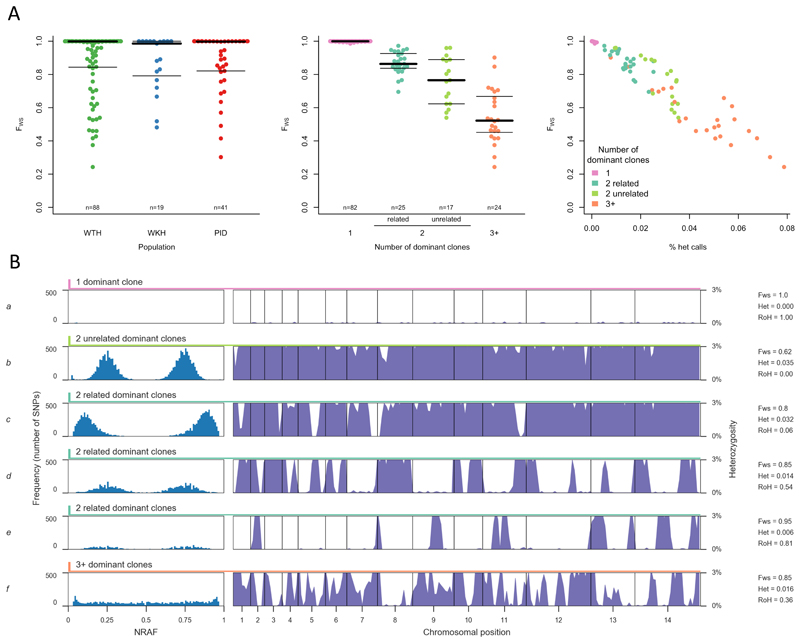
Figure 3. Genetic structure of mixed infections
A shows distribution of FWS across all samples. FWS is analogous to an inbreeding coefficient and a value of 1 indicates a perfect clone. Left: Distribution of FWS in western Thailand (WTH), western Cambodia (WKH) and Papua Indonesia (PID), showing median (thick line) and inter-quartile range (thin line). Middle: Distribution of FWS stratified by the number of dominant clones in a sample and by whether they are related to each other, showing median (thick line) and inter-quartile range (thin line). Right: Distribution of FWS (vertical axis) and the proportion of heterozygous genotype calls (horizontal axis) in samples with different numbers of dominant clones. Each row of B shows an illustrative sample. Left: non-reference allele frequency (NRAF) distribution across all heterozygous SNPs. Right: vertical axis is heterozygosity calculated in 20kb bins with the scale truncated (0–0.03) to highlight runs of homozygosity (RoH). Sample a is near-clonal as evidenced by FWS = 1 and lack of heterozygous SNPs. Samples b-e each contain two dominant clones as evidenced by the bimodal NRAF distribution. Sample b contains two unrelated clones (no RoH). Sample c contains two partially related clones (RoH across minority of the genome). Sample d contains two meiotic siblings (RoH extending over ~50% of the genome). Sample e contains two clones that are the product of inbreeding over multiple generations (RoH extending over ~80% of the genome). Sample f appears to contain a complex mixture of related parasites (relatively flat NRAF distribution indicates multiple dominant clones but there is substantial RoH).
Figure 4
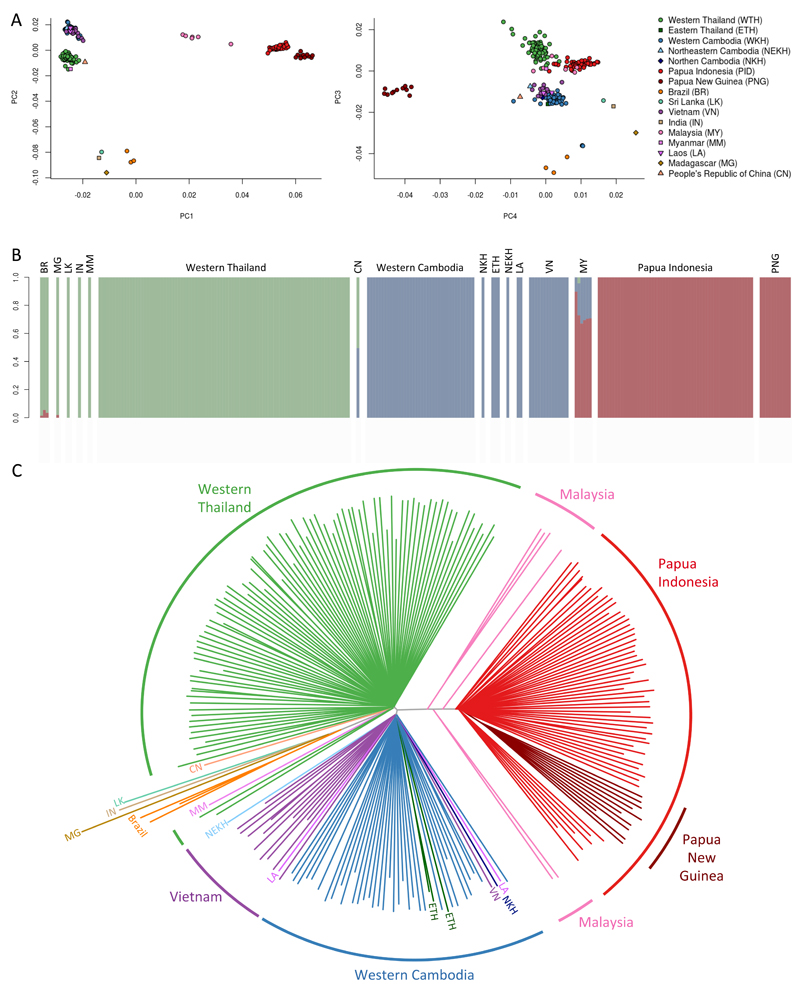
Figure 4. Parasite population structure.
Population structure is evident by principal components analysis (panel A), ADMIXTURE (panel B) and on a neighbour joining tree (panel C). ADMIXTURE analysis identifies three major components of population structure which correspond to the three largest groups of samples, i.e. western Thailand (n=88), western Cambodia (n=37) and Papua Indonesia (n=55). The neighbour-joining tree shows how these three major components encompass the Southeast Asian and Pacific Islands (Malaysia, Papua Indonesia, Papua New Guinea), the western part of mainland Southeast Asia (Western Thailand, Myanmar, and China) and the eastern part of the mainland (Cambodia, Vietnam, Eastern Thailand, and Laos). Samples from other parts of the world (India, Sri Lanka, Madagascar, and Brazil) are separated from Southeast Asian samples by long branches.
Figure 5
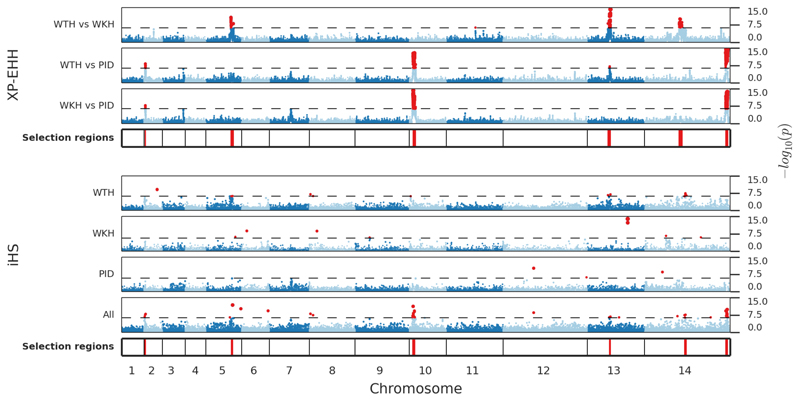
Figure 5. Population-specific signatures of recent positive selection
Metrics of extended haplotype homozygosity were estimated in 88 samples from western Thailand (WTH), 19 from western Cambodia (WKH) and 41 from Papua Indonesia (PID). The strongest evidence for recent selection was identified by XP-EHH (i.e. by comparing populations) and in most cases this was supported by iHS tests within individual populations. Horizontal axis represents genome position with chromosomes 1-14 shown in alternating colours. Vertical axis shows the results of XP-EHH and iHS tests represented by –log10 P values on a scale of 0 to 15. Dashed line shows the Bonferroni-corrected threshold for genome-wide significance, red points mark significant P values. Loci with ≥2 SNPs with significant P values within 80 kb of each other are marked by red lines in the tracks labelled ‘Selected regions’. The iHS signal on chromosome 13 in WKH was confined to two adjacent SNPs and is therefore not marked as significant. These signatures are described in more detail in Supplementary Table 6 and Supplementary Figure 7.

Comment in

References

    1. Gething PW, et al. A long neglected world malaria map: Plasmodium vivax endemicity in 2010. PLoS Negl Trop Dis. 2012;6:e1814. - PMC - PubMed
    1. Miller LH, Mason SJ, Clyde DF, McGinniss MH. The resistance factor to Plasmodium vivax in blacks. The Duffy-blood-group genotype, FyFy. N Engl J Med. 1976;295:302–4. - PubMed
    1. Ménard D, et al. Plasmodium vivax clinical malaria is commonly observed in Duffy-negative Malagasy people. Proc Natl Acad Sci U S A. 2010;107:5967–71. - PMC - PubMed
    1. Price RN, et al. Vivax malaria: neglected and not benign. Am J Trop Med Hyg. 2007;77:79–87. - PMC - PubMed
    1. Battle KE, et al. The global public health significance of Plasmodium vivax. Adv Parasitol. 2012;80:1. - PubMed

Publication types

Substances