


No difference in long-term development of rotator cuff rupture and muscle volumes in impingement patients with or without decompression
- PMID: 27348693
- PMCID: PMC4967276
- DOI: 10.1080/17453674.2016.1177780
No difference in long-term development of rotator cuff rupture and muscle volumes in impingement patients with or without decompression
Abstract
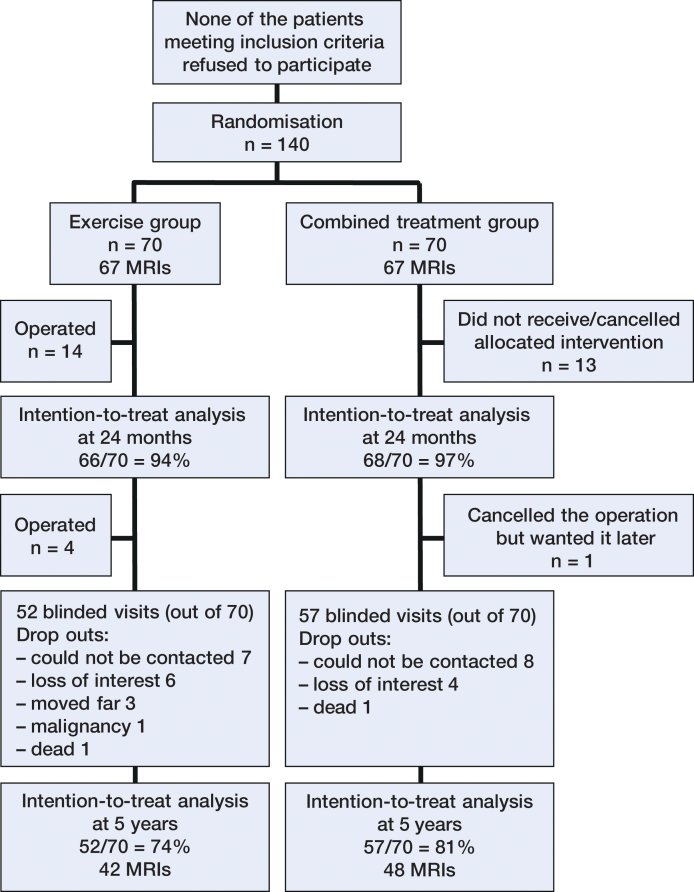
Background and purpose - Arthroscopic acromioplasty is still commonly used in the treatment of shoulder impingement syndrome, even though its benefits are questioned; randomized controlled studies have not shown any benefits when compared to non-operative treatment. In this randomized study, we investigated whether operative treatment protects from later rotator cuff rupture and whether it has any effect on the development of rotator cuff muscle volume. Patients and methods - 140 stage-II impingement patients were randomized to a structured exercise group (n = 70) or to an operative group (n = 70). In the operative group, arthroscopic acromioplasty was performed, after which a similar structured exercise program was begun. MRI of the shoulder was done at baseline and at 5 years. Results - There were no statistically significant differences in either the amount of perforating ruptures of the supraspinatus tendon or in the changes in muscle volume at 5 years. The grading of muscle fatty degeneration showed worse results in the operative group, but this difference was not statistically significant. Interpretation - In this study, we found that arthroscopic acromioplasty does not have any long-term benefit based on radiological findings of muscle volumes. Also, the frequency of later rotator cuff rupture was similar irrespective of whether or not surgery was performed. Acromioplasty is not justified as a treatment for dynamic shoulder impingement syndrome.
Figures
References
-
- Bigliani L U, Levine W N.. Subacromial impingement syndrome. J Bone Joint Surg Am 1997; 79(12): 1854–68. - PubMed
-
- Bjornsson H, Norlin R, Knutsson A, Adolfsson L.. Fewer rotator cuff tears fifteen years after arthroscopic subacromial decompression. J Shoulder Elbow Surg 2010; 19(1): 111–5. - PubMed
-
- Bright A S, Torpey B, Magid D, Codd T, McFarland E G.. Reliability of radiographic evaluation for acromial morphology. Skeletal Radiol 1997; 26(12): 718–21. - PubMed
-
- Brox J I, Gjengedal E, Uppheim G, Bohmer A S, Brevik J I, Ljunggren A E, et al. Arthroscopic surgery versus supervised exercises in patients with rotator cuff disease (stage II impingement syndrome): a prospective, randomized, controlled study in 125 patients with a 2 1/2-year follow-up. J Shoulder Elbow Surg 1999; 8(2): 102–11. - PubMed
-
- Fuchs B, Weishaupt D, Zanetti M, Hodler J, Gerber C.. Fatty degeneration of the muscles of the rotator cuff: assessment by computed tomography versus magnetic resonance imaging. J Shoulder Elbow Surg 1999; 8(6): 599–605. - PubMed
Publication types
MeSH terms
LinkOut - more resources
Full Text Sources
Other Literature Sources
Medical