Comparison of rates of safety issues and reporting of trial outcomes for medical devices approved in the European Union and United States: cohort study
- PMID: 27352914
- PMCID: PMC4925918
- DOI: 10.1136/bmj.i3323
Comparison of rates of safety issues and reporting of trial outcomes for medical devices approved in the European Union and United States: cohort study
Abstract
Objective: To evaluate safety alerts and recalls, publication of key trial outcomes, and subsequent US approval of high profile medical devices introduced in the European Union.
Design: Cohort study.
Setting: Novel cardiovascular, orthopedic, and neurologic devices approved in the EU through Conformité Européenne marking between 2005 and 2010.
Data sources: Public and commercial databases searched up to January 2016 for press releases and announcements of approvals; public Food and Drug Administration and European regulatory authority databases for US approvals and safety alerts and recalls; and Medline, Embase, and Web of Science for peer reviewed publications.
Main outcome measures: We categorized the novelty of the devices in the study sample as a "major innovation" or an "other change," and extracted descriptive data about the devices and information on any safety alerts and withdrawals. Linear regression models examined factors associated with differential EU and US approvals. Cox proportional hazards regression models were used to evaluate factors associated with safety alerts and recalls and the publication of trial outcomes for devices categorized as major innovations. Models controlled for time, therapeutic category, regulatory pathway, size of sponsoring company, and indicator variables for devices approved first in the EU and devices approved only in the EU.
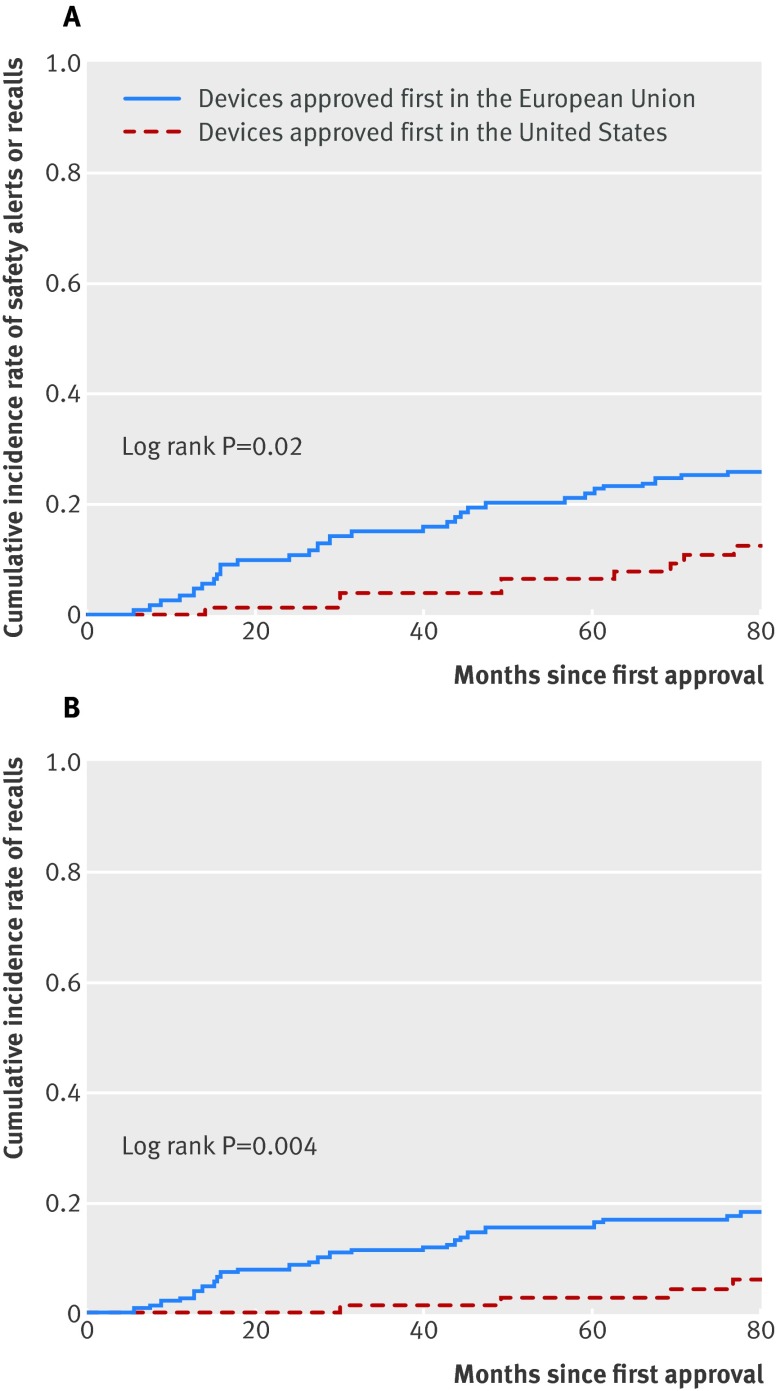
Results: 67% (206/309) of devices identified were approved in both the US and the EU, of which 63% (129/206) were approved first in the EU. The unadjusted rate of safety alerts and recalls for devices approved first in the EU was 27% (62/232) compared with 14% (11/77) for devices approved first in the US. The adjusted hazard ratio for safety alerts and recalls was 2.9 (95% confidence interval 1.4 to 6.2) for devices approved first in the EU. The results of pivotal trials were published for 49% (37/75) of devices categorized as major innovations, with an overall publication rate of 37% five years after approval.
Conclusions: Devices approved first in the EU are associated with an increased risk of post-marketing safety alerts and recalls. Poor trial publication rates mean that patients and clinicians need greater regulatory transparency to make informed decisions about treatment.
Published by the BMJ Publishing Group Limited. For permission to use (where not already granted under a licence) please go to http://group.bmj.com/group/rights-licensing/permissions.
Conflict of interest statement
Competing interests: All authors have completed the ICMJE uniform disclosure form at
Figures
References
-
- Kramer DB, Xu S, Kesselheim AS. Regulation of medical devices in the United States and European Union. N Engl J Med 2012;366:848-55. 10.1056/NEJMhle1113918 pmid:22332952. - DOI - PubMed
-
- Curfman GD, Redberg RF. Medical devices--balancing regulation and innovation. N Engl J Med 2011;365:975-7. 10.1056/NEJMp1109094 pmid:21830959. - DOI - PubMed
-
- Hwang TJ, Carpenter D, Kesselheim AS. Assessment of US pathway for approving medical devices for rare conditions. BMJ 2014;348:g217 10.1136/bmj.g217 pmid:24443478. - DOI - PubMed
-
- Sorenson C, Drummond M. Improving medical device regulation: the United States and Europe in perspective. Milbank Q 2014;92:114-50. 10.1111/1468-0009.12043 pmid:24597558. - DOI - PMC - PubMed
-
- Fox DM, Zuckerman DM. Regulatory reticence and medical devices. Milbank Q 2014;92:151-9. 10.1111/1468-0009.12044 pmid:24597559. - DOI - PMC - PubMed
Publication types
MeSH terms
LinkOut - more resources
Full Text Sources
Other Literature Sources