Discontinuation and restarting in patients on statin treatment: prospective open cohort study using a primary care database
- PMID: 27353261
- PMCID: PMC4925919
- DOI: 10.1136/bmj.i3305
Discontinuation and restarting in patients on statin treatment: prospective open cohort study using a primary care database
Abstract
Objectives: To estimate rates of discontinuation and restarting of statins, and to identify patient characteristics associated with either discontinuation or restarting.
Design: Prospective open cohort study.
Setting: 664 general practices contributing to the Clinical Practice Research Datalink in the United Kingdom. Data extracted in October 2014.
Participants: Incident statin users aged 25-84 years identified between January 2002 and September 2013. Patients with statin prescriptions divided into two groups: primary prevention and secondary prevention (those already diagnosed with cardiovascular disease). Patients with statin prescriptions in the 12 months before study entry were excluded.
Main outcome measures: Discontinuation of statin treatment (first 90 day gap after the estimated end date of a statin prescription), and restarting statin treatment for those who discontinued (defined as any subsequent prescription between discontinuation and study end).
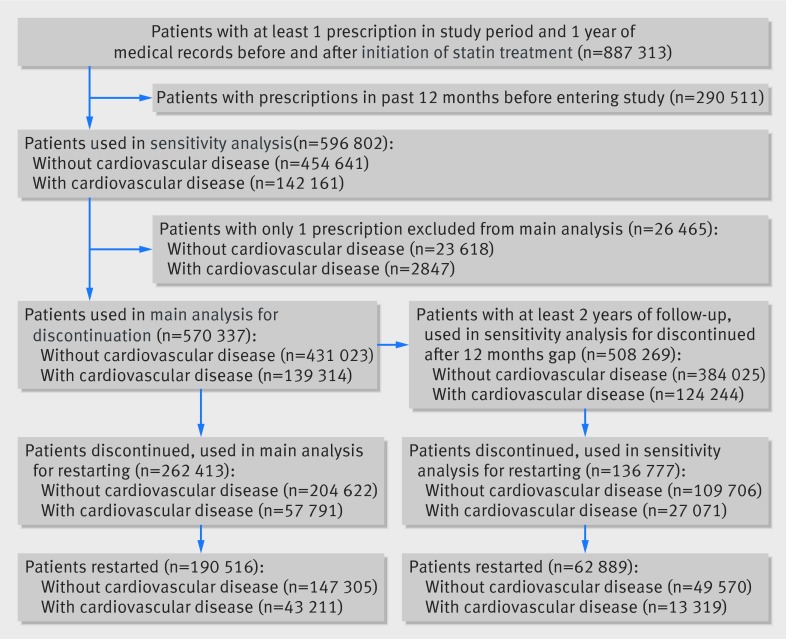
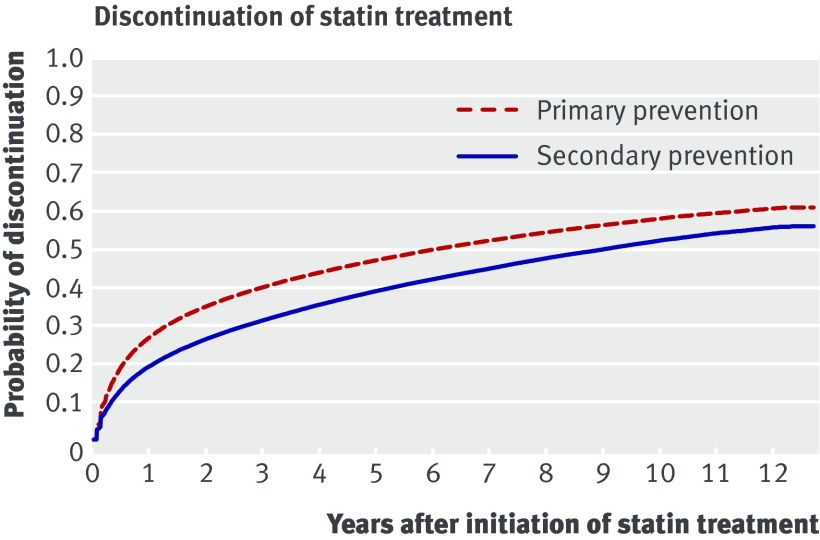
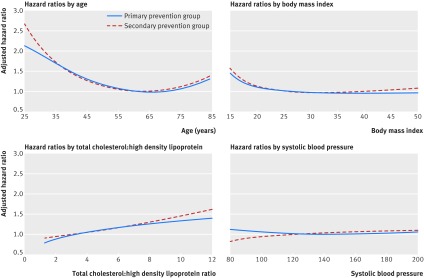
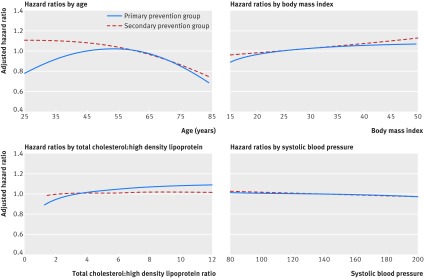
Results: Of 431 023 patients prescribed statins as primary prevention with a median follow-up time of 137 weeks, 47% (n=204 622) discontinued treatment and 72% (n=147 305) of those who discontinued restarted. Of 139 314 patients prescribed statins as secondary prevention with median follow-up time of 182 weeks, 41% (n=57 791) discontinued treatment and 75% (43 211) of those who discontinued restarted. Younger patients (aged ≤50 years), older patients (≥75 years), women, and patients with chronic liver disease were more likely to discontinue statins and less likely to restart. However, patients in ethnic minority groups, current smokers, and patients with type 1 diabetes were more likely to discontinue treatment but then were more likely to restart, whereas patients with hypertension and type 2 diabetes were less likely to discontinue treatment and more likely to restart if they did discontinue. These results were mainly consistent in the primary prevention and secondary prevention groups.
Conclusions: Although a large proportion of statin users discontinue, many of them restart. For many patient groups previously considered as "stoppers," the problem of statin treatment "stopping" could be part of the wider issue of poor adherence. Identification of patient groups associated with completely stopping or stop-starting behaviour has positive implications for patients and doctors as well as suggesting areas for future research.
Published by the BMJ Publishing Group Limited. For permission to use (where not already granted under a licence) please go to http://group.bmj.com/group/rights-licensing/permissions.
Conflict of interest statement
Competing interests: All authors have completed the ICMJE uniform disclosure form at
Figures

References
-
- Trusler D. Statin prescriptions in UK now total a million each week. BMJ 2011;343:d4350 10.1136/bmj.d4350 pmid:21757438. - DOI - PubMed
-
- Stone NJ, Robinson JG, Lichtenstein AH, et al. American College of Cardiology/American Heart Association Task Force on Practice Guidelines. 2013 ACC/AHA guideline on the treatment of blood cholesterol to reduce atherosclerotic cardiovascular risk in adults: a report of the American College of Cardiology/American Heart Association Task Force on Practice Guidelines [corrections in: J Am Coll Cardiol 2015;66:2812 and J Am Coll Cardiol 2014;63:3024-5]. J Am Coll Cardiol 2014;63(25, Part B):2889-934. 10.1016/j.jacc.2013.11.002 pmid:24239923. - DOI - PubMed
-
- National Institute for Health and Care Excellence. Lipid modification: cardiovascular risk assessment and the modification of blood lipids for the primary and secondary prevention of cardiovascular disease. Clinical guideline 181.NICE, 2014. - PubMed
-
- National Institute for Health and Care Excellence. Lipid modification: cardiovascular risk assessment and the modification of blood lipids for the primary and secondary prevention of cardiovascular disease. Clinical guideline 67.NICE, 2008. - PubMed
-
- Mihaylova B, Emberson J, Blackwell L, et al. Cholesterol Treatment Trialists’ (CTT) Collaborators. The effects of lowering LDL cholesterol with statin therapy in people at low risk of vascular disease: meta-analysis of individual data from 27 randomised trials. Lancet 2012;380:581-90. 10.1016/S0140-6736(12)60367-5 pmid:22607822. - DOI - PMC - PubMed
MeSH terms
Substances
LinkOut - more resources
Full Text Sources
Other Literature Sources
Medical
Miscellaneous