


Mother-Child Interaction: Links Between Mother and Child Frontal Electroencephalograph Asymmetry and Negative Behavior
- PMID: 27354097
- PMCID: PMC5247379
- DOI: 10.1111/cdev.12583
Mother-Child Interaction: Links Between Mother and Child Frontal Electroencephalograph Asymmetry and Negative Behavior
Abstract
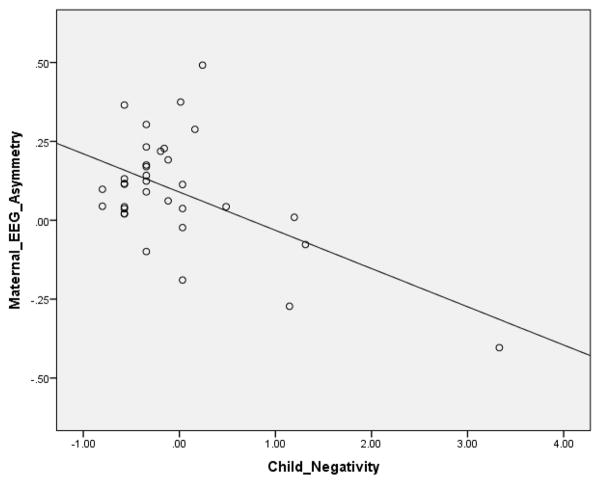
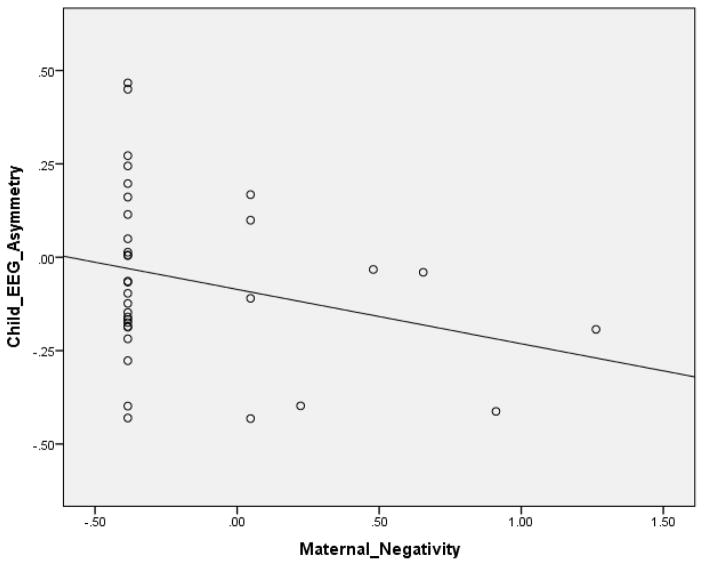
It is well accepted that parent-child interactions are bidirectional by nature, yet not much is known about the psychophysiological activity underlying these interactions. This study examined, during a parent-child interaction, how a child's negativity statistically predicted maternal frontal electroencephalograph (EEG) asymmetry and how a mother's negativity statistically predicted child frontal EEG asymmetry. Thirty-four mother-child dyads participated in the study. Maternal and child behaviors and physiology were measured during a puzzle task. Results indicated that mothers whose children exhibited more challenging behaviors during the dyadic interaction displayed more right (relative to left) asymmetry, as did children whose mothers were high in negativity during the interaction. These findings suggest that mothers and children react to each other's signals not only behaviorally but also physiologically.
© 2016 The Authors. Child Development © 2016 Society for Research in Child Development, Inc.
Figures
References
-
- Bakeman R, Gottman JM. Observing interaction: An introduction to sequential analysis. New York, NY: Cambridge University Press; 1986.
-
- Bell MA, Fox NA. Brain development over the first year of life. In: Dawson G, Fischer KW, editors. Human behavior and the developing brain. New York, NY: Guilford; 1994. pp. 314–345.
-
- Bell RQ. A reinterpretation of the direction of effects in studies of socialization. Psychological Review. 1968;75:81–95. - PubMed
-
- Belsky J, de Haan M. Annual research review: Parenting and children’s brain development: The end of the beginning. Journal of Child Psychology and Psychiatry. 2011;52:409–428. - PubMed
-
- Calkins SD. Origins and outcomes of individual differences in emotion regulation. Monographs of the Society for Research in Child Development. 1994;59:53–72. - PubMed
Publication types
MeSH terms
Grants and funding
LinkOut - more resources
Full Text Sources
Other Literature Sources
