


Elevated Angiopoietin-2 Level in Patients With Continuous-Flow Left Ventricular Assist Devices Leads to Altered Angiogenesis and Is Associated With Higher Nonsurgical Bleeding
- PMID: 27354285
- PMCID: PMC4942355
- DOI: 10.1161/CIRCULATIONAHA.115.019692
Elevated Angiopoietin-2 Level in Patients With Continuous-Flow Left Ventricular Assist Devices Leads to Altered Angiogenesis and Is Associated With Higher Nonsurgical Bleeding
Abstract
Background: Nonsurgical bleeding is the most common adverse event in patients with continuous-flow left ventricular assist devices (LVADs) and is caused by arteriovenous malformations. We hypothesized that deregulation of an angiogenic factor, angiopoietin-2 (Ang-2), in patients with LVADs leads to increased angiogenesis and higher nonsurgical bleeding.
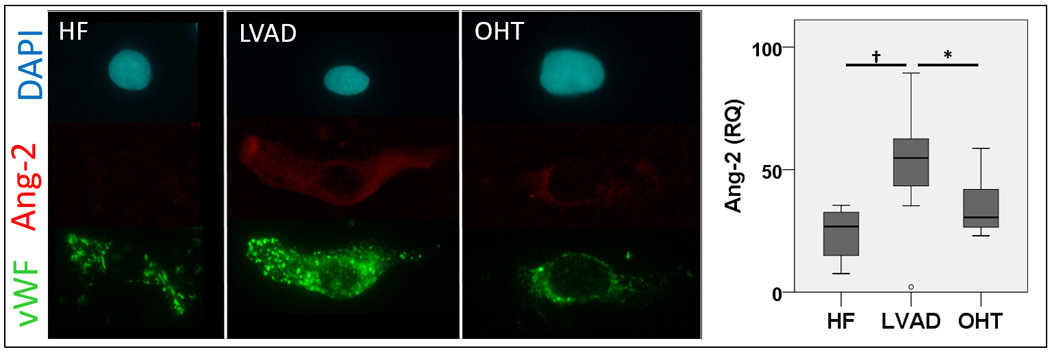
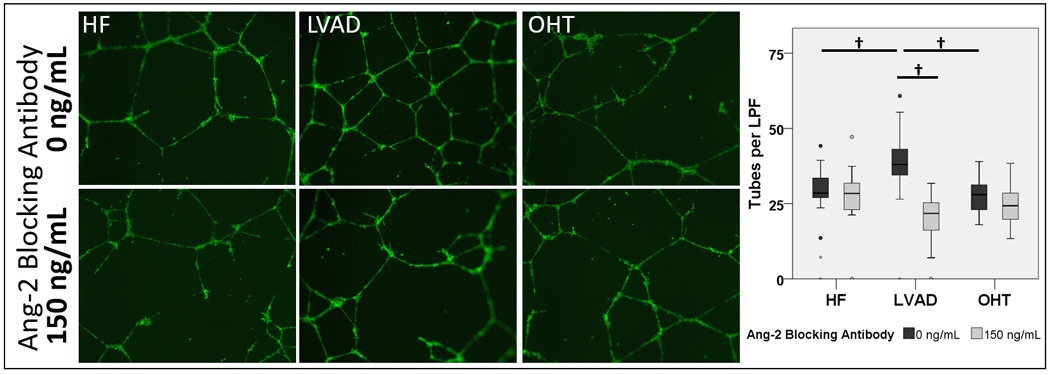
Methods: Ang-2 and thrombin levels were measured by ELISA and Western blotting, respectively, in blood samples from 101 patients with heart failure, LVAD, or orthotopic heart transplantation. Ang-2 expression in endothelial biopsy was quantified by immunofluorescence. Angiogenesis was determined by in vitro tube formation from serum from each patient with or without Ang-2-blocking antibody. Ang-2 gene expression was measured by reverse transcription-polymerase chain reaction in endothelial cells incubated with plasma from each patient with or without the thrombin receptor blocker vorapaxar.
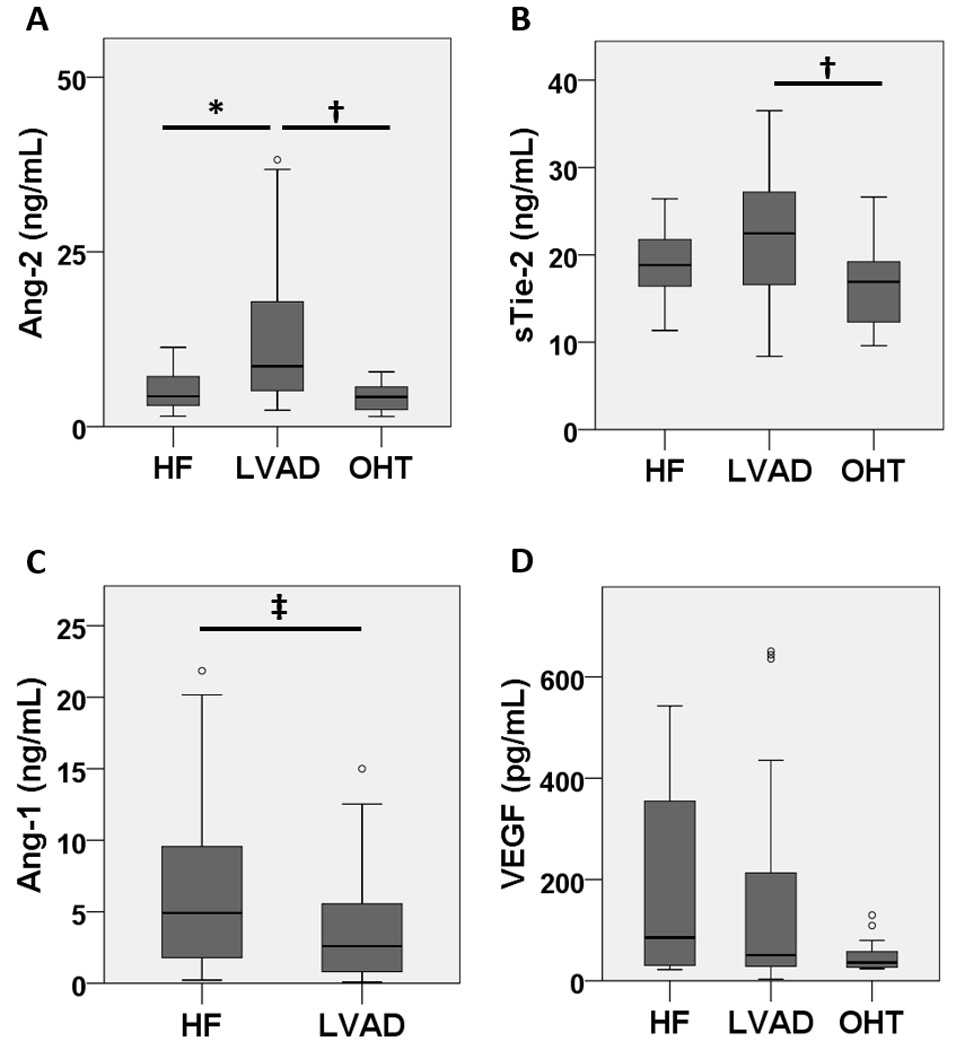
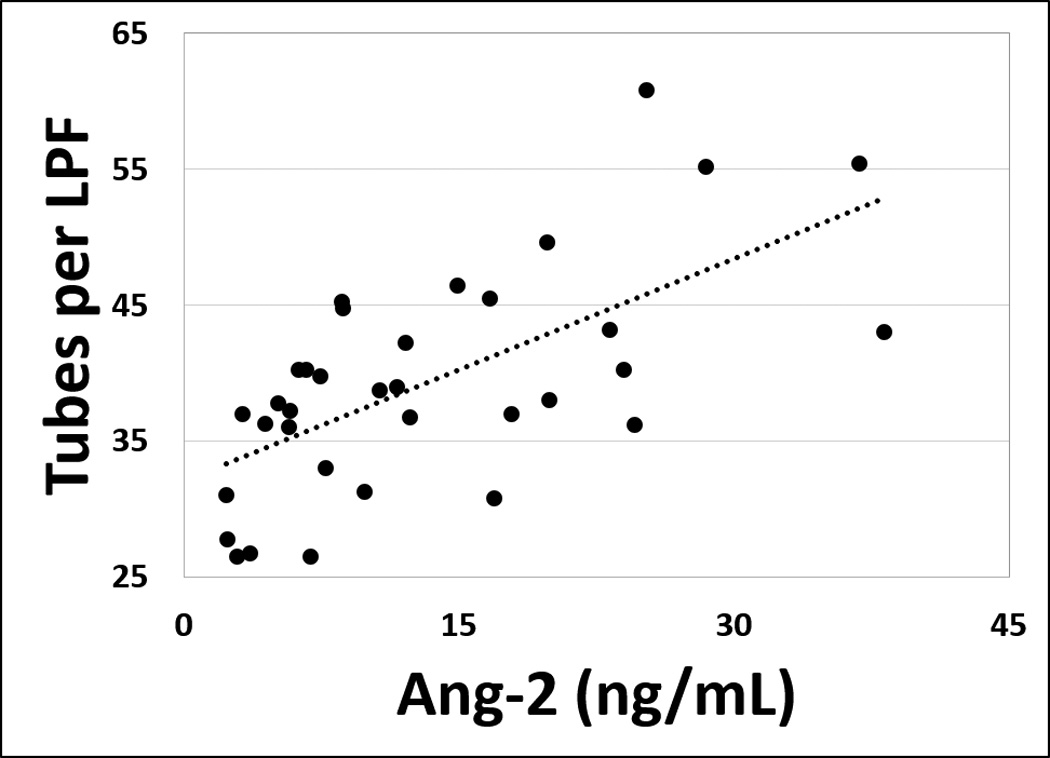
Results: Compared with patients with heart failure or those with orthotopic heart transplantation, serum levels and endothelial expression of Ang-2 were higher in LVAD patients (P=0.001 and P<0.001, respectively). This corresponded to an increased angiogenic potential of serum from patients with LVADs (P<0.001), which was normalized with Ang-2 blockade. Furthermore, plasma from LVAD patients contained higher amounts of thrombin (P=0.003), which was associated with activation of the contact coagulation system. Plasma from LVAD patients induced more Ang-2 gene expression in endothelial cells (P<0.001), which was reduced with thrombin receptor blockade (P=0.013). LVAD patients with Ang-2 levels above the mean (12.32 ng/mL) had more nonsurgical bleeding events compared with patients with Ang-2 levels below the mean (P=0.003).
Conclusions: Our findings indicate that thrombin-induced Ang-2 expression in LVAD patients leads to increased angiogenesis in vitro and may be associated with higher nonsurgical bleeding events. Ang-2 therefore may contribute to arteriovenous malformation formation and subsequent bleeding in LVAD patients.
Keywords: LVAD; angiogenesis; angiopoietin-2; cardiac transplant; nonsurgical bleeding; thrombin.
© 2016 American Heart Association, Inc.
Figures


Comment in
-
Bleeding in continuous flow left ventricular assist device recipients: an acquired vasculopathy?J Thorac Dis. 2016 Oct;8(10):E1321-E1327. doi: 10.21037/jtd.2016.10.81. J Thorac Dis. 2016. PMID: 27867617 Free PMC article. No abstract available.
-
Angiopoietin-2: marker or mediator of angiogenesis in continuous-flow left ventricular assist device patients?J Thorac Dis. 2016 Nov;8(11):3042-3045. doi: 10.21037/jtd.2016.11.04. J Thorac Dis. 2016. PMID: 28066578 Free PMC article. No abstract available.
-
Stop the LVAD bleeding.J Thorac Dis. 2017 May;9(5):E437-E439. doi: 10.21037/jtd.2017.03.09. J Thorac Dis. 2017. PMID: 28616303 Free PMC article. No abstract available.
References
-
- Morgan JA, Paone G, Nemeh HW, Henry SE, Patel R, Vavra J, Williams CT, Lanfear DE, Tita C, Brewer RJ. Gastrointestinal bleeding with the HeartMate II left ventricular assist device. The Journal of heart and lung transplantation : the official publication of the International Society for Heart Transplantation. 2012;31:715–718. - PubMed
-
- Suarez J, Patel CB, Felker GM, Becker R, Hernandez AF, Rogers JG. Mechanisms of bleeding and approach to patients with axial-flow left ventricular assist devices. Circulation Heart failure. 2011;4:779–784. - PubMed
-
- Yuzefpolskaya M, Godier-Furnemont A, Levin AP, Dionizovik-Dimanovski M, Takayama H, Naka Y, Uriel N, Colombo PC, Vunjak-Novakovic G, Jorde UP. Myocardial Microvascular Density Increases After Chronic Continuous Flow Left Ventricular Assist Device (CF-LVAD) Support. The Journal of Heart and Lung Transplantation. 33:S236–S237.
-
- Cascone T, Heymach JV. Targeting the angiopoietin/Tie2 pathway: cutting tumor vessels with a double-edged sword? Journal of clinical oncology : official journal of the American Society of Clinical Oncology. 2012;30:441–444. - PubMed
-
- Metcalf DJ, Nightingale TD, Zenner HL, Lui-Roberts WW, Cutler DF. Formation and function of Weibel-Palade bodies. Journal of cell science. 2008;121:19–27. - PubMed
Publication types
MeSH terms
Substances
Grants and funding
LinkOut - more resources
Full Text Sources
Other Literature Sources
Medical
Miscellaneous
