Comparative Study
. 2016 Jul 12;113(28):E4107-16.
doi: 10.1073/pnas.1606267113. Epub 2016 Jun 27.

β-arrestin-biased signaling through the β2-adrenergic receptor promotes cardiomyocyte contraction

Affiliations
Comparative Study

β-arrestin-biased signaling through the β2-adrenergic receptor promotes cardiomyocyte contraction

Richard Carr 3rd et al. Proc Natl Acad Sci U S A. .

Abstract

β-adrenergic receptors (βARs) are critical regulators of acute cardiovascular physiology. In response to elevated catecholamine stimulation during development of congestive heart failure (CHF), chronic activation of Gs-dependent β1AR and Gi-dependent β2AR pathways leads to enhanced cardiomyocyte death, reduced β1AR expression, and decreased inotropic reserve. β-blockers act to block excessive catecholamine stimulation of βARs to decrease cellular apoptotic signaling and normalize β1AR expression and inotropy. Whereas these actions reduce cardiac remodeling and mortality outcomes, the effects are not sustained. Converse to G-protein-dependent signaling, β-arrestin-dependent signaling promotes cardiomyocyte survival. Given that β2AR expression is unaltered in CHF, a β-arrestin-biased agonist that operates through the β2AR represents a potentially useful therapeutic approach. Carvedilol, a currently prescribed nonselective β-blocker, has been classified as a β-arrestin-biased agonist that can inhibit basal signaling from βARs and also stimulate cell survival signaling pathways. To understand the relative contribution of β-arrestin bias to the efficacy of select β-blockers, a specific β-arrestin-biased pepducin for the β2AR, intracellular loop (ICL)1-9, was used to decouple β-arrestin-biased signaling from occupation of the orthosteric ligand-binding pocket. With similar efficacy to carvedilol, ICL1-9 was able to promote β2AR phosphorylation, β-arrestin recruitment, β2AR internalization, and β-arrestin-biased signaling. Interestingly, ICL1-9 was also able to induce β2AR- and β-arrestin-dependent and Ca(2+)-independent contractility in primary adult murine cardiomyocytes, whereas carvedilol had no efficacy. Thus, ICL1-9 is an effective tool to access a pharmacological profile stimulating cardioprotective signaling and inotropic effects through the β2AR and serves as a model for the next generation of cardiovascular drug development.

Keywords: GPCR; arrestin; carvedilol; heart failure; pepducin.


Conflict of interest statement

The authors declare no conflict of interest.

Figures
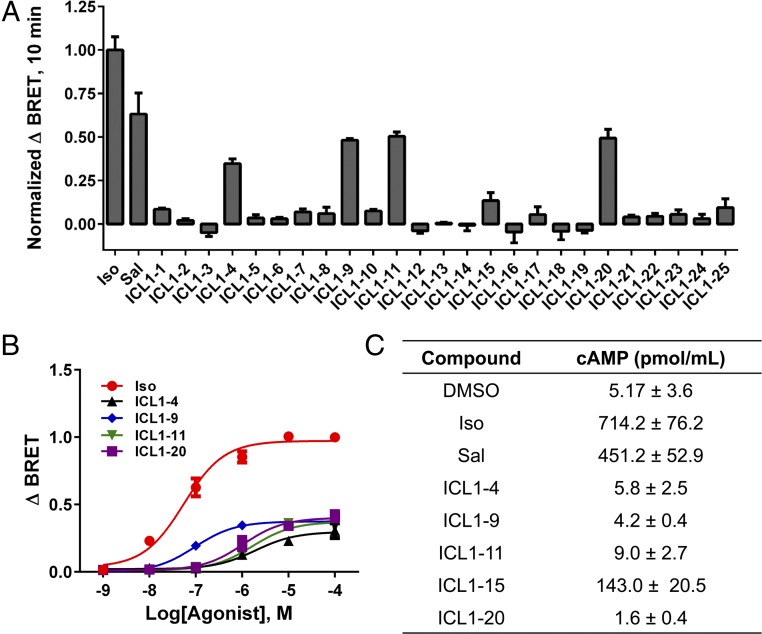
Fig. 1.
Fig. 1.
ICL1–9 is a potent β-arrestin–biased pepducin. (A) β-Arrestin recruitment was assessed by BRET2 in HEK293 cells transiently transfected with β2AR–RLucII and GFP10–β-arrestin2. β-Arrestin2 recruitment is reported at 10 min postagonist stimulation with 1 μM isoproterenol (Iso), 5 μM salbutamol (Sal), or 10 μM pepducin. The sequences of these pepducins and initial BRET analysis for isoproterenol, salbutamol, ICL1–4, ICL1–11, ICL1–15, and ICL1–20 have been previously reported, albeit as time courses (5). Although ICL1–9 exhibited a modest ability to promote β-arrestin recruitment in our previous primary screen (5), subsequent analysis shows that it has comparable efficacy to ICL1–4, ICL1–11, and ICL1–20. The data are represented by the mean ± SD from three independent experiments. (B) ICL1–9 is a high-potency β-arrestin–biased pepducin with an EC50 of 96 ± 14 nM with a sequence of LVITAIAKFERLQTVTNY containing an N-terminal palmitate and C-terminal amide (5). ICL1–4 (1.9 ± 0.5 μM), ICL1–11 (1.7 ± 0.5 μM), and ICL1–20 (1.1 ± 0.3 μM) demonstrated comparable efficacy to ICL1–9 but operated with lower potency. The data are represented by the mean ± SD from three independent experiments. (C) cAMP production in HEK293 cells using Iso, Sal, and the pepducins that promoted β-arrestin recruitment in A. The data represent the mean ± SD from three independent experiments and are primarily derived from our previous report (5).
Fig. 2.
Fig. 2.
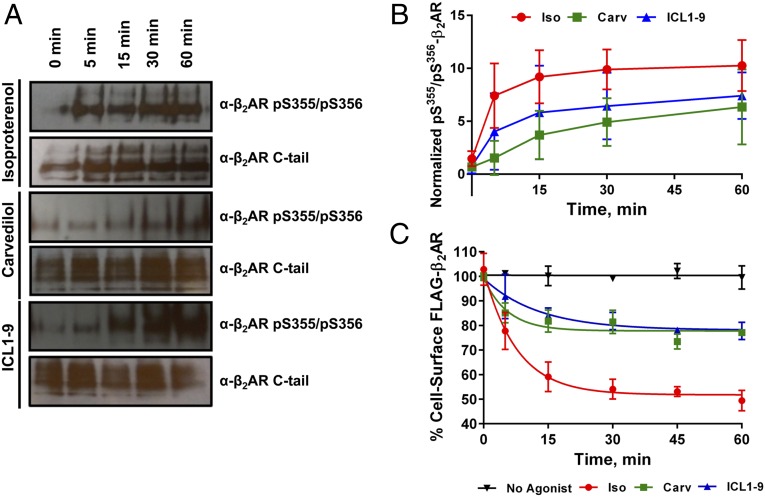
ICL1–9 promotes β2AR phosphorylation and internalization. (A) Receptor phosphorylation was monitored over a time course in the presence of 1 μM isoproterenol, 10 μM carvedilol or 10 μM ICL1–9 in HEK293 cells stably overexpressing FLAG–β2AR. In-cell phosphorylation was detected using a phosphospecific antibody for pSer355/pSer356 postreceptor immunoprecipitation. With slower kinetics than isoproterenol, ICL1–9 and carvedilol promoted robust receptor phosphorylation. The data are representative of three independent experiments. (B) Relative pSer355/pSer356 detection as determined by densitometry analysis (ImageJ) of immunoprecipitated β2AR from HEK293 cells stably overexpressing a FLAG–β2AR in the presence of 1 μM isoproterenol, 10 μM carvedilol, or 10 μM ICL1–9. The data are represented by the mean ± SD from three independent experiments. (C) Both carvedilol and ICL1–9 were able to stimulate comparable levels of FLAG–β2AR internalization as monitored by a cell-surface ELISA, albeit less than that induced by isoproterenol. The data are represented by the mean ± SD from three independent experiments.
Fig. 3.
Fig. 3.
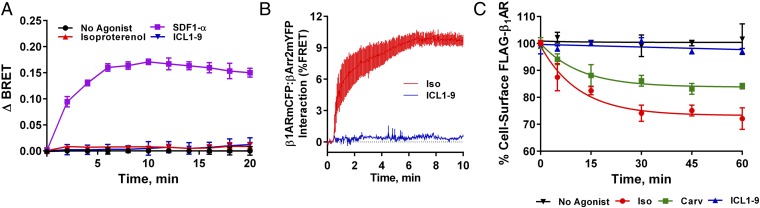
ICL1–9 demonstrates specificity toward the β2AR compared with CXCR4 and the β1AR. (A) β-Arrestin2 recruitment was monitored over a time-course postagonist stimulation with 50 nM SDF-1α, 1 μM isoproterenol, or 10 μM ICL1–9 by BRET2 in HEK293 cells stably overexpressing FLAG–β2AR and transiently transfected with CXCR4–RLucII and GFP10–β-arrestin2. SDF-1α was able to effectively promote β-arrestin2 recruitment to CXCR4, whereas isoproterenol and ICL1–9 had no effect. The data are represented by the mean ± SD from three independent experiments. (B) β-Arrestin2 recruitment was monitored over a time-course postagonist stimulation with 1 μM isoproterenol or 10 μM ICL1–9 by FRET in U2S cells infected with FLAG–β1AR–mCFP and Ad–β-arrestin2–mYFP. Isoproterenol was able to effectively promote β-arrestin2 recruitment to the β1AR, whereas ICL1–9 did not demonstrate similar efficacy. The data are represented by the mean ± SEM from three independent experiments. (C) Agonist-promoted β1AR internalization was monitored by a cell-surface ELISA in HEK293 cells transiently expressing FLAG–β1AR. Both carvedilol (10 μM) and isoproterenol (1 μM) were able to promote FLAG–β1AR internalization, whereas ICL1–9 (10 μM) did not stimulate FLAG–β1AR internalization. The data are represented by the mean ± SD from three independent experiments.
Fig. 4.
Fig. 4.
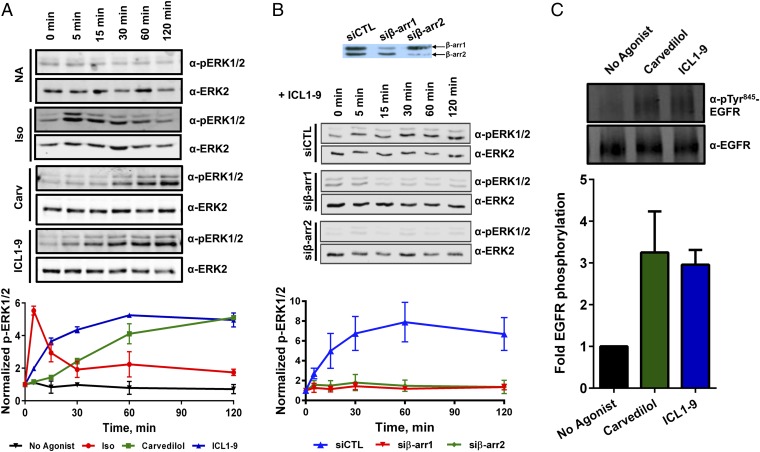
ICL1–9 promotes β-arrestin–biased intracellular signaling. (A) As monitored by Western blotting, ICL1–9, carvedilol, and isoproterenol promoted ERK1/2 phosphorylation in HEK293 cells stably overexpressing a FLAG–β2AR with response profiles that varied in kinetics (isoproterenol > ICL1–9 > carvedilol) and efficacy. The blots are representative of three independent experiments and the plot represents the quantitated mean ± SD from three independent experiments. (B) In cells treated with siRNAs targeted to β-arrestin1 (Middle) and β-arrestin2 (Bottom), ICL1–9-promoted ERK1/2 phosphorylation (blue) is dependent on β-arrestin expression. The blots are representative of three independent experiments and the plot represents the quantitated mean ± SD from three independent experiments. (C) Carvedilol and ICL1–9 demonstrated similar efficacy in EGFR transactivation as monitored by Western blotting for EGFR pTyr845 in HEK293 cells stably overexpressing FLAG–β2AR. The blot is representative of three independent experiments and the plot represents the quantitated mean ± SD from three independent experiments.
Fig. S1.
Fig. S1.
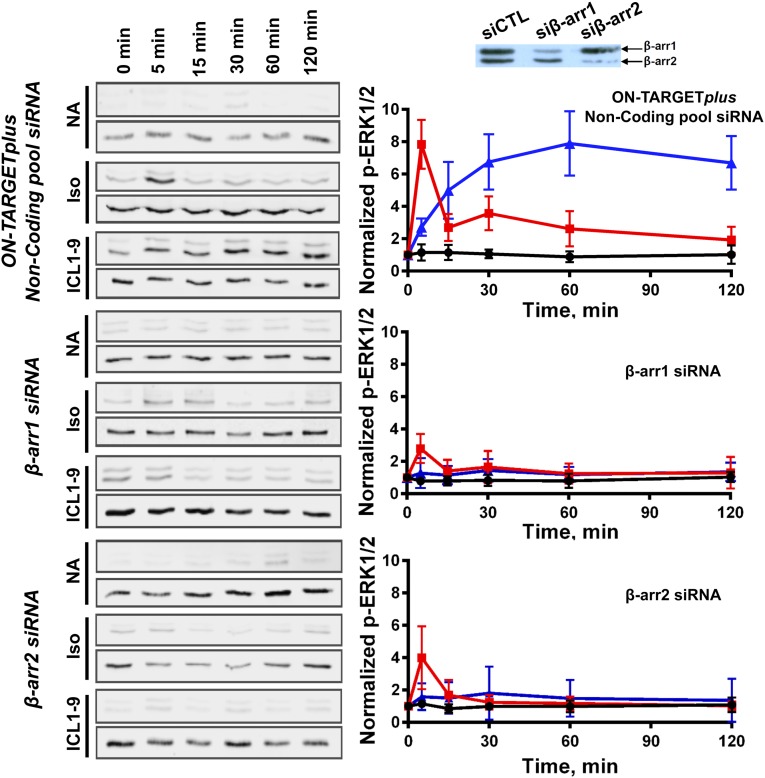
In cells treated with siRNAs targeted to β-arrestin1 (Middle) and β-arrestin2 (Bottom), ICL1–9-promoted ERK1/2 phosphorylation (blue) is dependent on β-arrestin expression. Interestingly, siRNA treatment targeting β-arrestin1 and β-arrestin2 also reduced the burst and sustained phase of isoproterenol-promoted ERK1/2 phosphorylation (red). The blots are representative of three independent experiments and the plot represents the quantitated mean ± SD from three independent experiments. The ICL1–9 results are identical to those shown in Fig. 4B.
Fig. 5.
Fig. 5.
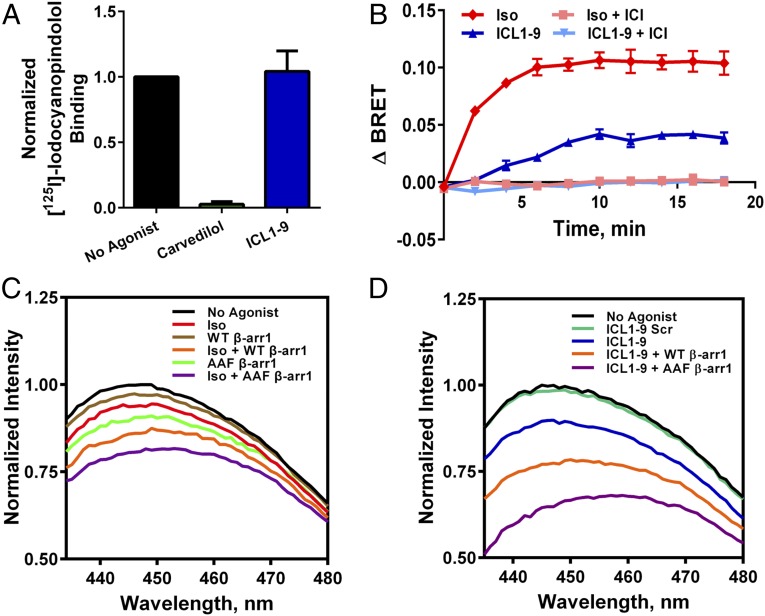
ICL1–9 operates independently of the orthosteric ligand-binding site to stabilize a β2AR conformation that can interact with β-arrestins. (A) ICL1–9 did not modulate [125I]-iodocyanopindolol binding in HEK293 cells stably overexpressing a FLAG–β2AR, whereas carvedilol completely inhibited radioligand binding. The data are represented by the mean ± SD from three independent experiments. (B) The ability of ICL1–9 to recruit β-arrestins (as monitored by BRET2) can be inhibited by the inverse agonist ICI-118551 despite its ability to operate independently of the ligand-binding site. The data are represented by the mean ± SD from three independent experiments. (C) Lipid bicelles containing 50 nM purified β2AR labeled with monobromobimane at Cys265 detected TM6 movement (loss of peak fluorescence and increase in λmax) in the presence of 100 nM isoproterenol (red), 50 nM WT β-arrestin1 (brown), and 50 nM β-arrestin1–AAF (green) with response profiles that varied in magnitude (β-arrestin1–AAF > isoproterenol > WT β-arrestin1). Coincubation with WT β-arrestin1 (orange) or β-arrestin1–AAF (purple) in the presence of isoproterenol further stabilized TM6 movement. (D) ICL1–9 (10 μM, blue) also stabilized a conformational change in the β2AR that promoted TM6 movement. Coincubation of ICL1–9 with WT β-arrestin1 (orange) or β-arrestin1–AAF (purple) further stabilized TM6 movement.
Fig. 6.
Fig. 6.
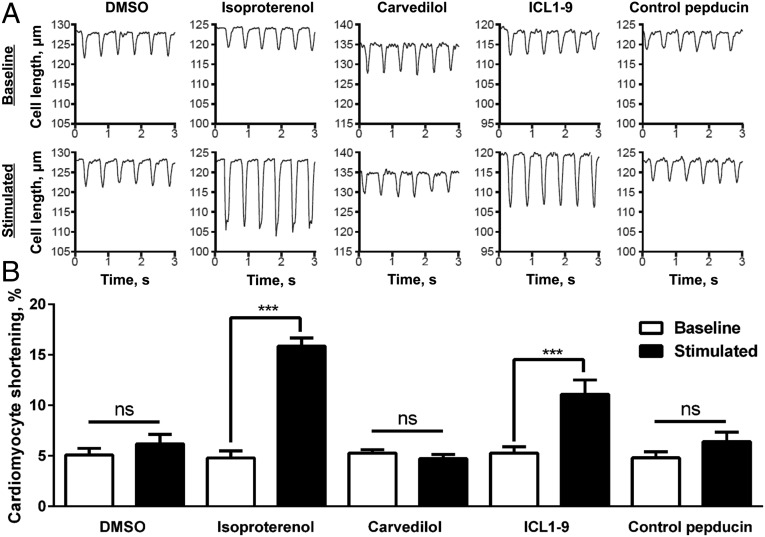
ICL1–9 promotes β2AR-mediated cardiomyocyte contraction, whereas carvedilol does not demonstrate similar efficacy. (A) WT adult murine cardiomyocytes were isolated and assessed for basal and agonist-promoted contractility using a digital videocamera-coupled microscope in the presence or absence of 0.1% DMSO, 0.5 μM isoproterenol, 10 μM carvedilol, 10 μM ICL1–9, or 10 μM control pepducin. Representative cell length (in micrometers) tracings at 2 Hz in the basal or stimulated state for each test condition are reported. (B) ICL1–9 was able to promote significant contraction in WT adult murine cardiomyocytes, whereas carvedilol did not stimulate a similar effect. The data are represented by the mean ± SEM from n = 4–8 individual cardiomyocytes from at least three independent primary isolations. ns, not significant, ***P < 0.001 using a one-way ANOVA with Newman–Keuls multiple comparison test.
Fig. 7.
Fig. 7.
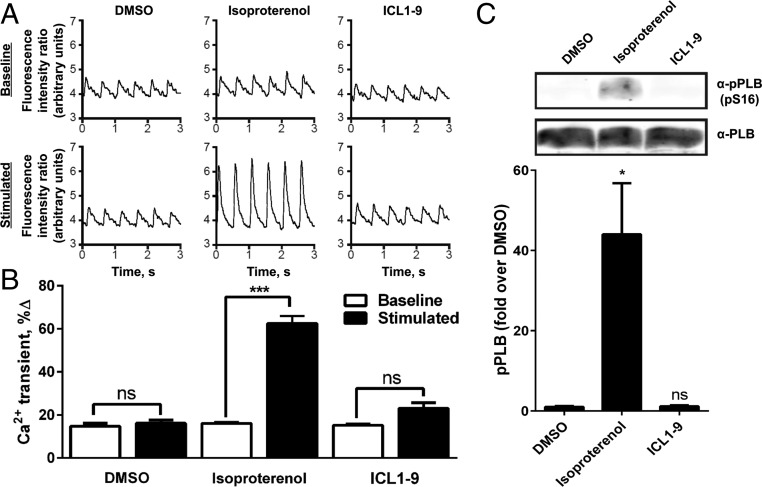
ICL1–9 does not induce Ca2+ mobilization or PLB phosphorylation in adult cardiomyocytes. (A) Representative tracings from field stimulation (2 Hz)–induced Ca2+ transients in Fura2-loaded WT adult murine cardiomyocytes in response to 0.1% DMSO, 0.5 μM isoproterenol, or 10 μM ICL1–9. Representative fluorescence intensity ratio tracings in the basal or stimulated state for each test condition are reported. (B) Isoproterenol increased, whereas ICL1–9 did not have a significant impact on Ca2+-transient responses in adult murine cardiomyocytes. The data are represented by the mean ± SEM from 6–12 cardiomyocytes from at least three independent primary isolations. ns, not significant, ***P < 0.001 using a one-way ANOVA with Newman–Keuls multiple comparison test. (C) Immunoblot for total (Bottom) and phosphorylated (Ser16, Top) PLB following stimulation of isolated WT adult murine cardiomyocytes with 0.1% DMSO, 0.1 μM isoproterenol or 10 μM ICL1–9 for 5 min. Summarized data in the histogram show that isoproterenol, but not ICL1–9, significantly increased PLB phosphorylation. The data are represented by the mean ± SEM from three independent primary cardiomyocyte isolations. ns, not significant, *P < 0.05, **P < 0.01 using a one-way ANOVA with Newman–Keuls multiple comparison test.
Fig. 8.
Fig. 8.
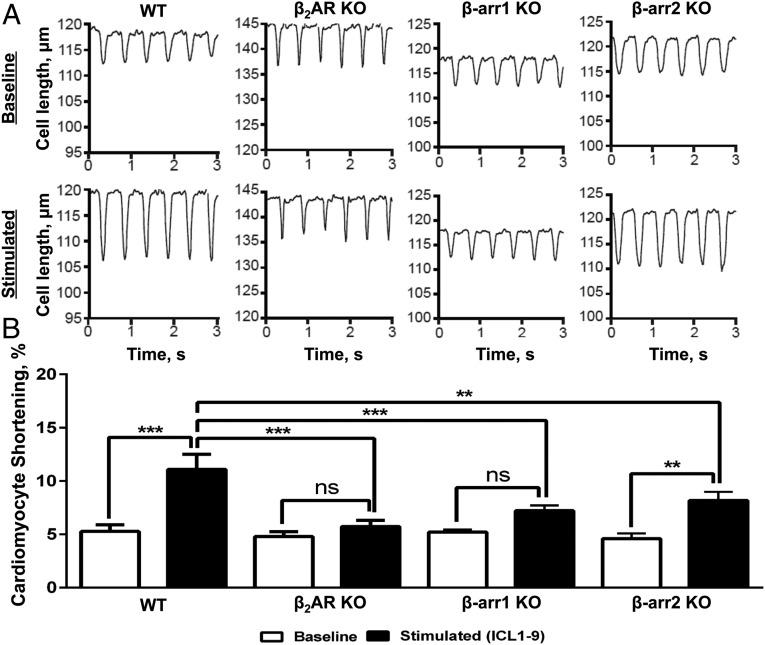
ICL1–9-promoted cardiomyocyte contractility is dependent on the expression of the β2AR and β-arrestin. (A) β2AR-, β-arrestin1-, or β-arrestin2 knockout adult murine cardiomyocytes were isolated and assessed for basal and agonist-promoted contractility using a digital videocamera-coupled microscope in the presence or absence of 0.1% DMSO or 10 μM ICL1–9. Representative cell length (in micrometers) tracings at 2 Hz in the basal or stimulated state for each test condition are reported. (B) ICL1–9 was unable to promote significant contraction in β2AR- and β-arrestin1 knockout adult murine cardiomyocytes, and its ability to do so in β-arrestin2 knockout cardiomyocytes was significantly reduced. The data are represented by the mean ± SEM from six to seven cardiomyocytes from at least three independent primary isolations. ns, not significant, **P < 0.01, ***P < 0.001 using a one-way ANOVA with Newman–Keuls multiple comparison test.
Fig. S2.
Fig. S2.
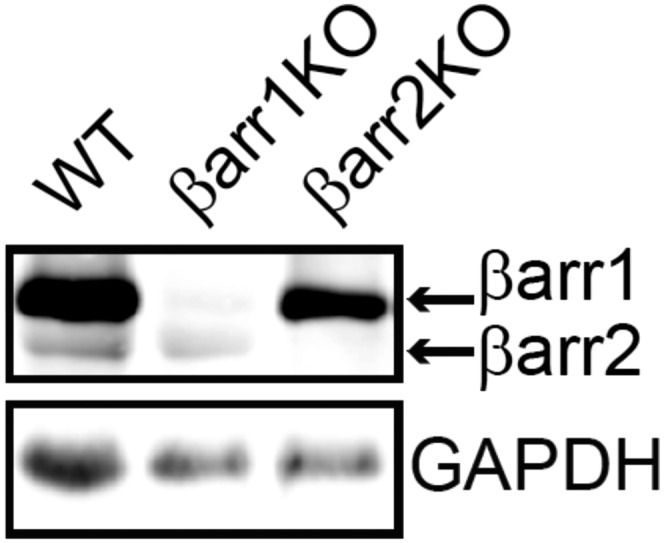
Immunoblotting of β-arrestins from whole heart lysates from WT, β-arrestin1, and β-arrestin2 knockout mice. Cardiac lysates from WT mice have higher expression of β-arrestin1 vs. β-arrestin2, whereas the respective knockout strains have a specific loss of either β-arrestin1 or β-arrestin2.

References

    1. Javed U, Deedwania PC. Beta-adrenergic blockers for chronic heart failure. Cardiol Rev. 2009;17(6):287–292. - PubMed
    1. Ramani GV, Uber PA, Mehra MR. Chronic heart failure: Contemporary diagnosis and management. Mayo Clin Proc. 2010;85(2):180–195. - PMC - PubMed
    1. Wisler JW, et al. A unique mechanism of beta-blocker action: Carvedilol stimulates beta-arrestin signaling. Proc Natl Acad Sci USA. 2007;104(42):16657–16662. - PMC - PubMed
    1. Erickson CE, et al. The β-blocker nebivolol is a GRK/β-arrestin biased agonist. PLoS One. 2013;8(8):e71980. - PMC - PubMed
    1. Carr R, 3rd, et al. Development and characterization of pepducins as Gs-biased allosteric agonists. J Biol Chem. 2014;289(52):35668–35684. - PMC - PubMed

Publication types

MeSH terms