


Cognitive behavioral therapy for depression in Japanese Parkinson's disease patients: a pilot study
- PMID: 27354802
- PMCID: PMC4908947
- DOI: 10.2147/NDT.S104777
Cognitive behavioral therapy for depression in Japanese Parkinson's disease patients: a pilot study
Abstract
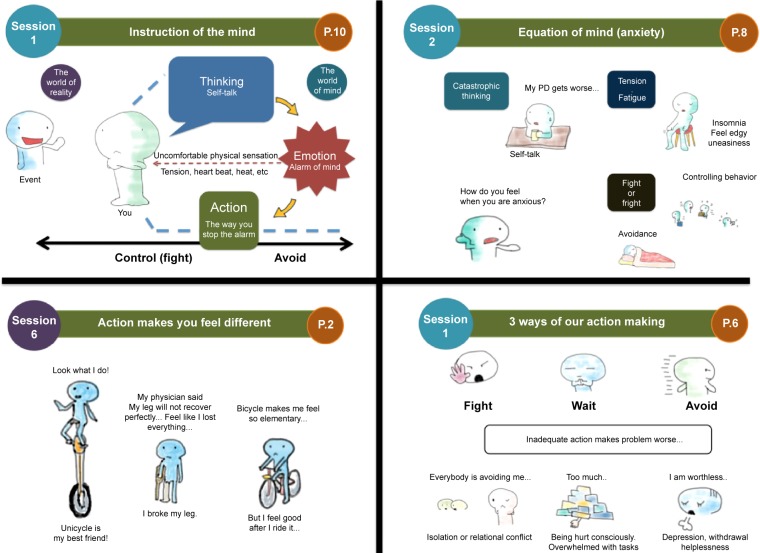
Objectives: This study evaluated the feasibility of cognitive behavioral therapy (CBT) for Japanese Parkinson's disease (PD) patients with depression. To increase cultural acceptability, we developed the CBT program using manga, a type of Japanese comic novel.
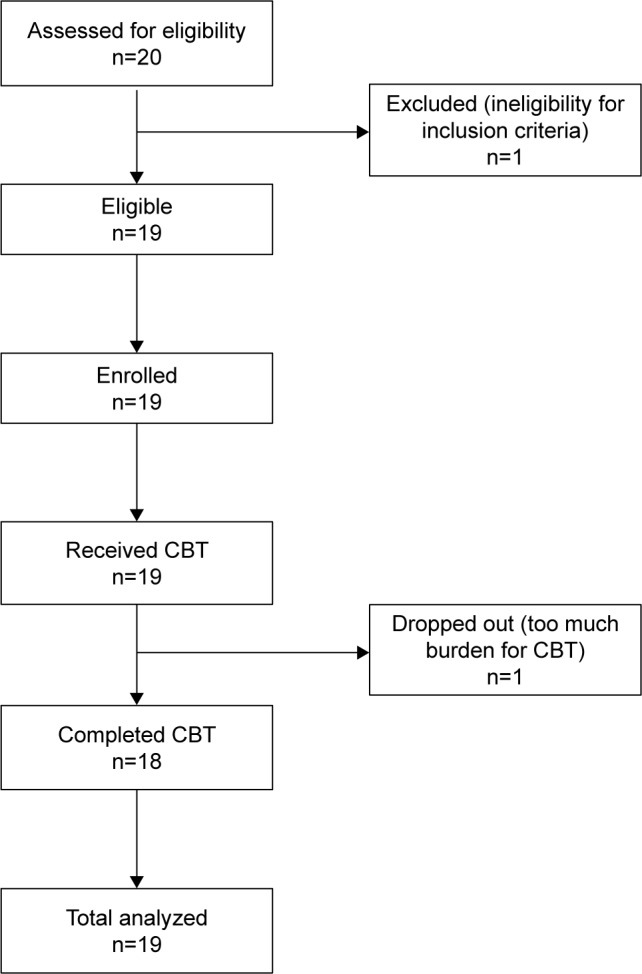
Methods: Participants included 19 non-demented PD patients who had depressive symptoms (GRID-Hamilton Rating Scale for Depression score ≥8). A CBT program comprising six sessions was individually administered. We evaluated the feasibility and safety of the CBT program in terms of the dropout rate and occurrence of adverse events. The primary outcome was depressive symptom reduction in the GRID-Hamilton Rating Scale for Depression upon completion of CBT. Secondary outcomes included changes in the self-report measures of depression (Beck Depression Inventory-II, Hospital Anxiety and Depression Scale-Depression), anxiety (Hospital Anxiety and Depression Scale-Anxiety, State and Trait Anxiety Inventory, Overall Anxiety Severity and Impairment Scale), functional impairment, and quality of life (Medical Outcomes Study 36-Item Short-Form Health Survey).
Results: Of the 19 participants (mean age =63.8 years, standard deviation [SD] =9.9 years; mean Hohen-Yahr score =1.7, SD =0.8), one patient (5%) withdrew. No severe adverse event was observed. The patients reported significant improvements in depression (Hedges' g =-1.02, 95% confidence interval =-1.62 to -0.39). The effects were maintained over a 3-month follow-up period. Most of the secondary outcome measurements showed a small-to-moderate but nonsignificant effect size from baseline to post-intervention.
Conclusion: This study provides preliminary evidence that CBT is feasible among Japanese PD patients with depression. Similar approaches may be effective for people with PD from other cultural backgrounds. The results warrant replication in a randomized controlled trial.
Keywords: CBT; Japan; anxiety; comorbidity; dPD.
Figures
References
-
- Reijnders JS, Lousberg R, Leentjens AF. Assessment of depression in Parkinson’s disease: the contribution of somatic symptoms to the clinimetric performance of the Hamilton and Montgomery-Asberg rating scales. J Psychosom Res. 2010;68(6):561–565. - PubMed
-
- Yamanishi T, Tachibana H, Oguru M, et al. Anxiety and depression in patients with Parkinson’s disease. Intern Med. 2013;52(5):539–545. - PubMed
-
- Henderson R, Kurlan R, Kersun JM, Como P. Preliminary examination of the comorbidity of anxiety and depression in Parkinson’s disease. J Neuropsychiatry Clin Neurosci. 1992;4(3):257–264. - PubMed
-
- Gallagher DA, Schrag A. Psychosis, apathy, depression and anxiety in Parkinson’s disease. Neurobiol Dis. 2012;46(3):581–589. - PubMed
-
- Mellilo KD, Houde SC, Sudbury MA. Geropsychiatric and Mental Health Nursing. 2nd ed. Sudbury, MA: Jones & Bartlett Learning; 2011.
LinkOut - more resources
Full Text Sources
Other Literature Sources
