. 2016 Jul 3;7(4):313-322.
doi: 10.1080/19490976.2016.1203502. Epub 2016 Jun 29.

Sex differences and hormonal effects on gut microbiota composition in mice

Affiliations

Sex differences and hormonal effects on gut microbiota composition in mice

Elin Org et al. Gut Microbes. .

Abstract

We previously reported quantitation of gut microbiota in a panel of 89 different inbred strains of mice, and we now examine the question of sex differences in microbiota composition. When the total population of 689 mice was examined together, several taxa exhibited significant differences in abundance between sexes but a larger number of differences were observed at the single strain level, suggesting that sex differences can be obscured by host genetics and environmental factors. We also examined a subset of mice on chow and high fat diets and observed sex-by-diet interactions. We further investigated the sex differences using gonadectomized and hormone treated mice from 3 different inbred strains. Principal coordinate analysis with unweighted UniFrac distances revealed very clear effects of gonadectomy and hormone replacement on microbiota composition in all 3 strains. Moreover, bile acid analyses showed gender-specific differences as well as effects of gonodectomy, providing one possible mechanism mediating sex differences in microbiota composition.

Keywords: genetics; gut microbiota interactions; hormones; inbred strains; sex differences; sex-by-diet interactions.


Figures
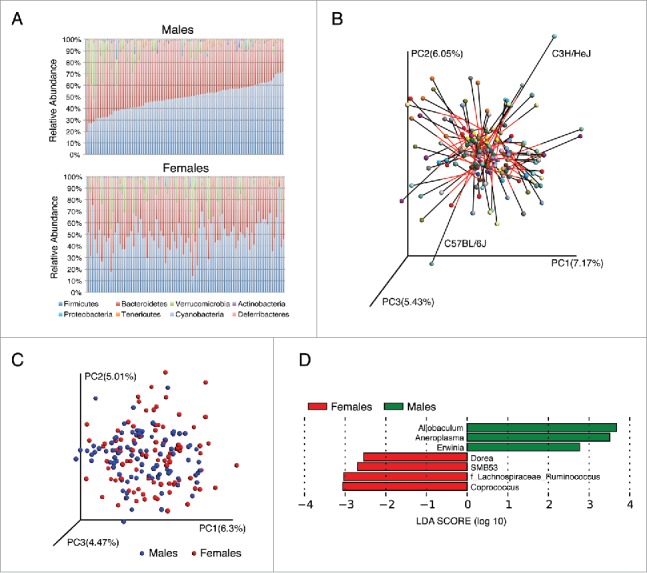
Figure 1.
Figure 1.
Sex differences in gut microbiota composition in 89 different inbred strains of mice. (A) Columns represent the average relative abundance of microbial phyla within 89 matched strains of male (n = 348) and female (n = 341) mice arranged in the same order. (B) Procrustes plot comparing β diversity between females and males of the same strains. The Bray-Curtis distances between the genders vary across the strains (M2 = 0.89, p < 0.001), highlighting the differences in microbial composition between sexes. (C) Bray-Curtis dissimilarity metric plotted in PCoA space comparing the gender microbial communities from different genders (89 matched strains). Each circle representing a different strain colored according to the gender. The first 3 principal components (PC1, PC2 and PC3) are shown, with the amount of variation explained are reported for each axes. Both sex and strain effects account for PC1 and PC3 variations (p < 0.0001, F test) and PC2 variation is explained only by strain effect (p < 0.001, F test). (D) Linear discriminant analysis (LDA) coupled with effect size measurements identified the most differentially abundant genus level taxa between female and male mice from 89 matched strains.
Figure 2.
Figure 2.
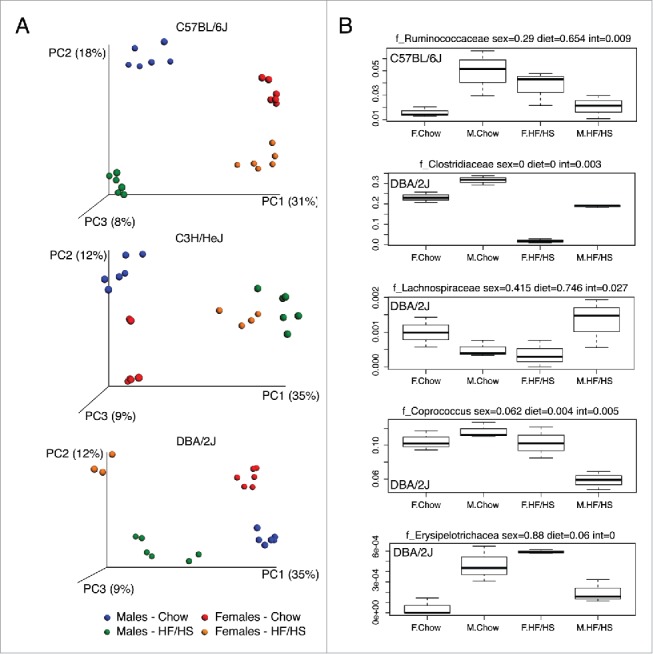
Principal coordinate analysis (PCoA) plot of unweighted UniFrac distances between male and female mice. C57BL/6J, C3H/HeJ, and DBA/2J strains fed a normal chow or high fat diets were studied as described in the text. PC1, PC2, and PC3 values for each mouse sample are plotted with the percent variation explained by each PC is shown in parentheses. (B) Examples of sex-by-diet interactions with 5 taxa in female and male from C57BL/6J and DBA/2J mice fed with chow or high fat diets. P values from MANOVA analysis are shown for sex, diet and sex-by-diet interactions (int).
Figure 3.
Figure 3.
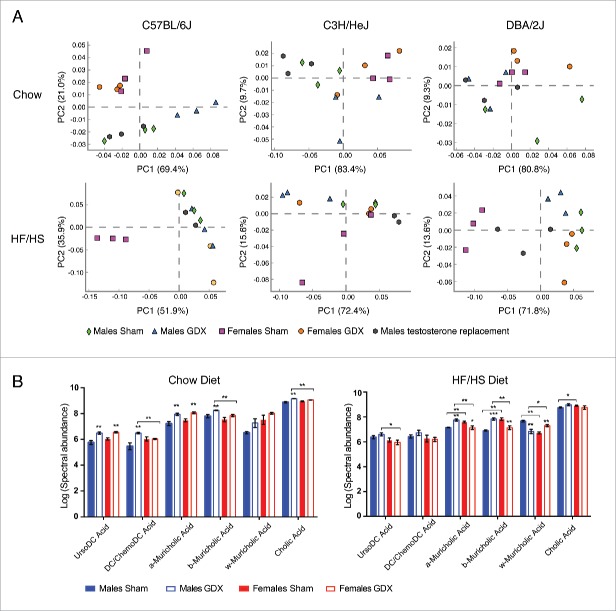
The effect of gonadectomy in C57BL/6J, C3H/HeJ and DBA/2J mice. (A) Principal component analysis between male and female mice in normal chow or high fat/high-sucrose diet (B) from C57BL/6J, C3H/HeJ, and DBA/2J strains.(B) Bile acids measurements from gallbladder in male and female C57BL/6J mice on chow and HF/HS diet. Significance of differences was defined using unpaired T test with Holm-Sidak's correction for multiple hypothesis. *P ≤ 0.05; **P ≤ 0.01; ***P ≤ 0.001. DC, deoxycholic; GDX, gonadectomized.

References

    1. Costello EK, Lauber CL, Hamady M, Fierer N, Gordon JI, Knight R. Bacterial community variation in human body habitats across space and time. Science 2009; 326:1694-7; PMID:19892944 - PMC - PubMed
    1. Goodrich JK, Waters JL, Poole AC, Sutter JL, Koren O, Blekhman R, Beaumont M, Van Treuren W, Knight R, Bell JT, et al.. Human genetics shape the gut microbiome. Cell 2014; 159:789-799; PMID:25417156 - PMC - PubMed
    1. Org E, Parks BW, Joo JW, Emert B, Schwartzman W, Kang EY, Mehrabian M, Pan C, Knight R, Gunsalus R, et al.. Genetic and environmental control of host-gut microbiota interactions. Genome Res 2015; 25:1558-69; PMID:26260972 - PMC - PubMed
    1. Wu GD, Chen J, Hoffmann C, Bittinger K, Chen YY, Keilbaugh SA, Bewtra M, Knights D, Walters WA, Knight R, et al.. Linking long-term dietary patterns with gut microbial enterotypes. Science 2011; 334:105-8; PMID:21885731 - PMC - PubMed
    1. Parks BW, Nam E, Org E, Kostem E, Norheim F, Hui ST, Pan C, Civelek M, Rau CD, Bennett BJ, et al.Genetic control of obesity and gut microbiota composition in response to high-fat, high-sucrose diet in mice. Cell Metab 2013; 17:141-152; PMID:23312289 - PMC - PubMed

Publication types