


Tradeoffs Associated With Contralateral Prophylactic Mastectomy in Women Choosing Breast Reconstruction: Results of a Prospective Multicenter Cohort
- PMID: 27355266
- PMCID: PMC5459619
- DOI: 10.1097/SLA.0000000000001840
Tradeoffs Associated With Contralateral Prophylactic Mastectomy in Women Choosing Breast Reconstruction: Results of a Prospective Multicenter Cohort
Abstract
Objective: Assess postoperative morbidity and patient-reported outcomes after unilateral and bilateral breast reconstruction in patients with unilateral breast cancer.
Background: Relatively little is known about the morbidity associated with and changes in quality of life experienced by patients who undergo contralateral prophylactic mastectomy (CPM) and breast reconstruction. This information would be valuable for decision making in patients with unilateral breast cancer.
Methods: Women undergoing mastectomy and breast reconstruction for unilateral breast cancer were recruited for this prospective observational study. Postoperative complications after implant and autologous breast reconstruction in patients undergoing unilateral or bilateral mastectomy were recorded. Preoperative and 1 year patient-reported outcomes were measured. Univariate tests and logistic regression analyses were performed, studying the effects of reconstructive method, laterality, and risk factors on surgical complication rates, patient satisfaction, and anxiety.
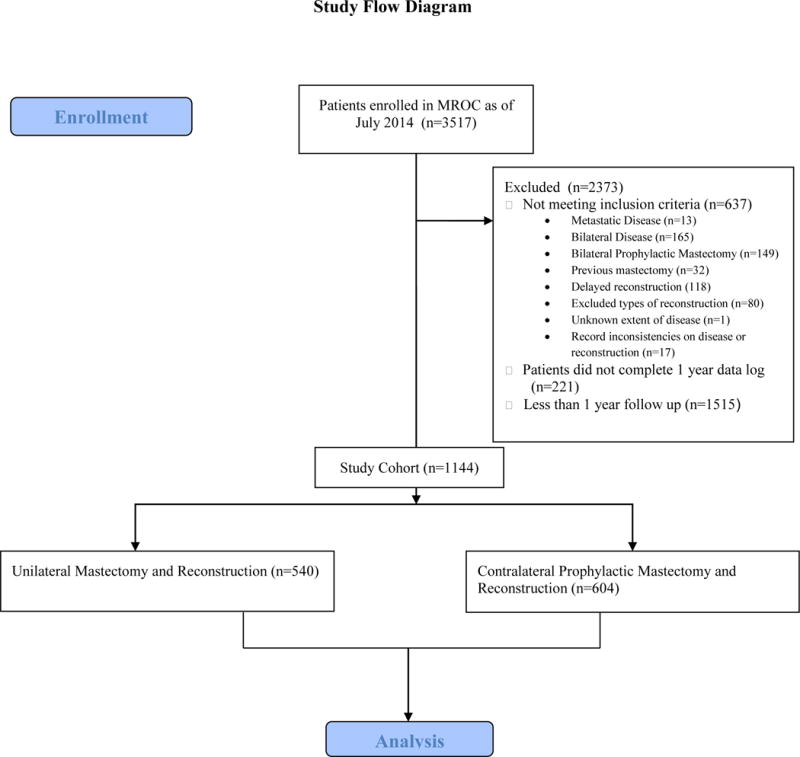
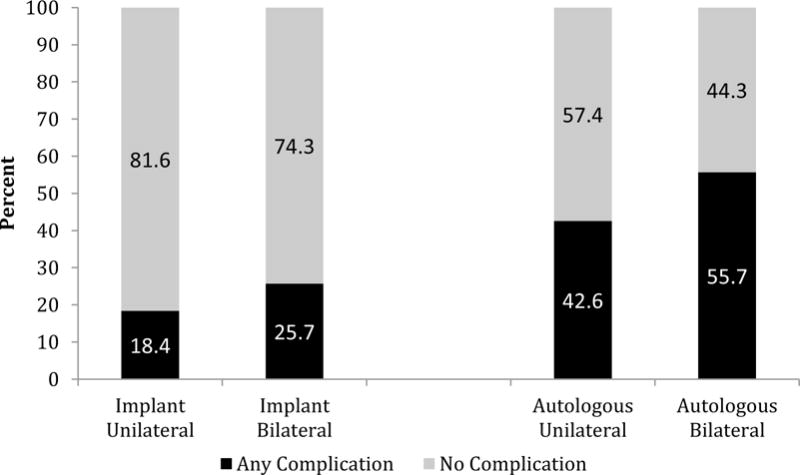
Results: We identified 1144 women who underwent either unilateral (47.2%) or bilateral (52.8%) mastectomies with reconstruction. Bilateral autologous (odds ratio 1.73, 95% confidence interval 1.07-2.81) and implant reconstructions (odds ratio 1.73, 95% confidence interval 1.22-2.47) were associated with a higher risk of complications compared with unilateral reconstructions. Baseline anxiety was greater in women who chose bilateral compared with unilateral implant reconstructions (P = 0.001). There was no difference in anxiety levels between groups postoperatively. Postoperatively, women who chose CPM with implant reconstructions were more satisfied with their breasts than women with unilateral reconstructions (P = 0.034).
Conclusions: Although higher postoperative complications were observed after CPM and reconstruction, these procedures were associated with decreased anxiety levels and improved satisfaction with breasts for women who underwent implant reconstructions.
Figures
References
-
- Tuttle TM, Habermann EB, Grund EH, Morris TJ, Virnig BA. Increasing use of contralateral prophylactic mastectomy for breast cancer patients: a trend toward more aggressive surgical treatment. Journal of clinical oncology : official journal of the American Society of Clinical Oncology. 2007;25:5203–9. - PubMed
-
- Koslow S, Pharmer LA, Scott AM, et al. Long-term patient-reported satisfaction after contralateral prophylactic mastectomy and implant reconstruction. Annals of surgical oncology. 2013;20:3422–9. - PubMed
-
- Pusic AL, Klassen AF, Scott AM, Klok JA, Cordeiro PG, Cano SJ. Development of a new patient-reported outcome measure for breast surgery: the BREAST-Q. Plastic and reconstructive surgery. 2009;124:345–53. - PubMed
-
- QScore Scoring Software. 2015 Accessed 8/9/15. at https://webcore.mskcc.org/breastq/scoring.html.
Publication types
MeSH terms
Grants and funding
LinkOut - more resources
Full Text Sources
Other Literature Sources
Medical
