


Patient and Provider Satisfaction With a Comprehensive Strategy to Improve Prevention of Mother-to-Child HIV Transmission Services in Rural Nigeria
- PMID: 27355498
- PMCID: PMC5113240
- DOI: 10.1097/QAI.0000000000001058
Patient and Provider Satisfaction With a Comprehensive Strategy to Improve Prevention of Mother-to-Child HIV Transmission Services in Rural Nigeria
Abstract
Background: High mother-to-child HIV transmission rates in Nigeria are coupled with a critical shortage of trained health personnel, dearth of infrastructure, and low levels of male involvement in HIV care. This study evaluated maternal and provider satisfaction with services for prevention of mother-to-child transmission within the context of an implementation science cluster-randomized trial that included task shifting to lower-cadre workers, male engagement, point-of-care CD4 cell counts, and integrated mother-infant care.
Methods: Patient and clinician satisfaction were measured at 6 control and 6 intervention sites using a 5-point Likert scale. Patient satisfaction was assessed at 6 weeks postpartum through a 22-item scale about the provider's ability to explain the health problem, time spent with the clinician, and motivation to follow prescribed treatment. Provider satisfaction was assessed through a 12-item scale about motivation, compensation, and training, with 4 additional questions about the impact of task shifting on job satisfaction to intervention arm providers.
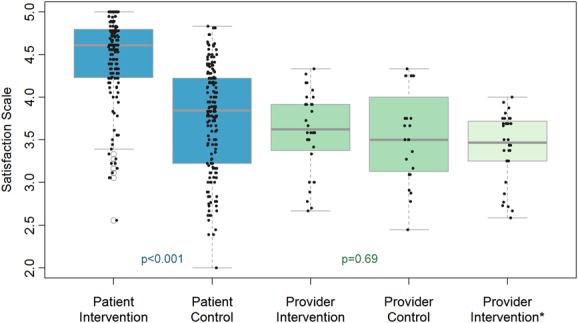
Results: We measured satisfaction among 340 mothers (intervention n = 160; control n = 180) and 60 providers (intervention n = 36; control n = 24). Total patient satisfaction (maximum 5) was higher in the intervention than control arm [median (interquartile range) = 4.61 (4.22-4.79) vs. 3.84 (3.22-4.22), respectively; P < 0.001]. Provider satisfaction was generally high, and was similar between the intervention and the control arms [median (interquartile range) = 3.60 (3.37-3.91) vs. 3.50 (3.08-4.25), respectively; P = 0.69]. Provider satisfaction dropped when questions on newly acquired provider roles were included [3.47 (3.25-3.72)]. Patient and provider satisfaction were not associated with uptake of antiretroviral therapy or mother-infant retention at 6 and 12 weeks postpartum.
Conclusions: Satisfaction was higher among patients at intervention sites, and provider satisfaction decreased when newly assigned roles were factored in. Task shifting should include training and supportive oversight to ensure comfort with assigned tasks.
Conflict of interest statement
The authors have no or conflicts of interest to disclose.
Figures
References
-
- Agu KA, Oqua D, Agada P, et al. Assessment of satisfaction with pharmaceutical services in patients receiving antiretroviral therapy in outpatient HIV treatment setting. Int J Clin Pharm. 2014;36:636–647. - PubMed
-
- Aliyu MH, Varkey P, Salihu HM, Iliyasu Z, Abubakar IS. The HIV/AIDS epidemic in Nigeria: progress, problems and prospects. Afr J Med Med Sci. 2010;39:233–239. - PubMed
-
- Olowookere SA, Fatiregun AA, Ladipo MMA, et al. Reducing waiting time at a Nigerian HIV treatment clinic: opinions from and the satisfaction of people living with HIV/AIDS. J Int Assoc Physicians AIDS Care (Chic). 2012;11:188–191. - PubMed
-
- Owolabi RS, Araoye MO, Osagbemi GK, et al. Assessment of stigma and discrimination experienced by people living with HIV and AIDS receiving care/treatment in University of Ilorin Teaching Hospital (UITH), Ilorin, Nigeria. J Int Assoc Physicians AIDS Care (Chic). 2012;11:121–127. - PubMed
-
- De Silva A, Valentine N. A framework for measuring responsiveness. Geneva: World Health Organization; 2000.
Publication types
MeSH terms
Substances
Grants and funding
LinkOut - more resources
Full Text Sources
Other Literature Sources
Medical
Research Materials
