


Predicting mortality over different time horizons: which data elements are needed?
- PMID: 27357832
- PMCID: PMC5201182
- DOI: 10.1093/jamia/ocw057
Predicting mortality over different time horizons: which data elements are needed?
Abstract
Objective: Electronic health records (EHRs) are a resource for "big data" analytics, containing a variety of data elements. We investigate how different categories of information contribute to prediction of mortality over different time horizons among patients undergoing hemodialysis treatment.
Material and methods: We derived prediction models for mortality over 7 time horizons using EHR data on older patients from a national chain of dialysis clinics linked with administrative data using LASSO (least absolute shrinkage and selection operator) regression. We assessed how different categories of information relate to risk assessment and compared discrete models to time-to-event models.
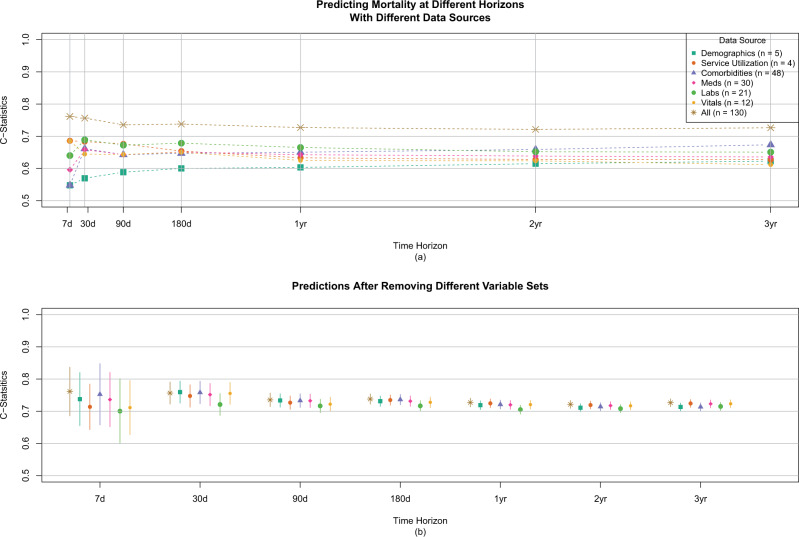
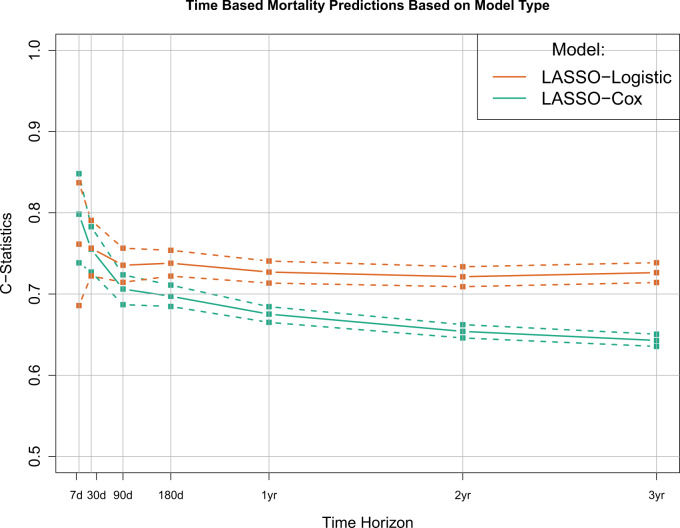
Results: The best predictors used all the available data (c-statistic ranged from 0.72-0.76), with stronger models in the near term. While different variable groups showed different utility, exclusion of any particular group did not lead to a meaningfully different risk assessment. Discrete time models performed better than time-to-event models.
Conclusions: Different variable groups were predictive over different time horizons, with vital signs most predictive for near-term mortality and demographic and comorbidities more important in long-term mortality.
Keywords: ESRD; Electronic Health Records; hemodialysis; predictive modeling.
© The Author 2016. Published by Oxford University Press on behalf of the American Medical Informatics Association. All rights reserved. For Permissions, please email: journals.permissions@oup.com.
Figures
References
-
- Hivert M-F, Dusseault-Bélanger F, Cohen A, Courteau J, Vanasse A. Modified metabolic syndrome criteria for identification of patients at risk of developing diabetes and coronary heart diseases: longitudinal assessment via electronic health records. Can J Cardiol. 2012;28(6):744–749. - PubMed
-
- Eapen ZJ, Liang L, Fonarow GC, et al. Validated, electronic health record deployable prediction models for assessing patient risk of 30-day rehospitalization and mortality in older heart failure patients. JACC Heart Fail. 2013;1(3):245–251. - PubMed
-
- U.S. Renal Data System, USRDS 2014 Annual Data Report: Atlas of End-Stage Renal Disease in the United States. National Institute of Health, Bethesda, MD: National Diabetes and Digestive and Kidney Diseases; 2014.
Publication types
MeSH terms
Grants and funding
LinkOut - more resources
Full Text Sources
Other Literature Sources
Medical
