Gene Editing: Powerful New Tools for Nephrology Research and Therapy
- PMID: 27358322
- PMCID: PMC5042678
- DOI: 10.1681/ASN.2016020146
Gene Editing: Powerful New Tools for Nephrology Research and Therapy
Abstract
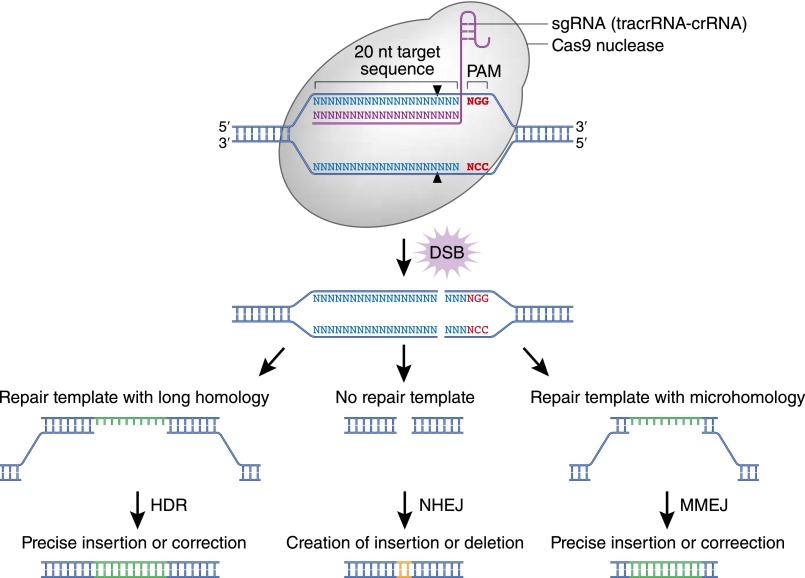
Biologic research is experiencing a transformation brought about by the ability of programmable nucleases to manipulate the genome. In the recently developed CRISPR/Cas system, short RNA sequences guide the endonuclease Cas9 to any location in the genome, causing a DNA double-strand break (DSB). Repair of DSBs allows the introduction of targeted genetic manipulations with high precision. Cas9-mediated gene editing is simple, scalable, and rapid, and it can be applied to virtually any organism. Here, we summarize the development of modern gene editing techniques and the biology of DSB repair on which these techniques are based. We discuss technical points in applying this technology and review its use in model organisms. Finally, we describe prospects for the use of gene editing to treat human genetic diseases. This technology offers tremendous promise for equipping the nephrology research community to better model and ultimately, treat kidney diseases.
Keywords: gene therapy; molecular genetics; transgenic mouse.
Copyright © 2016 by the American Society of Nephrology.
Figures
References
-
- Smithies O, Gregg RG, Boggs SS, Koralewski MA, Kucherlapati RS: Insertion of DNA sequences into the human chromosomal beta-globin locus by homologous recombination. Nature 317: 230–234, 1985 - PubMed
-
- Thomas KR, Folger KR, Capecchi MR: High frequency targeting of genes to specific sites in the mammalian genome. Cell 44: 419–428, 1986 - PubMed
-
- Pavletich NP, Pabo CO: Zinc finger-DNA recognition: Crystal structure of a Zif268-DNA complex at 2.1 A. Science 252: 809–817, 1991 - PubMed
Publication types
MeSH terms
Grants and funding
LinkOut - more resources
Full Text Sources
Other Literature Sources
Medical